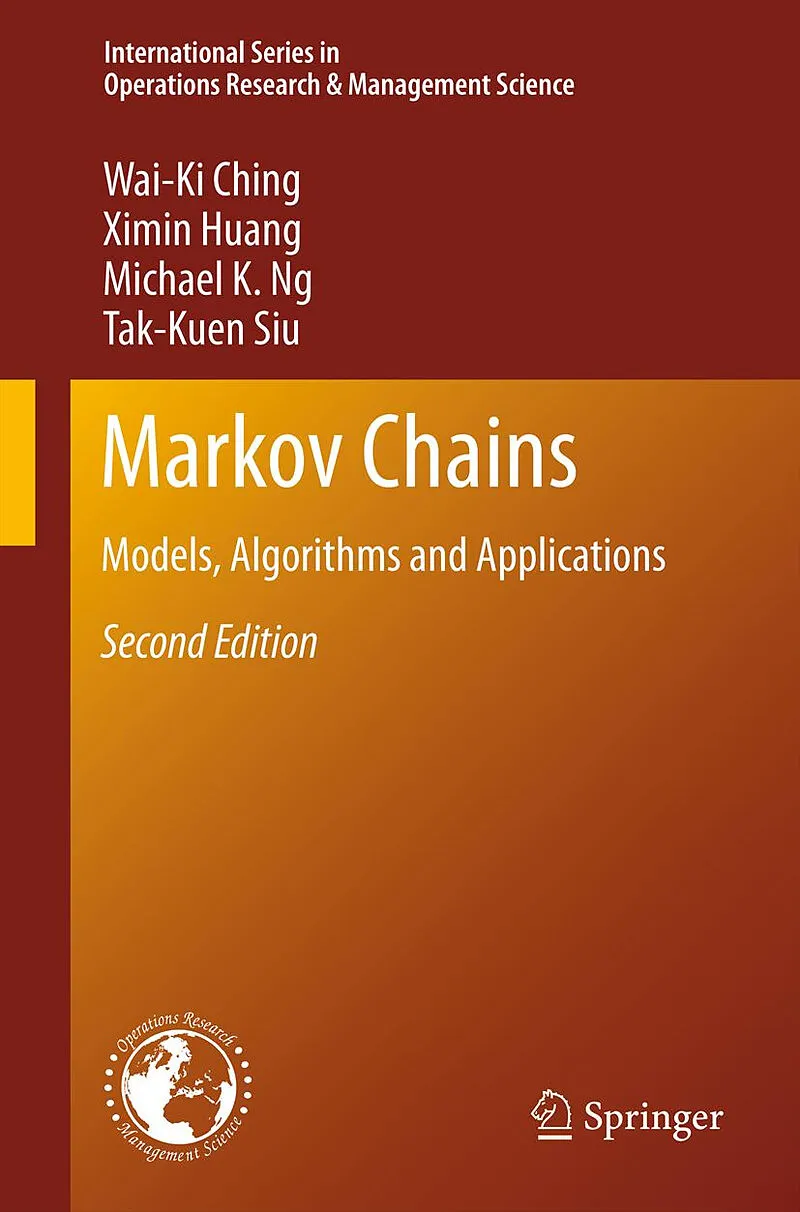
Markov Chains
Beschreibung
This new edition is expanded and updated, complete with end-of-chapter exercises. Outlines the recent development of Markov chain models for modeling queueing systems, manufacturing and re-manufacturing systems, inventory systems and financial risk management....Format auswählen
- Kartonierter EinbandCHF 141.20
- Kartonierter EinbandCHF 149.20
- Fester EinbandCHF 141.20
- E-Book (pdf)CHF 142.00

Wird oft zusammen gekauft
Andere Kunden kauften auch
Beschreibung
This new edition is expanded and updated, complete with end-of-chapter exercises. Outlines the recent development of Markov chain models for modeling queueing systems, manufacturing and re-manufacturing systems, inventory systems and financial risk management.
This new edition of Markov Chains: Models, Algorithms and Applications has been completely reformatted as a text, complete with end-of-chapter exercises, a new focus on management science, new applications of the models, and new examples with applications in financial risk management and modeling of financial data.
This book consists of eight chapters. Chapter 1 gives a brief introduction to the classical theory on both discrete and continuous time Markov chains. The relationship between Markov chains of finite states and matrix theory will also be highlighted. Some classical iterative methods for solving linear systems will be introduced for finding the stationary distribution of a Markov chain. The chapter then covers the basic theories and algorithms for hidden Markov models (HMMs) and Markov decision processes (MDPs).
Chapter 2 discusses the applications of continuous time Markov chains to model queueing systems and discrete time Markov chain for computing the PageRank, the ranking of websites on the Internet. Chapter 3 studies Markovian models for manufacturing and re-manufacturing systems and presents closed form solutions and fast numerical algorithms for solving the captured systems. In Chapter 4, the authors present a simple hidden Markov model (HMM) with fast numerical algorithms for estimating the model parameters. An application of the HMM for customer classification is also presented.
Chapter 5 discusses Markov decision processes for customer lifetime values. Customer Lifetime Values (CLV) is an important concept and quantity in marketing management. The authors present an approach based on Markov decision processes for the calculation of CLV using real data.
Chapter 6 considers higher-order Markov chain models, particularly a class of parsimonious higher-order Markov chain models. Efficient estimation methods for model parameters based on linear programming are presented. Contemporary research results on applications to demand predictions, inventory control and financial risk measurement are also presented. In Chapter 7, a class of parsimonious multivariate Markov models is introduced. Again, efficient estimation methods based on linear programming are presented. Applications to demand predictions, inventory control policy and modeling credit ratings data are discussed. Finally, Chapter 8 re-visits hidden Markov models, and the authors present a new class of hidden Markov models with efficient algorithms for estimating the model parameters. Applications to modeling interest rates, credit ratings and default data are discussed.
This book is aimed at senior undergraduate students, postgraduate students, professionals, practitioners, and researchers in applied mathematics, computational science, operational research, management science and finance, who are interested in the formulation and computation of queueing networks, Markov chain models and related topics. Readers are expected to have some basic knowledge of probability theory, Markov processes and matrix theory.
New edition now focused on applications where Markov chains have seen explosive growth New edition now with exercises in each chapter Three of the authors are among the leading researchers/academics in the field Includes supplementary material: sn.pub/extras
Autorentext
Hao Jiang received the B.Sc. degree in Mathematics from the Harbin Institute of Technology, Harbin, China, in 2009. She received the Ph.D. degree from the University of Hong Kong, in 2013. She was the recipient of the University Postgraduate Fellowships in 2010. In 2010 and 2012, she was a Visiting Scholar with Soka University, Tokyo, Japan, and Kyoto University, Kyoto, Japan, respectively. She is currently a full Professor with the School of Mathematics, Renmin University of China, Beijing, China. Her research interests include learning-based modeling in bioinformatics, optimization, and control of complex systems. She has published more than 60 refereed journal and conference papers. In addition, she was the recipient of Best paper award of ISB in 2012, and the Best paper award finalist award of DDCLS in 2022. Wai-Ki Ching is a full Professor at the Department of Mathematics, University of Hong Kong. He obtained his B. Sc. and M. Phil. in Mathematics from University of Hong Kong and his Ph.D. Systems Engineering and Engineering Management from Chinese University of Hong Kong. He received 2013 Higher Education Outstanding Scientific Research Output Awards (Second Prize) from the Ministry of Education, China (2014), Distinguished Alumni Award, Faculty of Engineering, Chinese University of Hong Kong (2017), 2019 Higher Education Outstanding Scientific Research Output Awards (Second Prize), Hunan Province, China (2019), Outstanding Research Student Supervisor Award, University of Hong Kong (2020) and he was World's Top 2% Most-cited Scientists (2021) by Stanford University. His research interests are Matrix Computations and Stochastic Modeling for Quantitative Finance and Bioinformatics. He is an author/editor of over 350 publications including over 250 journal papers, 5 edited journal special issues, 6 books and over 110 book chapters and conference proceedings.
Klappentext
This new edition of Markov Chains: Models, Algorithms and Applications has been completely reformatted as a text, complete with end-of-chapter exercises, a new focus on management science, new applications of the models, and new examples with applications in financial risk management and modeling of financial data.
This book consists of eight chapters. Chapter 1 gives a brief introduction to the classical theory on both discrete and continuous time Markov chains. The relationship between Markov chains of finite states and matrix theory will also be highlighted. Some classical iterative methods for solving linear systems will be introduced for finding the stationary distribution of a Markov chain. The chapter then covers the basic theories and algorithms for hidden Markov models (HMMs) and Markov decision processes (MDPs).
Chapter 2 discusses the applications of continuous time Markov chains to model queueing systems and discrete time Markov chain for computing the PageRank, the ranking of websites on the Internet. Chapter 3 studies Markovian models for manufacturing and re-manufacturing systems and presents closed form solutions and fast numerical algorithms for solving the captured systems. In Chapter 4, the authors present a simple hidden Markov model (HMM) with fast numerical algorithms for estimating the model parameters. An application of the HMM for customer classification is also presented.
Chapter 5 discusses Markov decision processes for customer lifetime values. Customer Lifetime Values (CLV) is an important concept and quantity in marketing management. The authors present an approach based on Markov decision processes for the calculation of CLV using real data.
Chapter 6 considers higher-order Markov chain models, particularly a class of parsimonious higher-order Markov chain models. Efficient estimation methods for model parameters based on linear programming are presented. Contemporary research results on applications to demand predictions, inventory control and financial risk measurement are also presented. In Chapter 7, a class of parsimonious multivariate Markov models is introduced. Again, efficient estimation methods based on linear programming are presented. Applications to demand predictions, inventory control policy and modeling credit ratings data are discussed. Finally, Chapter 8 re-visits hidden Markov models, and the authors present a new class of hidden Markov models with effi…