
IHR WARENKORB IST AKTUELL LEER.
Haben Sie noch nichts passendes gefunden? Stöbern Sie durch unser komplettes Sortiment.
Oder melden Sie sich an bzw. registrieren Sie sich.
- Kostenlose Lieferung
- Kauf auf Rechnung
- Ex Libris Tiefpreis
- Filiallieferung und 650+ Abholorte
- Rabatt-Bons als Club-Mitglied
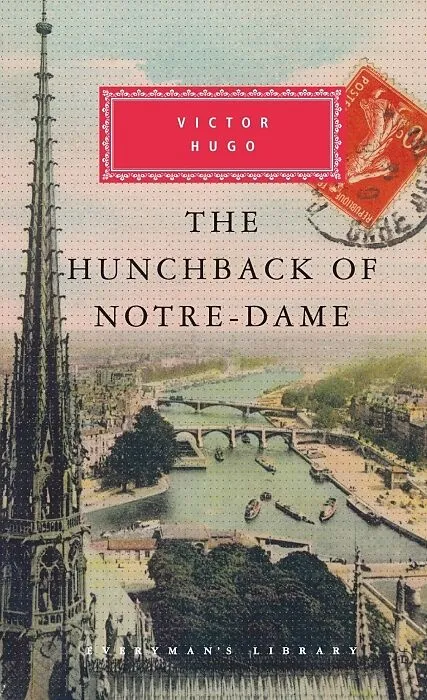
The Hunchback of Notre-Dame
Beschreibung
Zusatztext What a beautiful thing Notre-Dame is! Gustave Flaubert Informationen zum Autor VICTOR HUGO (1802-1885) was a French poet, playwright, novelist, essayist, artist, statesman, and human rights activist, best known for his novels Les Misérables and Nôtr...Format auswählen
- Fester EinbandCHF 37.20

Wird oft zusammen gekauft
Andere Kunden kauften auch
Beschreibung
Zusatztext What a beautiful thing Notre-Dame is! Gustave Flaubert Informationen zum Autor VICTOR HUGO (1802-1885) was a French poet, playwright, novelist, essayist, artist, statesman, and human rights activist, best known for his novels Les Misérables and Nôtre-Dame de Paris (translated into English as The Hunchback of Notre-Dame ). JEAN-MARC HOVASSE is the author of a biography of Victor Hugo and Director of the Center for the Study of Correspondence and Diaries at the University of Brest, France. Introduction by Jean-Marc Hovasse Klappentext Hugo's grand medieval melodrama tells the story of the beautiful Esmeralda, a gypsy girl loved by three men: Archdeacon Frollo, his adoptive son Quasimodo, bell-ringer of Notre-Dame cathedral, and Captain Phoebus. Falsely accused of trying to murder Phoebus, who attempts to rape her, Esmeralda is sentenced to death and rescued from the gallows by Quasimodo who defends her to the last. The subject of many adaptations for stage and screen, this remains perhaps one of the most romantic yet gripping stories ever told. The Hunchback of Notre-Dame is an epic of a whole people, with a cast of characters that ranges from the king of France to the beggars who inhabit the Parisian sewers, and at their center the massive figure--a character in itself--of the great Cathedral of Notre-Dame. Quasimodo, the deformed bell-ringer of the cathedral; his foster father, the tormented archdeacon Frollo; and the beautiful and doomed Gypsy Esmeralda are caught up in a tragedy that still speaks clearly to us of revolution and social strife, of destiny and free will, and of love and loss. The only widely available hardcover edition of Victor Hugo's masterful historical novel of medieval Paris--one of the most beloved of world classics. From the Introduction True, there is something strange and marvellous in the talent of this man who sweeps the reader before him as the wind sweeps the leaf, who leads him at will through every place and era; unveils before him as if it were child's play the heart's innermost recesses, the most mysterious phenomena of nature and the most obscure pages of history; whose imagination dominates and embraces every other imagination, clothing itself with the same astonishing truth in the rags of the beggar and the robes of the king, taking on every attitude, adopting every garb, speaking every language; leaving to the physiognomy of the centuries whatever in their features the wisdom of God has rendered eternal and immutable and whatever the folly of humanity in its ephemeral variety has cast upon them; who does not, as some ignorant novelists do, deck the protagonists of yesteryear in our face-paint nor daub them with the gloss of today, but forces the contemporary reader, under the thrall of his magical powers, to re-assume for the space of a few hours the spirit of olden times a spirit held in such low esteem today like a wise and tactful adviser inviting the ingrate son to return to his father's house. Despite appearances, this epic sentence was not written to greet Notre-Dame de Paris ( The Hunchback of Notre-Dame ) on its publication in March 1831. It formed the opening of an article written eight years earlier for the launch of La muse française , a journal founded by Hugo and his Romantic friends a circle of sentimental young royalists infatuated with the Middle Ages. Hugo had chosen the 'Literary Criticism' section for his first contribution. Only twenty-one, he was already very familiar with the work of the man whose 'magical powers' he so splendidly evoked: Walter Scott, thirty years his elder, whose Quentin Durward had just appeared in French. Hugo eulogized Scott. That same year, Stendhal noted 'the French are mad about Walter Scott'. Balzac shared this enthusiasm. But Hugo alone of the...
#8220;What a beautiful thing Notre-Dame is!” —Gustave Flaubert
Autorentext
VICTOR HUGO (1802-1885) was a French poet, playwright, novelist, essayist, artist, statesman, and human rights activist, best known for his novels Les Misérables and Nôtre-Dame de Paris (translated into English as The Hunchback of Notre-Dame).
JEAN-MARC HOVASSE is the author of a biography of Victor Hugo and Director of the Center for the Study of Correspondence and Diaries at the University of Brest, France.
Introduction by Jean-Marc Hovasse
Klappentext
Hugo's grand medieval melodrama tells the story of the beautiful Esmeralda, a gypsy girl loved by three men: Archdeacon Frollo, his adoptive son Quasimodo, bell-ringer of Notre-Dame cathedral, and Captain Phoebus. Falsely accused of trying to murder Phoebus, who attempts to rape her, Esmeralda is sentenced to death and rescued from the gallows by Quasimodo who defends her to the last.
The subject of many adaptations for stage and screen, this remains perhaps one of the most romantic yet gripping stories ever told.
The Hunchback of Notre-Dame is an epic of a whole people, with a cast of characters that ranges from the king of France to the beggars who inhabit the Parisian sewers, and at their center the massive figure--a character in itself--of the great Cathedral of Notre-Dame. Quasimodo, the deformed bell-ringer of the cathedral; his foster father, the tormented archdeacon Frollo; and the beautiful and doomed Gypsy Esmeralda are caught up in a tragedy that still speaks clearly to us of revolution and social strife, of destiny and free will, and of love and loss.
The only widely available hardcover edition of Victor Hugo's masterful historical novel of medieval Paris--one of the most beloved of world classics.
Leseprobe
From the Introduction
True, there is something strange and marvellous in the talent of this man who sweeps the reader before him as the wind sweeps the leaf, who leads him at will through every place and era; unveils before him as if it were child’s play the heart’s innermost recesses, the most mysterious phenomena of nature and the most obscure pages of history; whose imagination dominates and embraces every other imagination, clothing itself with the same astonishing truth in the rags of the beggar and the robes of the king, taking on every attitude, adopting every garb, speaking every language; leaving to the physiognomy of the centuries whatever in their features the wisdom of God has rendered eternal and immutable and whatever the folly of humanity in its ephemeral variety has cast upon them; who does not, as some ignorant novelists do, deck the protagonists of yesteryear in our face-paint nor daub them with the gloss of today, but forces the contemporary reader, under the thrall of his magical powers, to re-assume for the space of a few hours the spirit of olden times – a spirit held in such low esteem today – like a wise and tactful adviser inviting the ingrate son to return to his father’s house.
Despite appearances, this epic sentence was not written to greet Notre-Dame de Paris (The Hunchback of Notre-Dame) on its publication in March 1831. It formed the opening of an article written eight years earlier for the launch of La muse française, a journal founded by Hugo and his Romantic friends – a circle of sentimental young royalists infatuated with the Middle Ages. Hugo had chosen the ‘Literary Criticism’ section for his first contribution. Only twenty-one, he was already very familiar with the work of the man whose ‘magical powers’ he so splendidly evoked: Walter Scott, thirty years his elder, whose Quentin Durward had just appeared in French.
Hugo eulogized Scott. That same year, Stendhal noted ‘the French are mad about Walter Scott’. Balzac shared this enthusiasm. But Hugo alone of these admirers devoted an entire essay to Scott – he did the same for William Shakespeare forty years later. He seemed to speak m…