
IHR WARENKORB IST AKTUELL LEER.
Haben Sie noch nichts passendes gefunden? Stöbern Sie durch unser komplettes Sortiment.
Oder melden Sie sich an bzw. registrieren Sie sich.
- Kostenlose Lieferung
- Kauf auf Rechnung
- Ex Libris Tiefpreis
- Filiallieferung und 650+ Abholorte
- Rabatt-Bons als Club-Mitglied
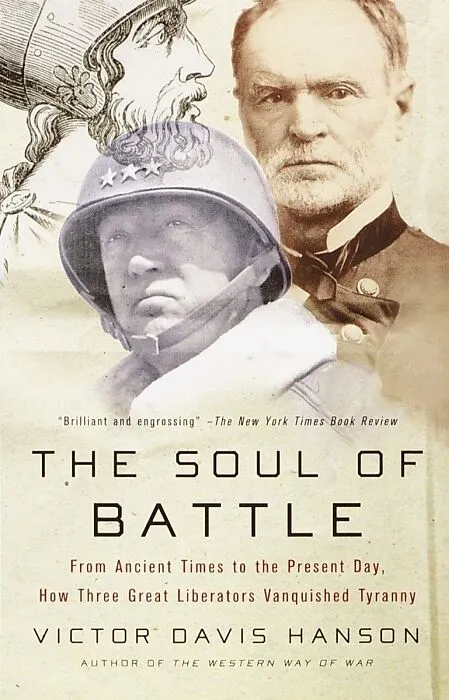
The Soul of Battle
Beschreibung
Zusatztext Most enjoyable. [A] strong point of view and robust prose. The Wall Street Journal Informationen zum Autor Victor Davis Hanson Klappentext Victor David Hanson, author of the highly regarded classic The Western Way of War, presents an audacious and c...Format auswählen
- TaschenbuchCHF 21.10

Wird oft zusammen gekauft
Andere Kunden kauften auch
Beschreibung
Zusatztext Most enjoyable. [A] strong point of view and robust prose. The Wall Street Journal Informationen zum Autor Victor Davis Hanson Klappentext Victor David Hanson, author of the highly regarded classic The Western Way of War, presents an audacious and controversial theory of what contributes to the success of military campaigns. Examining in riveting detail the campaigns of three brilliant generals who led largely untrained forces to victory over tyrannical enemies, Hanson shows how the moral confidence with which these generals imbued their troops may have been as significant as any military strategy they utilized. Theban general Epaminondas marched an army of farmers two hundred miles to defeat their Spartan overlords and forever change the complexion of Ancient Greece. William Tecumseh Sherman led his motley army across the South, ravaging the landscape and demoralizing the citizens in the defense of right. And George S. Patton commanded the recently formed Third Army against the German forces in the West, nearly completing the task before his superiors called a halt. Intelligent and dramatic, The Soul of Battle is narrative history at it's best and a work of great moral conviction. Leseprobe 1. "The Dancing Floor of War" Thebesthe present-day community is built right atop the ancientis a pleasant but little-visited Greek provincial town. No one travels to Greece to experience either ancient or modern Thebes. A pity. There are indeed certain things worth seeing there. A farmer, unconcerned about the absence of good beaches, the paucity of impressive archaeological remains, or the dearth of majestic landscape, immediately feels at home among the rolling plains of the surrounding Boeotian landscapeover 250,000 acres of rich wheat fields, row crops, olive orchards, and vineyards, a larger area even than the Attic countryside that surrounds Athens. From the Theban acropolis a keen agrarian eye notices that things grow wonderfully on this good groundboth food and people. The ancients knew that. The Theban soil, all Greeks conceded, could fuel a prosperity that would be manifested in ways other than the mere production of food. The poets Hesiod, Pindar, and Corinna were Boeotians; so was Plutarch and a host of lesser-known philosophers, artists, and politicians who inhabit the pages of Greek literature and remark on the fertility of their native ground. The Boeotian Pythagorean philosophers, Philolaus, Simmias, and Cebes, are prominent in Plato's dialogue Phaedo, suggesting that the out-of-the-way wheat fields and vineyards of Thebes may have in fact served as a refuge for an enclave of that vanishing philosophical sect. Boeotia means cow pastures in Greek, but despite its ancient reputation for rusticity, this rich farmland developed a peculiar rural culture all its own, one that was always inseparable from the land. The mountains in the distancethe verdant Mts. Cithaeron and Helicon on the west flank, snow-capped Parnassus looming to the north, eastward the barren Messapion and Ptoön, and wooded Parnes separating Attica to the southrise in all directions to provide good watershed. The summer heatnearly unbearable for touristsensures bountiful vegetables and fruits; the soil is heavy and black in its fertility, the present-day population skilled and healthy. Water, heat, soil, and independent farmers combine to create a real agrarianism, successful enough to produce food to feed other Greeks not so fortunate, both ancient and modern. Such climate, agriculture, and terrain instantly explain the prominent place of ancient Thebes in Greek historythe site of an important Mycenaean citadel (still unexcavated beneath the modern streets and shops); the seven-gated city of myth and home to Cadmus, Herakles, Oedipus, and Antigone; and the capital city of the surrounding classical Boeotian federation. Forei...
#8220;Most enjoyable…. [A] strong point of view and robust prose.”–The Wall Street Journal
Autorentext
Victor Davis Hanson
Klappentext
Victor David Hanson, author of the highly regarded classic The Western Way of War, presents an audacious and controversial theory of what contributes to the success of military campaigns.
Examining in riveting detail the campaigns of three brilliant generals who led largely untrained forces to victory over tyrannical enemies, Hanson shows how the moral confidence with which these generals imbued their troops may have been as significant as any military strategy they utilized. Theban general Epaminondas marched an army of farmers two hundred miles to defeat their Spartan overlords and forever change the complexion of Ancient Greece. William Tecumseh Sherman led his motley army across the South, ravaging the landscape and demoralizing the citizens in the defense of right. And George S. Patton commanded the recently formed Third Army against the German forces in the West, nearly completing the task before his superiors called a halt. Intelligent and dramatic, The Soul of Battle is narrative history at it's best and a work of great moral conviction.
Zusammenfassung
Victor David Hanson, author of the highly regarded classic The Western Way of War, presents an audacious and controversial theory of what contributes to the success of military campaigns.
Examining in riveting detail the campaigns of three brilliant generals who led largely untrained forces to victory over tyrannical enemies, Hanson shows how the moral confidence with which these generals imbued their troops may have been as significant as any military strategy they utilized. Theban general Epaminondas marched an army of farmers two hundred miles to defeat their Spartan overlords and forever change the complexion of Ancient Greece. William Tecumseh Sherman led his motley army across the South, ravaging the landscape and demoralizing the citizens in the defense of right. And George S. Patton commanded the recently formed Third Army against the German forces in the West, nearly completing the task before his superiors called a halt. Intelligent and dramatic, **The Soul of Battle **is narrative history at it’s best and a work of great moral conviction.
Leseprobe
1.
"The Dancing Floor of War"
Thebes—the present-day community is built right atop the ancient—is a pleasant but little-visited Greek provincial town. No one travels to Greece to experience either ancient or modern Thebes. A pity. There are indeed certain things worth seeing there. A farmer, unconcerned about the absence of good beaches, the paucity of impressive archaeological remains, or the dearth of majestic landscape, immediately feels at home among the rolling plains of the surrounding Boeotian landscape—over 250,000 acres of rich wheat fields, row crops, olive orchards, and vineyards, a larger area even than the Attic countryside that surrounds Athens. From the Theban acropolis a keen agrarian eye notices that things grow wonderfully on this good ground—both food and people.
The ancients knew that. The Theban soil, all Greeks conceded, could fuel a prosperity that would be manifested in ways other than the mere production of food. The poets Hesiod, Pindar, and Corinna were Boeotians; so was Plutarch and a host of lesser-known philosophers, artists, and politicians who inhabit the pages of Greek literature and remark on the fertility of their native ground. The Boeotian Pythagorean philosophers, Philolaus, Simmias, and Cebes, are prominent in Plato’s dialogue Phaedo, suggesting that the out-of-the-way wheat fields and vineyards of Thebes may have in fact served as a refuge for an enclave of that vanishing philosophical sect. Boeotia means “cow pastures” in Greek, but despite its ancient reputation for rusticity, this rich farmland developed a peculiar rural culture all its own, one that was always inseparable from the land.
The mountains in …