
IHR WARENKORB IST AKTUELL LEER.
Haben Sie noch nichts passendes gefunden? Stöbern Sie durch unser komplettes Sortiment.
Oder melden Sie sich an bzw. registrieren Sie sich.
- Kostenlose Lieferung
- Kauf auf Rechnung
- Ex Libris Tiefpreis
- Filiallieferung und 650+ Abholorte
- Rabatt-Bons als Club-Mitglied
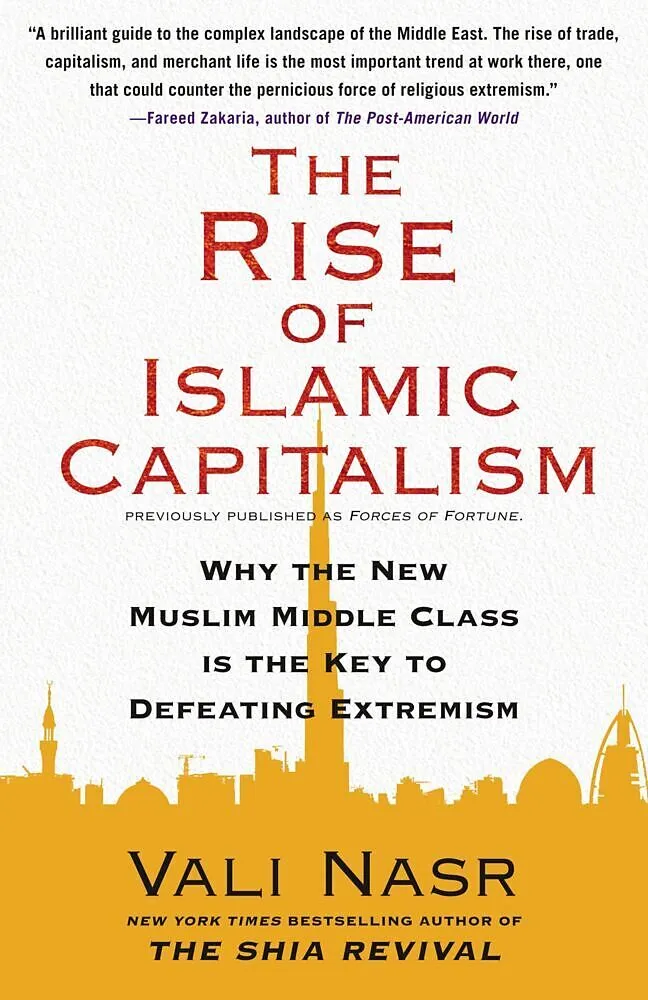
Rise of Islamic Capitalism: Why the New Muslim Middle Class Is the Key to Defeating Extremism
Beschreibung
From the bestselling author of The Shia Revival comes a vital analysis of how the west can win the new Cold War against Iran. Zusatztext [A] humane and clear-eyed narrative Harvard Business Review Informationen zum Autor Born in Iran, Vali Nasr is a professor ...Format auswählen
- Kartonierter EinbandCHF 0.10

Wird oft zusammen gekauft
Andere Kunden kauften auch
Beschreibung
From the bestselling author of The Shia Revival comes a vital analysis of how the west can win the new Cold War against Iran.
Zusatztext [A] humane and clear-eyed narrative Harvard Business Review Informationen zum Autor Born in Iran, Vali Nasr is a professor of international relations at the Fletcher School of Law and Diplomacy of Tufts University, an adjunct senior fellow at the Council on Foreign Relations, and a senior fellow of The Dubai Initiative at Harvard University's John F. Kennedy School of Government. His book The Shia Revival was a New York Times bestseller. He has contributed to The New York Times , The Washington Post , and Time and appeared on Anderson Cooper 360 , The Situation Room , Fareed Zakaria GPS , The Today Show , and . Klappentext Leading authority on the Islamic world and influential advisor to the Obama administration Vali Nasr shows that the West's best hope of winning the battle against Islamic extremists is to foster the growth of a vibrant new Muslim middle class. This flourishing of Muslim bourgeoisie is reshaping the mind-set, politics, and even the religious values of Muslims in much the same way the Western bourgeoisie lead the capitalist and democratic revolution in Europe. Whereas extremism has grown out of the dismal economic failures of the authoritarian Islamic regimes, Nasr explains, the wealth and aspirations of this Islamic critical middle put them squarely at odds with extremism. They have ushered in remarkable transformations already in Dubai, Turkey, and Indonesia, and they are the key to tipping the balance in both Iran and Pakistan. As he writes the great battle for the soul of the Muslim world will be fought not over religion but over market capitalism. Zusammenfassung Synopsis coming soon.......
“[A] humane and clear-eyed narrative…”
—Harvard Business Review
Autorentext
Born in Iran, Vali Nasr is a professor of international relations at the Fletcher School of Law and Diplomacy of Tufts University, an adjunct senior fellow at the Council on Foreign Relations, and a senior fellow of The Dubai Initiative at Harvard University’s John F. Kennedy School of Government. His book The Shia Revival was a New York Times bestseller. He has contributed to The New York Times, The Washington Post, and Time and appeared on Anderson Cooper 360, The Situation Room, Fareed Zakaria GPS, The Today Show, and .
Klappentext
Leading authority on the Islamic world and influential advisor to the Obama administration Vali Nasr shows that the West’s best hope of winning the battle against Islamic extremists is to foster the growth of a vibrant new Muslim middle class. This flourishing of Muslim bourgeoisie is reshaping the mind-set, politics, and even the religious values of Muslims in much the same way the Western bourgeoisie lead the capitalist and democratic revolution in Europe. Whereas extremism has grown out of the dismal economic failures of the authoritarian Islamic regimes, Nasr explains, the wealth and aspirations of this Islamic “critical middle” put them squarely at odds with extremism. They have ushered in remarkable transformations already in Dubai, Turkey, and Indonesia, and they are the key to tipping the balance in both Iran and Pakistan. As he writes “the great battle for the soul of the Muslim world will be fought not over religion but over market capitalism.”
Zusammenfassung
Synopsis coming soon.......
Leseprobe
Chapter 1: The Power of Commerce CHAPTER 1 THE POWER OF COMMERCE
It all happened quickly. The Muslim world changed dramatically in the short thirty-two months that separated the Ayatollah Khomeini's return to Iran on February 1, 1979, and the assassination of Anwar Sadat in Cairo on October 6, 1981. During that time of remarkable upheaval the forces of Islamic revolution seized Iran; Pakistan proclaimed itself an Islamic state; the Soviet Union touched off a jihad by invading Afghanistan; and Egyptian president Anwar Sadat was assassinated by radical fundamentalists. Since those fateful years, many more violent revolts, deadly clashes, terror attacks, and bloody suppressions have followed, along with deepening conservative Islamic attitudes and anti-Americanism across a vast swath of countries from North Africa to Southeast Asia. Extremism has come of age in this cauldron, giving rise to al-Qaeda, and its cult of violence and dark vision of the future.
In the face of all of this tumult, and in response to the rise of terrorism, America's most abiding objective in the Middle East since 1979 has been to contain and defeat Islamic fundamentalism. That object has determined how America sorts its allies from its adversaries, which fights it has taken on, and whether in pursuing its interests it will champion reform, promote democracy, or look to dictators and military solutions. It has also led America perilously close to reducing everything in the Middle East to the fight against fundamentalism, and to seeing every expression of Islam as a threat. The U.S. leadership has seen the fundamentalist challenge largely as a new kind of cold war. That sort of clarity can be a great help, but it can also grossly oversimplify, obscuring vital aspects of the situations within countries and regions that provide opportunities for improving relations.
Looking at the Middle East as it is today-caught in the web of violent conflicts, seething with anger and anti-Americanism, and vulnerable to extremist ideas-it is difficult to have hope for the future. But, however difficult, that is just what we must do. In his perceptive book The Age of the Unthinkable, the strategist Joshua Cooper Ramo argues that by intensely focusing on that which is before us, we miss important trends-some barely detectable-that will shape the future.1 The paradigms that dominate today may matter little tomorrow. We will do ourselves a disservice if we think of our future with the Muslim world only in terms of today's conflicts. These conflicts are serious, and we must prevail in them, but we should also recognize that there are other forces at work in the Muslim world and they too deserve our attention-they may ultimately matter more to us.
Take the case regarding the paradox of Iran, a brutish theocracy lording over a restless population that is also a rising power with ambitions to match its glorious ancient history, and a keen sense of purpose honed by decades of confrontation with the West. An examination of the ironies of Iranian power, and the fault lines within the country-on display in the recent presidential election-offer a particularly revealing starting point for rethinking the true challenges, and prospects, in transforming relations with the Muslim world. Iran's saber-rattling, and the Bush administration's hard-line stance-now being softened by the Obama administration-have diverted attention from important truths that belie the received wisdom regarding the Iranian threat, and those truths speak volumes about opportunities around the wider region.
The recent history of Iran's relations with the West is surely deeply troubling.