Beschreibung
This book is a concise, readable, yet authoritative primer of basic classic thermodynamics. Many students have difficulty with thermodynamics, and find at some stage of their careers in academia or industry that they have forgotten what they learned, or never...
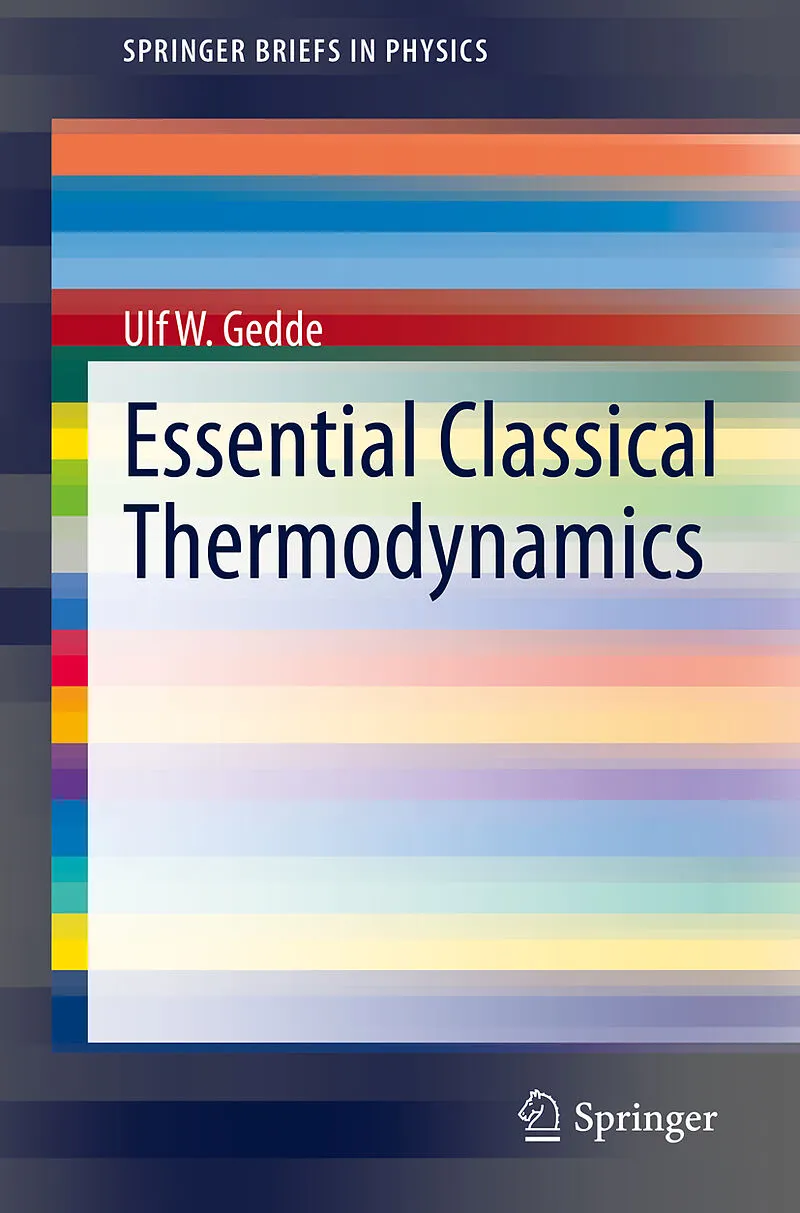
This book is a concise, readable, yet authoritative primer of basic classic thermodynamics. Many students have difficulty with thermodynamics, and find at some stage of their careers in academia or industry that they have forgotten what they learned, or never really understood these fundamental physical laws. As the title of the book suggests, the author has distilled the subject down to its essentials, using many simple and clear illustrations, instructive examples, and key equations and simple derivations to elucidate concepts. Based on many years of teaching experience at the undergraduate and graduate levels, Essential Classical Thermodynamics is intended to provide a positive learning experience, and to empower the reader to explore the many possibilities for applying thermodynamics in other fields of science, engineering, and even economics where energy plays a central role. Thermodynamics is fun when you understand it!
Satisfies the need for a clear, concise, yet authoritative treatment of a subject that students and professionals often fear Serves the needs of a wide range of readers with varying backgrounds Includes many illustrations, examples, and simple derivations to enliven and clarify topics
Autorentext
Ulf Gedde is professor emeritus at KTH Royal Institute of Technology after retirement from the professor chair of Polymeric Materials. His research interests are polymeric materials and their properties, polymer physics, crystalline polymers, polymers in power-electronics, the long-term performance of polymers, transport properties and polymer nanocomposites. Gedde is the author of 300 scientific papers and the textbooks Polymer Physics, Fundamental Polymer Science, Essential Classical Thermodynamics and Applied Polymer Science and is editor of Polymer Testing. He has supervised 44 PhDs, holds 5 patents and was involved in the development of the bimodal polyethylene materials. His teaching which extends over 40 years has been awarded at KTH. Professor Mikael Hedenqvist heads the division of Polymeric Materials at Fibre and Polymer Technology, KTH Royal Institute of Technology. His research interests include polymer modelling/simulation, transport properties, processing of polymers, foams and biobased polymers (incl. proteins). Hedenqvist is Editor-in-Chief of Polymer Testing, has supervised 49 PhDs and has authored 365 scientific papers and the textbooks Fundamental Polymer Science and Applied Polymer Science. He holds 7 patents and is co-founder of Peepoople AB. Hedenqvist teaches courses on the mechanical properties of materials, polymeric materials and transport properties. Lars Berglund is a senior professor of Wood Composites at KTH Royal Institute of Technology. His research interest is in polymer composites, recently cellulose bio-composites and nanomaterials establishing structure-property relationships. His research contributed to industrial technologies for glass mat thermoplastics, carbon fibre/vinylester composites and rubber-toughened epoxies. Berglund has published more than 300 scientific papers, holds 10 patents and has supervised 30 PhDs. He is the founding director of Wallenberg Wood Science Centre, a member of the Royal Swedish Academy of Engineering Sciences and he is an Advanced Grantee from the European Research Council. His teaching includes polymer science and engineering, processing and mechanical behaviour of polymers and composites, cellular materials, and wood and cellulose science. Mats Johansson is a professor in Polymer Technology at KTH Royal Institute of Technology. His research interests are polymer chemistry, thermoset polymers in thin film applications, coatings technology, bio-based monomers and polymers, photopolymerization, thiol-ene chemistry, polymerization reaction kinetics and structure - property relationships. Johansson is the author of 180 scientific papers, several book chapters and the supervisor of 20 PhDs. He holds two patents both resulting in commercial full-scale implementation. He is Editor-in-Chief for Progress in Organic Coatings. He has 30 years of experience in teaching on basic polymer technology, polymer chemistry and coating technology. Jakob Wohlert is Docent in Fibre and Polymer Technology at KTH Royal Institute of Technology. He has a background in computational biophysics and his research interests are modelling of biopolymers and plant polysaccharides with focus on both their function in the plant cell wall and their application in sustainable materials, structure-property relationships in heterogeneous systems, macromolecular dynamics, interactions between macromolecules and water, and the thermodynamics of adsorption and solubility. He is the author of 60 scientific papers.
Inhalt
Chapter1: An introduction to thermodynamics and the first law.- Chapter2: The second and third laws.- Chapter3: Gibbs and Helmholtz free energies.- Chapter4: A comprehensive view of the state functions including Maxwell's relations.- Chapter5: Chemical potential and partial molar properties.- Chapter6: One component systems: transitions and phase diagrams.- Chapter7: Solutions, phase-separated systems colligative properties and phase diagrams.- Chapter8: Chemical equilibrium.- Chapter9: Thermodynamics problems.- Chapter10: Solutions to problems.- Chapter11: Mathematics useful for the thermodynamics.