
IHR WARENKORB IST AKTUELL LEER.
Haben Sie noch nichts passendes gefunden? Stöbern Sie durch unser komplettes Sortiment.
Oder melden Sie sich an bzw. registrieren Sie sich.
- Kostenlose Lieferung
- Kauf auf Rechnung
- Ex Libris Tiefpreis
- Filiallieferung und 650+ Abholorte
- Rabatt-Bons als Club-Mitglied
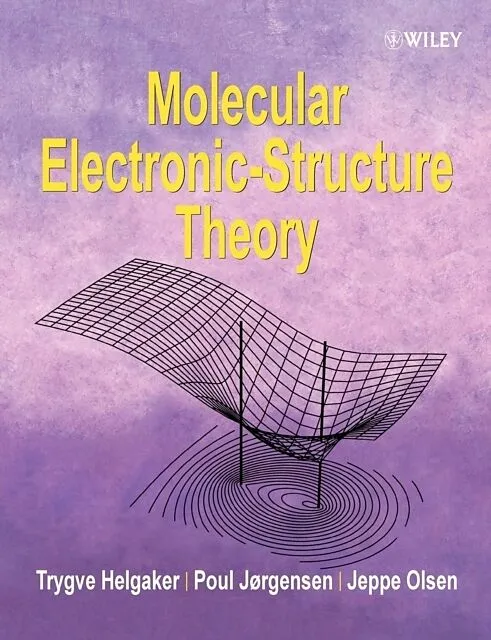
Molecular Electronic-Structure Theory
Beschreibung
Informationen zum Autor Trygve Helgaker, Department of Chemistry, University of Oslo, Norway. Poul Jorgensen and Jeppe Olsen Department of Chemistry, University of Aarhus, Denmark. Klappentext Spätestens seit der Entwicklung leistungsfähiger Computerprogramme ...Format auswählen
- Kartonierter EinbandCHF 138.40

Wird oft zusammen gekauft
Andere Kunden kauften auch
Beschreibung
Informationen zum Autor Trygve Helgaker, Department of Chemistry, University of Oslo, Norway. Poul Jorgensen and Jeppe Olsen Department of Chemistry, University of Aarhus, Denmark. Klappentext Spätestens seit der Entwicklung leistungsfähiger Computerprogramme interessieren sich auch Nichtspezialisten für die theoretischen Grundlagen quantenchemischer Berechnungen. Dieses Buch bietet einen umfassenden, modernen Überblick über die zweite Quantisierung, Wellenfunktionen, Basissätze und Integrale; alle gängigen Verfahren werden berücksichtigt (Hartree-Fock-Theorie, CI, MCSCF, Coupled Clusters, Störungstheorie). Ausführlich diskutiert wird auch die Kalibration der Methoden. (03/00) Zusammenfassung Molecular electronic-structure theory uses quantum mechanics to calculate the energies and wave functions of molecules and their molecular properties. It uses sophisticated mathematics and computers to solved the wave equations. The calculations can be used to find out how the atoms of the molecule are linked together in a molecule. Inhaltsverzeichnis Preface xxi Overview xxv Programs used in the preparation of this book xxix 1. Second Quantization 1 1.1 The Fock space 1 1.2 Creation and annihilation operators 2 1.3 Number-conserving operators 6 1.4 The representation of one- and two-electron operators 9 1.5 Products of operators in second quantization 14 1.6 First- and second-quantization operators compared 18 1.7 Density matrices 19 1.8 Commutators and anticommutators 25 1.9 Nonorthogonal spin orbitals 27 2. Spin in Second Quantization 34 2.1 Spin functions 34 2.2 Operators in the orbital basis 35 2.3 Spin tensor operators 41 2.4 Spin properties of determinants 46 2.5 Configuration state functions 51 2.6 The genealogical coupling scheme 53 2.7 Density matrices 61 3. Orbital Rotations 80 3.1 Unitary transformations and matrix exponentials 80 3.2 Unitary spin-orbital transformations 86 3.3 Symmetry-restricted unitary transformations 89 3.4 The logarithmic matrix function 93 4. Exact and Approximate Wave Functions 107 4.1 Characteristics of the exact wave function 107 4.2 The variation principle 111 4.3 Size-extensivity 126 4.4 Symmetry constraints 135 5. The Standard Models 142 5.1 One- and N-electron expansions 143 5.2 A model system: the hydrogen molecule in a minimal basis 146 5.3 Exact wave functions in Fock space 162 5.4 The Hartree-Fock approximation 167 5.5 Multiconfigurational self-consistent field theory 176 5.6 Configuration-interaction theory 181 5.7 Coupled-cluster theory 186 5.8 Perturbation theory 192 6. Atomic Basis Functions 201 6.1 Requirements on one-electron basis functions 201 6.2 One- and many-centre expansions 203 6.3 The one-electron central-field system 204 6.4 The angular basis 207 6.5 Exponential radial functions 218 6.6 Gaussian radial functions 229 7. Short-Range Interactions and Orbital Expansions 256 7.1 The Coulomb hole 256 7.2 The Coulomb cusp 259 7.3 Approximate treatments of the ground-state helium atom 262 7.4 The partial-wave expansion of the ground-state helium atom 267 7.5 The principal expansion of the ground-state helium atom 273 7.6 Electron-correlation effects summarized 278 8. Gaussian Basis Sets 287 8.1 Gaussian basis functions 287 8.2 Gaussian basis sets for Hartree-Fock calculations 288 8.3 Gaussian basis sets for correlated calculations 300 8.4 Basis-set convergence 315 8.5 Basis-set superposition error 327 9. Molecular Integral Evaluation 336 9.1...
Autorentext
Trygve Helgaker, Department of Chemistry, University of Oslo, Norway. Poul Jorgensen and Jeppe Olsen Department of Chemistry, University of Aarhus, Denmark.
Klappentext
Spätestens seit der Entwicklung leistungsfähiger Computerprogramme interessieren sich auch Nichtspezialisten für die theoretischen Grundlagen quantenchemischer Berechnungen. Dieses Buch bietet einen umfassenden, modernen Überblick über die zweite Quantisierung, Wellenfunktionen, Basissätze und Integrale; alle gängigen Verfahren werden berücksichtigt (Hartree-Fock-Theorie, CI, MCSCF, Coupled Clusters, Störungstheorie). Ausführlich diskutiert wird auch die Kalibration der Methoden. (03/00)
Zusammenfassung
Molecular electronic-structure theory uses quantum mechanics to calculate the energies and wave functions of molecules and their molecular properties. It uses sophisticated mathematics and computers to solved the wave equations. The calculations can be used to find out how the atoms of the molecule are linked together in a molecule.
Inhalt
Preface xxi
Overview xxv
Programs used in the preparation of this book xxix
1. Second Quantization 1
1.1 The Fock space 1
1.2 Creation and annihilation operators 2
1.3 Number-conserving operators 6
1.4 The representation of one- and two-electron operators 9
1.5 Products of operators in second quantization 14
1.6 First- and second-quantization operators compared 18
1.7 Density matrices 19
1.8 Commutators and anticommutators 25
1.9 Nonorthogonal spin orbitals 27
2. Spin in Second Quantization 34
2.1 Spin functions 34
2.2 Operators in the orbital basis 35
2.3 Spin tensor operators 41
2.4 Spin properties of determinants 46
2.5 Configuration state functions 51
2.6 The genealogical coupling scheme 53
2.7 Density matrices 61
3. Orbital Rotations 80
3.1 Unitary transformations and matrix exponentials 80
3.2 Unitary spin-orbital transformations 86
3.3 Symmetry-restricted unitary transformations 89
3.4 The logarithmic matrix function 93
4. Exact and Approximate Wave Functions 107
4.1 Characteristics of the exact wave function 107
4.2 The variation principle 111
4.3 Size-extensivity 126
4.4 Symmetry constraints 135
5. The Standard Models 142
5.1 One- and N-electron expansions 143
5.2 A model system: the hydrogen molecule in a minimal basis 146
5.3 Exact wave functions in Fock space 162
5.4 The Hartree-Fock approximation 167
5.5 Multiconfigurational self-consistent field theory 176
5.6 Configuration-interaction theory 181
5.7 Coupled-cluster theory 186
5.8 Perturbation theory 192
6. Atomic Basis Functions 201
6.1 Requirements on one-electron basis functions 201
6.2 One- and many-centre expansions 203
6.3 The one-electron central-field system 204
6.4 The angular basis 207
6.5 Exponential radial functions 218
6.6 Gaussian radial functions 229
7. Short-Range Interactions and Orbital Expansions 256
7.1 The Coulomb hole 256
7.2 The Coulomb cusp 259
7.3 Approximate treatments of the ground-state helium atom 262
7.4 The partial-wave expansion of the ground-state helium atom 267
7.5 The principal expansion of the ground-state helium atom 273
7.6 Electron-correlation effects summarized 278
8. Gaussian Basis Sets 287
8.1 Gaussian basis functions 287
8.2 Gaussian basis sets for Hartree-Fock calculations 288
8.3 Gaussian basis sets for correlated calculations 300
8.4 Basis-set convergence 315
8.5 Basis-set superposition error 327
9. Molecular Integral Evaluation 336
9.1 Contracted spherical-harmonic Gaussians 336
9.2 Cartesian Gaussians 338
9.3 The Obara-Saika scheme for simple integrals 344
9.4 Hermite Gaussians 349
9.5 The McMurchie-Davidson scheme for simple integrals 352
9.6 Gaussian quadrature for simple integrals 357
9.7 Coulomb integra;s over spherical Gaussians 361
9.8 The Boys function 365
9.9 The McMurchie-Davidson scheme for Coulomb integrals 372
9.10 The Obara-Saika scheme for Coulomb integrals 381
9.11 Rys quadrature for Coulomb integrals 387
9.12 Scaling properties of the molecular integrals 398
9.13 The multipole method for Coulomb integrals 405
9.14 The multipole method for large systems 417
10. Hartree-Fock Theory 433
10.1 Parametrization of the wave function and the energy 433
10.2 The Hartree-Fock wave function 438
10.3 Canonical Hartree-Fock theory 443
10.4 The RHF total energy and orbital energies 450 …