
IHR WARENKORB IST AKTUELL LEER.
Haben Sie noch nichts passendes gefunden? Stöbern Sie durch unser komplettes Sortiment.
Oder melden Sie sich an bzw. registrieren Sie sich.
- Kostenlose Lieferung
- Kauf auf Rechnung
- Ex Libris Tiefpreis
- Filiallieferung und 650+ Abholorte
- Rabatt-Bons als Club-Mitglied
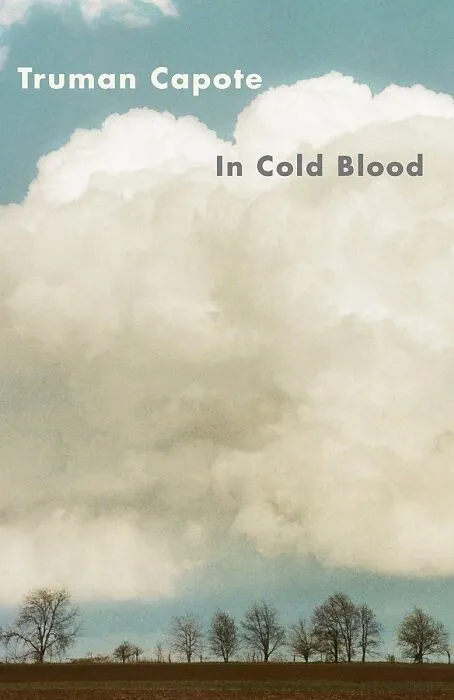
In Cold Blood
Beschreibung
Zusatztext "A masterpiece ... a spellbinding work." Life "A remarkable, tensely exciting, superbly written 'true account.' " The New York Times "The best documentary account of an American crime ever written ... The book chills the blood and exercises the inte...Format auswählen
- Kartonierter EinbandCHF 24.00
- Livre Audio CDCHF 32.70
- Fester EinbandCHF 31.50
- Fester EinbandCHF 31.60

Wird oft zusammen gekauft
Andere Kunden kauften auch
Beschreibung
Zusatztext "A masterpiece ... a spellbinding work." Life "A remarkable, tensely exciting, superbly written 'true account.' " The New York Times "The best documentary account of an American crime ever written ... The book chills the blood and exercises the intelligence ... harrowing." The New York Review of Books Informationen zum Autor Truman Capote was born September 30, 1924, in New Orleans. After his parents' divorce, he was sent to live with relatives in Monroeville, Alabama. It was here he would meet his lifelong friend, the author Harper Lee. Capote rose to international prominence in 1948 with the publication of his debut novel, Other Voices, Other Rooms. Among his celebrated works are Breakfast at Tiffany's, A Tree of Night, The Grass Harp, Summer Crossing, A Christmas Memory, and In Cold Blood, widely considered one of the greatest books of the twentieth century. Twice awarded the O. Henry Short Story Prize, Capote was also the recipient of a National Institute of Arts and Letters Creative Writing Award and an Edgar Award. He died August 25, 1984, shortly before his sixtieth birthday. Klappentext Truman Capote's masterpiece of true crime, intensely researched and vividly atmosphericas it if were happening before [the reader's] very eyes ( Time ) Harrowing . . . The best documentary account of an American crime ever written. . . . The book chills the blood and exercises the intelligence. The New York Times Book Review On November 15th, 1959, Richard Eugene Hickock and Perry Edward Smith brutally murdered the Clutter family in Holcomb, Kansas. This superb work, an exhaustively researched narrative of the lives of the family and the men who killed them, created a sensation when it was first published, serially, in The New Yorker in 1965. Perry Smith is one of the great dark characters of American literature, full of contradictory emotions. I thought he was a very nice gentleman, he says of Herb Clutter. Soft-spoken. I thought so right up to the moment I cut his throat. Told in chapters that alternate between the Clutter household and the approach of Smith and Hickock in their black Chevrolet, then between the investigation of the case and the killers' flight, Capote's account is so detailed that the reader comes to feel almost like a participant in the events. Leseprobe I The Last to See Them Alive THE village of Holcomb stands on the high wheat plains of western Kansas, a lonesome area that other Kansans call "out there." Some seventy miles east of the Colorado border, the countryside, with its hard blue skies and desert-clear air, has an atmosphere that is rather more Far West than Middle West. The local accent is barbed with a prairie twang, a ranch-hand nasalness, and the men, many of them, wear narrow frontier trousers, Stetsons, and high-heeled boots with pointed toes. The land is flat, and the views are awesomely extensive; horses, herds of cattle, a white cluster of grain elevators rising as gracefully as Greek temples are visible long before a traveler reaches them. Holcomb, too, can be seen from great distances. Not that there is much to see--simply an aimless congregation of buildings divided in the center by the main-line tracks of the Santa Fe Railroad, a haphazard hamlet bounded on the south by a brown stretch of the Arkansas (pronounced "Ar-kan-sas") River, on the north by a highway, Route 50, and on the east and west by prairie lands and wheat fields. After rain, or when snowfalls thaw, the streets, unnamed, unshaded, unpaved, turn from the thickest dust into the direst mud. At one end of the town stands a stark old stucco structure, the roof of which supports an electric sign--DANCE--but the dancing has ceased and the advertisement has been dark for several years. Near...
"A masterpiece ... a spellbinding work." —Life
"A remarkable, tensely exciting, superbly written 'true account.' " —*The New York Times
*"The best documentary account of an American crime ever written ... The book chills the blood and exercises the intelligence ... harrowing." —The New York Review of Books
Autorentext
Truman Capote was born September 30, 1924, in New Orleans. After his parents’ divorce, he was sent to live with relatives in Monroeville, Alabama. It was here he would meet his lifelong friend, the author Harper Lee. Capote rose to international prominence in 1948 with the publication of his debut novel, Other Voices, Other Rooms. Among his celebrated works are Breakfast at Tiffany’s, A Tree of Night, The Grass Harp, Summer Crossing, A Christmas Memory, and In Cold Blood, widely considered one of the greatest books of the twentieth century. Twice awarded the O. Henry Short Story Prize, Capote was also the recipient of a National Institute of Arts and Letters Creative Writing Award and an Edgar Award. He died August 25, 1984, shortly before his sixtieth birthday.
Klappentext
Truman Capote’s masterpiece of true crime, intensely researched and vividly atmospheric—“as it if were happening before [the reader’s] very eyes” (Time)
“Harrowing . . . The best documentary account of an American crime ever written. . . . The book chills the blood and exercises the intelligence.”—The New York Times Book Review
On November 15th, 1959, Richard Eugene Hickock and Perry Edward Smith brutally murdered the Clutter family in Holcomb, Kansas. This superb work, an exhaustively researched narrative of the lives of the family and the men who killed them, created a sensation when it was first published, serially, in The New Yorker in 1965.
Perry Smith is one of the great dark characters of American literature, full of contradictory emotions. “I thought he was a very nice gentleman,” he says of Herb Clutter. “Soft-spoken. I thought so right up to the moment I cut his throat.” Told in chapters that alternate between the Clutter household and the approach of Smith and Hickock in their black Chevrolet, then between the investigation of the case and the killers’ flight, Capote’s account is so detailed that the reader comes to feel almost like a participant in the events.
Leseprobe
I
The Last to See Them Alive
THE village of Holcomb stands on the high wheat plains of western Kansas, a lonesome area that other Kansans call "out there." Some seventy miles east of the Colorado border, the countryside, with its hard blue skies and desert-clear air, has an atmosphere that is rather more Far West than Middle West. The local accent is barbed with a prairie twang, a ranch-hand nasalness, and the men, many of them, wear narrow frontier trousers, Stetsons, and high-heeled boots with pointed toes. The land is flat, and the views are awesomely extensive; horses, herds of cattle, a white cluster of grain elevators rising as gracefully as Greek temples are visible long before a traveler reaches them.
Holcomb, too, can be seen from great distances. Not that there is much to see--simply an aimless congregation of buildings divided in the center by the main-line tracks of the Santa Fe Railroad, a haphazard hamlet bounded on the south by a brown stretch of the Arkansas (pronounced "Ar-kan-sas") River, on the north by a highway, Route 50, and on the east and west by prairie lands and wheat fields. After rain, or when snowfalls thaw, the streets, unnamed, unshaded, unpaved, turn from the thickest dust into the direst mud. At one end of the town stands a stark old stucco structure, the roof of which supports an electric sign--DANCE--but the dancing has ceased and the advertisement has been dark for several years. Nearby is another building with an irrelevant sign, this one in flaking gold on a dirty window--HOLCOMB BANK. The bank closed in 1933, and its former counting rooms have been converted into apartments. It is one of the town's two …