
IHR WARENKORB IST AKTUELL LEER.
Haben Sie noch nichts passendes gefunden? Stöbern Sie durch unser komplettes Sortiment.
Oder melden Sie sich an bzw. registrieren Sie sich.
- Kostenlose Lieferung
- Kauf auf Rechnung
- Ex Libris Tiefpreis
- Filiallieferung und 650+ Abholorte
- Rabatt-Bons als Club-Mitglied
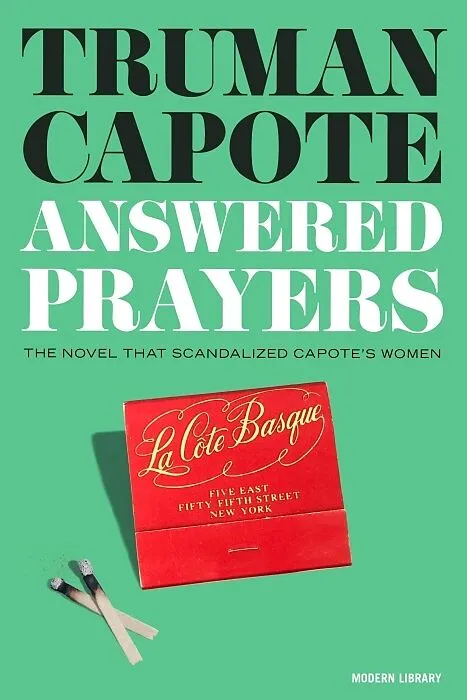
Answered Prayers
Beschreibung
Informationen zum Autor Truman Capote Klappentext "Catapulted from a childhood spent in a Missouri orphanage to the dizzying peaks of New York high society, the destitute and debauched writer P. B. Jones spends his days moving between the paltry cell of a Manh...Format auswählen
- Fester EinbandCHF 29.20

Wird oft zusammen gekauft
Andere Kunden kauften auch
Beschreibung
Informationen zum Autor Truman Capote Klappentext "Catapulted from a childhood spent in a Missouri orphanage to the dizzying peaks of New York high society, the destitute and debauched writer P. B. Jones spends his days moving between the paltry cell of a Manhattan Y.M.C.A. and the opulent playgrounds of the metropolitan elite. Though Jones struggles to make ends meet, his effortless associations with the moneyed and powerful thrust him into sumptuous business offices, bohemian bars inhabited by the likes of Jean-Paul Sartre and Simone de Beauvoir, and the trendiest restaurants, where the tables are arranged by the social status of their occupants. Jones's days and nights are a riptide of dysfunctional dinner parties and hobnobbing with drunken heiresses, accompanied by a carousel of legendary female characters who populated Capote's own life, among them Colette, Jackie Kennedy, and the Duchess of Windsor. Indeed, Answered Prayers teems with the real-life secrets and confessions of Capote's most trusted friends, and these pages, when first published as a magazine serial, astounded readers but betrayed his confidantes, banishing him from the exclusive circle that was once his. Unrestrained and irreverent, Answered Prayers renders a carnival of wealth and influence so unthinkable that it satirizes itself--with the inimitable wit of one of the twentieth century's most celebrated writers."-- Provided by publisher. Leseprobe I Unspoiled Monsters Somewhere in this world there exists an exceptional philosopher named Florie Rotondo. The other day I came across one of her ruminations printed in a magazine devoted to the writings of schoolchildren. It said: If I could do anything, I would go to the middle of our planet, Earth, and seek uranium, rubies, and gold. I'd look for Unspoiled Monsters. Then I'd move to the country. Florie Rotondo, age eight. Florie, honey, I know just what you meaneven if you don't: how could you, age eight? Because I have been to the middle of our planet; at any rate, have suffered the tribulations such a journey might inflict. I have searched for uranium, rubies, gold, and, en route, have observed others in these pursuits. And listen, FlorieI have met Unspoiled Monsters! Spoiled ones, too. But the unspoiled variety is the rara avis: white truffles compared to black; bitter wild asparagus as opposed to garden-grown. The one thing I haven't done is move to the country. As a matter of fact, I am writing this on Y.M.C.A. stationery in a Manhattan Y.M.C.A., where I have been existing the last month in a viewless second-floor cell. I'd prefer the sixth floorso if I decided to climb out the window, it would make a vital difference. Perhaps I'll change rooms. Ascend. Probably not. I'm a coward. But not cowardly enough to take the plunge. My name is P. B. Jones, and I'm of two mindswhether to tell you something about myself right now, or wait and weave the information into the text of the tale. I could just as well tell you nothing, or very little, for I consider myself a reporter in this matter, not a participant, at least not an important one. But maybe it's easier to start with me. As I say, I'm called P. B. Jones; I am either thirty-five or thirty-six: the reason for the uncertainty is that no one knows when I was born or who my parents were. All we know is that I was a baby abandoned in the balcony of a St. Louis vaudeville theater. This happened 20 January 1936. Catholic nuns raised me in an austere red-stone orphanage that dominated an embankment overlooking the Mississippi River. I was a favorite of the nuns, for I was a bright kid and a beauty; they never realized how conniving I was, duplicitous, or how much I despised their drabness, their aroma: incense and dishwater, candles and creosote, white sweat. One of the sisters, Sister Martha, I rather liked; she taught English and was so convinced I ...
Autorentext
Truman Capote
Klappentext
"Catapulted from a childhood spent in a Missouri orphanage to the dizzying peaks of New York high society, the destitute and debauched writer P. B. Jones spends his days moving between the paltry cell of a Manhattan Y.M.C.A. and the opulent playgrounds of the metropolitan elite. Though Jones struggles to make ends meet, his effortless associations with the moneyed and powerful thrust him into sumptuous business offices, bohemian bars inhabited by the likes of Jean-Paul Sartre and Simone de Beauvoir, and the trendiest restaurants, where the tables are arranged by the social status of their occupants. Jones's days and nights are a riptide of dysfunctional dinner parties and hobnobbing with drunken heiresses, accompanied by a carousel of legendary female characters who populated Capote's own life, among them Colette, Jackie Kennedy, and the Duchess of Windsor. Indeed, Answered Prayers teems with the real-life secrets and confessions of Capote's most trusted friends, and these pages, when first published as a magazine serial, astounded readers but betrayed his confidantes, banishing him from the exclusive circle that was once his. Unrestrained and irreverent, Answered Prayers renders a carnival of wealth and influence so unthinkable that it satirizes itself--with the inimitable wit of one of the twentieth century's most celebrated writers."-- Provided by publisher.
Zusammenfassung
Truman Capote’s unfinished final novel is an unsparing tell-all of New York high society that sent a sesimic shock through the public and Capote’s own social circle.
Catapulted from a childhood spent in a Missouri orphanage to the dizzying peaks of New York high society, the destitute and debauched writer P. B. Jones spends his days moving between the paltry cell of a Manhattan Y.M.C.A. and the opulent playgrounds of the metropolitan elite.
Though Jones struggles to make ends meet, his effortless associations with the moneyed and powerful thrust him into sumptuous business offices, bohemian bars inhabited by the likes of Jean-Paul Sartre and Simone de Beauvoir, and the trendiest restaurants, where the tables are arranged by the social status of their occupants. Jones’s days and nights are a riptide of dysfunctional dinner parties and hobnobbing with drunken heiresses, accompanied by a carousel of legendary female characters who populated Capote’s own life, among them Colette, Jackie Kennedy, and the Duchess of Windsor. Indeed, Answered Prayers teems with the real-life secrets and confessions of Capote’s most trusted friends, and these pages, when first published as a magazine serial, astounded readers but betrayed his confidantes, banishing him from the exclusive circle that was once his.
Unrestrained and irreverent, Answered Prayers renders a carnival of wealth and influence so unthinkable that it satirizes itself—with the inimitable wit of one of the twentieth century’s most celebrated writers.