Haben Sie noch nichts passendes gefunden? Stöbern Sie durch unser komplettes Sortiment.
Oder melden Sie sich an bzw. registrieren Sie sich.


Beschreibung
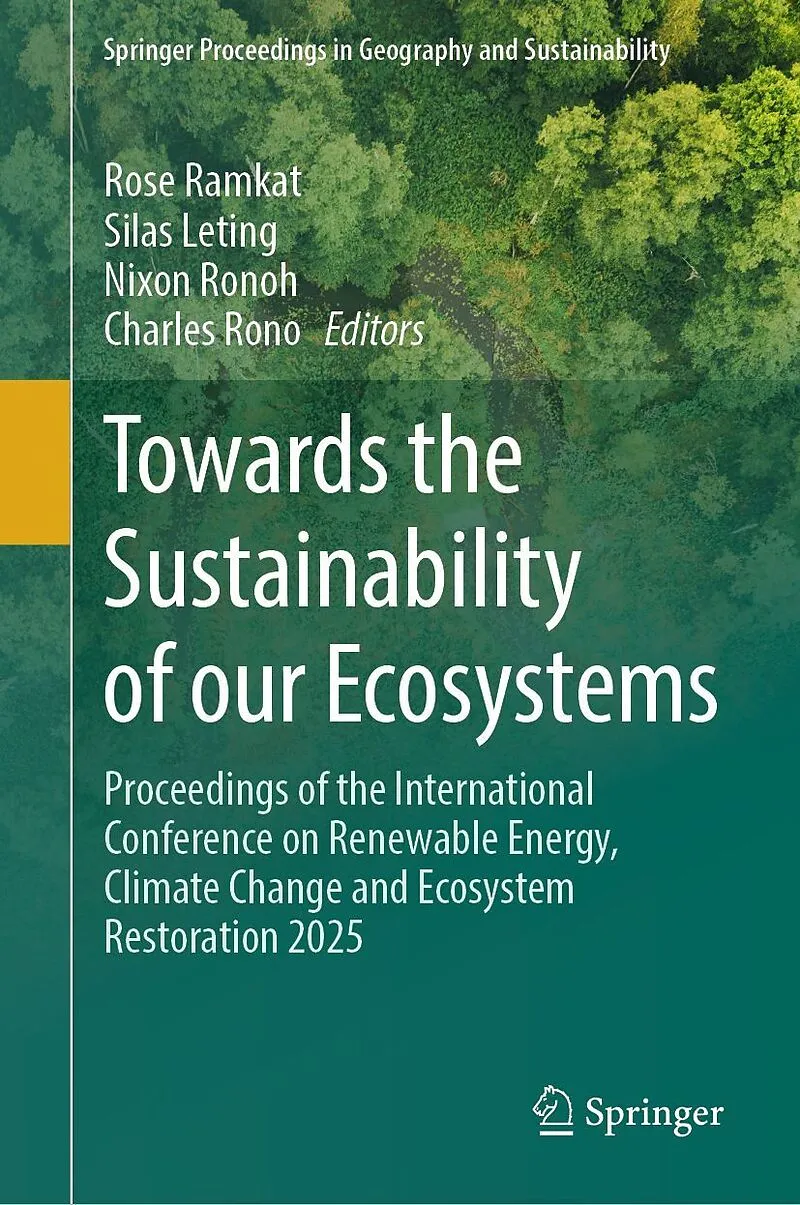
The International Conference on Renewable Energy, Climate Change and Restoration of Ecosystems (ICRECC-2025) brought together strategic partners from Government, research institutions, industries, the business community, financial institutions, private organi...
The International Conference on Renewable Energy, Climate Change and Restoration of Ecosystems (ICRECC-2025) brought together strategic partners from Government, research institutions, industries, the business community, financial institutions, private organizations, practitioners and local actors, who are united in building beneficial and sustainable climate action plans through research, innovation, capacity building and knowledge management. The 2025 conference focused on the theme Towards the sustainability of our Ecosystems and emphasized renewable energy use and the urgent need to restore critical ecosystems in the Great Rift Valley and beyond. The Conference was co-hosted by The County Government of Uasin Gishu and Moi University from 22nd to 25th April, 2025 in Eldoret, Kenya. Participants discussed challenges, shared knowledge, and explored actionable strategies towards adoption of renewable energy, climate smart policies and practices, and restoration of ecosystems.
Features multisectoral insights into climate change mitigation and management Highlights interventions centered on community engagement Exemplifies coordination and collaboration between academia and local governments
Autorentext
Rose Ramkat has PhD in Natural Resources and Applied Life Sciences from BOKU University, Austria; MSc and BSc degrees from Egerton University, Kenya. She worked previously for the Ministry of Agriculture, Kenya in many projects including: National Agriculture and Livestock Extension Project, Njaa Marufuku Kenya, International Fund for Agricultural Development, and Kenya Agricultural Productivity Project. She is currently involved in collaborative projects on biotechnology, food systems, and bio-circularity. She is Deputy Center leader and Principal Investigator for Africa Center of Excellence in Phytochemicals, Textile and Renewable Energy (ACE II – PTRE, Kenya) and Dean School of Science and Aerospace, Moi University. She is representative of the International Association of Universities Cluster for UN SDG 12 and serves in several boards including Scientific Sub-Committee of DSTI - NRF Center of Excellence in Food security. Silas Kering Leting is a nuclear scientist, energy expert, and policy strategist. He holds a Doctor of Philosophy (PhD) in Physics (Neutronics) from Moi University. He serves as the Director of Energy for the County Government of Uasin Gishu, Kenya. His leadership spans investor coordination, regulatory structuring, financial engineering, and implementation oversight, establishing the project as a benchmark for PPP-driven sustainable infrastructure. His influence extends regionally through the North Rift Economic Bloc, where he contributes to harmonized energy planning and regional investment frameworks. Charles Rono is a researcher and a faculty member in the Department of Chemistry, Kisii University. He is actively involved in collaborative interdisciplinary research focused on sustainable science solutions to climate change and ecosystem health. Some of his contributions include harnessing data chemistry and artificial intelligence for sustainability in product and process development, and phytochemicals in the development of materials for renewable energy applications. Nixon Ronoh is a faculty member, School of Science and Aerospace studies of Moi University, Kenya. Nixon obtained his Doctor of Sciences degree from Vrije Universiteit Brussel (VUB), and has published research papers cutting across the fields of Computer Science and Applied Mathematics. Nixon currently works with a research team studying the applications of Artificial Intelligence technologies in innovative and sustainable strategies towards renewable energy solutions, and the adaptation and mitigation of climate change.
Inhalt
Chapter 1: Forecasting Drought Events In Kenya Asal Region: A Cnn-Based Framework Using Chirps Precipitation.- Chapter 2: Assessment of Water Quality In Selected Fish Farms In Uasin Gishu County, Kenya.- Chapter 3: Spatial and Temporal Variation In The Diversity of Parasite Species Infecting Fish Cultured In Selected Fish Farms In Uasin Gishu County, Kenya.- Chapter 4: Variations In The Spatial And Temporal Diversity of Bacteria Isolated From Farm Cultured Fish In Uasin Gishu County, Kenya.- Chapter 5: Status of Forest Landscape Restoration In Kenya.- Chapter 6: Seed Banks For Tree Cover And Forest Restoration In Kenya.- Chapter 7: Pretreatment of Lignocellulosic Biomass For Biogas Enhancement: A Review.- Chapter 8: Leveraging Ai, Blockchain, and Big Data For Sustainable Energy Solutions In Africa.- Chapter 9: Soil Stabilization Using STEIN.- Chapter 10: Neutron Capture Reactions And The Role of Exotic Neutron-Rich Nuclei In The Optimization of Nuclear Energy Reactors.- Chapter 11: Investigation of The Effects of Matter Deposition On The Power Output of Mono- And Polycrystalline Solar Panels And The Assembly of An Automated Telecommunication-Based Cleaning System.- Chapter 12: Thermal Neutron Diffusion Deceleration Inside An Infinite Dimensions' Moderator. Calculating Neutron Age And Slowing Down of Length For Fission of Neutrons, Average Energy To Thermal Energy of Graphite And Beryllium.- Chapter 13: Effect of Sn Dopant On The Electronic Properties of Formamidinium Based Lead Halide Perovskite Materials: An Ab Initio Density Functional Theory Study.- Chapter 14: Harnessing Community Traditional Values For Ecosystem Preservation: Case of Kaptagat Forest of Elgeyo Marakwet County of Kenya.- Chapter 15: Methods of Synthesis, Characterization, and Applications of Nanoparticles: A Brief Review.- Chapter 16: Intelligent Optimization of PI-Controlled Grid-Connected Inverters for Enhanced Power Quality.- Chapter 17: Assessment of Nutrient Retention In Yala Wetland Ecosystem, Kenya.
Tief- preis