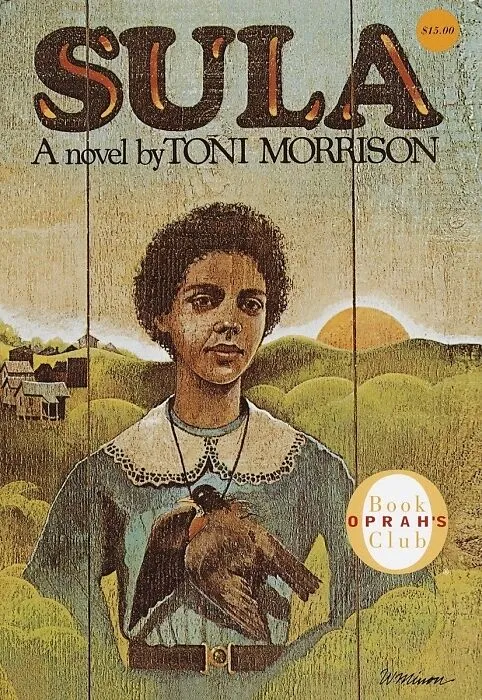
Sula
Beschreibung
Zusatztext Extravagantly beautiful. . . . Enormously, achingly alive. . . . A howl of love and rage, playful and funny as well as hard and bitter. The New York Times Exemplary. . . . The essential mysteries of death and sex, friendship and poverty are expresse...Format auswählen
- Fester EinbandCHF 29.20

Wird oft zusammen gekauft
Andere Kunden kauften auch
Beschreibung
Zusatztext Extravagantly beautiful. . . . Enormously, achingly alive. . . . A howl of love and rage, playful and funny as well as hard and bitter. The New York Times Exemplary. . . . The essential mysteries of death and sex, friendship and poverty are expressed with rare economy. Newsweek In characters like Sula, Toni Morrison's originality and power emerge. The Nation Enchanting. . . . Powerful. Chicago Daily News Toni Morrison is not just an important contemporary novelist but a major figure in our national literature. The New York Review of Books Sula is one of the most beautifully written, sustained works of fiction I have read in some time. . . . [Morrison] is a major talent. Elliot Anderson, Chicago Tribune As mournful as a spiritual and as angry as a clenched fist . . . written in language so pure and resonant that it makes you ache. Playboy In the first ranks of our living novelists. St. Louis Post-Dispatch Toni Morrison's gifts are rare: the re-creation of the black experience in America with both artistry and authenticity. Library Journal Should be read and passed around by book-lovers everywhere. Los Angeles Free Press Informationen zum Autor TONI MORRISON is the author of eleven novels and three essay collections. She received the National Book Critics Circle Award, the Pulitzer Prize, and in 1993 the Nobel Prize in Literature. She died in 2019. Klappentext One of The Atlantic 's Great American Novels of the Past 100 Years • A modern masterpiece about love and kinship, about living in an America birthed from slavery. Nobel Prize laureate Toni Morrison gives life to characters who struggle with what society tells them to be, and the love they long for and crave as Black women. Extravagantly beautiful. . . . Enormously, achingly alive. The New York Times Sula and Nel are born in the Bottoma small town at the top of a hill. Sula is wild, and daring; she does what she wants, while Nel is well-mannered, a mamma's girl with a questioning heart. Growing up they forge a bond stronger than anything, stronger even than the dark secret they have to bear. Strong enough, it seems, to last a lifetimeuntil, decades later, as the girls become women, Sula's anarchy leads to a betrayal that may be beyond forgiveness. In that place, where they tore the nightshade and blackberry patches from their roots to make room for the Medallion City Golf Course, there was once a neighborhood. It stood in the hills above the valley town of Medallion and spread all the way to the river. It is called the suburbs now, but when black people lived there it was called the Bottom. One road, shaded by beeches, oaks, maples and chestnuts, connected it to the valley. The beeches are gone now, and so are the pear trees where children sat and yelled down through the blossoms to passersby. Generous funds have been allotted to level the stripped and faded buildings that clutter the road from Medallion up to the golf course. They are going to raze the Time and a Half Pool Hall, where feet in long tan shoes once pointed down from chair rungs. A steel ball will knock to dust Irene's Palace of Cosmetology, where women used to lean their heads back on sink trays and doze while Irene lathered Nu Nile into their hair. Men in khaki work clothes will pry loose the slats of Reba's Grill, where the owner cooked in her hat because she couldn't remember the ingredients without it. There will be nothing left of the Bottom (the footbridge that crossed the river is already gone), but perhaps it is just as well, since it wasn't a town anyway: just a neighborhood where on quiet days people in valley houses could hear singing sometimes, banjos sometimes, and, if a valley man ...
Autorentext
TONI MORRISON is the author of eleven novels and three essay collections. She received the National Book Critics Circle Award, the Pulitzer Prize, and in 1993 the Nobel Prize in Literature. She died in 2019.
Klappentext
*One of The Atlantic*’s Great American Novels of the Past 100 Years • A modern masterpiece about love and kinship, about living in an America birthed from slavery. Nobel Prize laureate Toni Morrison gives life to characters who struggle with what society tells them to be, and the love they long for and crave as Black women.
“Extravagantly beautiful. . . . Enormously, achingly alive.” —The New York Times
Sula and Nel are born in the Bottom—a small town at the top of a hill. Sula is wild, and daring; she does what she wants, while Nel is well-mannered, a mamma’s girl with a questioning heart. Growing up they forge a bond stronger than anything, stronger even than the dark secret they have to bear. Strong enough, it seems, to last a lifetime—until, decades later, as the girls become women, Sula’s anarchy leads to a betrayal that may be beyond forgiveness.
**
Leseprobe
In that place, where they tore the nightshade and blackberry patches from their roots to make room for the Medallion City Golf Course, there was once a neighborhood. It stood in the hills above the valley town of Medallion and spread all the way to the river. It is called the suburbs now, but when black people lived there it was called the Bottom. One road, shaded by beeches, oaks, maples and chestnuts, connected it to the valley. The beeches are gone now, and so are the pear trees where children sat and yelled down through the blossoms to passersby. Generous funds have been allotted to level the stripped and faded buildings that clutter the road from Medallion up to the golf course. They are going to raze the Time and a Half Pool Hall, where feet in long tan shoes once pointed down from chair rungs. A steel ball will knock to dust Irene's Palace of Cosmetology, where women used to lean their heads back on sink trays and doze while Irene lathered Nu Nile into their hair. Men in khaki work clothes will pry loose the slats of Reba's Grill, where the owner cooked in her hat because she couldn't remember the ingredients without it.
There will be nothing left of the Bottom (the footbridge that crossed the river is already gone), but perhaps it is just as well, since it wasn't a town anyway: just a neighborhood where on quiet days people in valley houses could hear singing sometimes, banjos sometimes, and, if a valley man happened to have business up in those hills--collecting rent or insurance payments--he might see a dark woman in a flowered dress doing a bit of cakewalk, a bit of black bottom, a bit of "messing around" to the lively notes of a mouth organ. Her bare feet would raise the saffron dust that floated down on the coveralls and bunion-split shoes of the man breathing music in and out of his harmonica. The black people watching her would laugh and rub their knees, and it would be easy for the valley man to hear the laughter and not notice the adult pain that rested somewhere under the eyelids, somewhere under their head rags and soft felt hats, somewhere in the palm of the hand, somewhere behind the frayed lapels, somewhere in the sinew's curve, He'd have to stand in the back of Greater Saint Matthew's and let the tenor's voice dress him in silk, or touch the hands of the spoon carvers (who had not worked in eight years) and let the fingers that danced on wood kiss his skin. Otherwise the pain would escape him even though the laughter was part of the pain.
A shucking, knee-slapping, wet-eyed laughter that could even describe and explain how they came to be where they were.
A joke. A nigger joke. That was the way it got started. Not the town, of course, but that part of town where the Negroes lived, the part they called the Bottom in spite of the fact that it was up in the hills. Just a nigger joke. The kind white folks tell when the mill closes down and they're looking for a little comfort somewhere. The kind colored folks tell on themselves when the rain in doesn't come, or comes for weeks, and they'r…