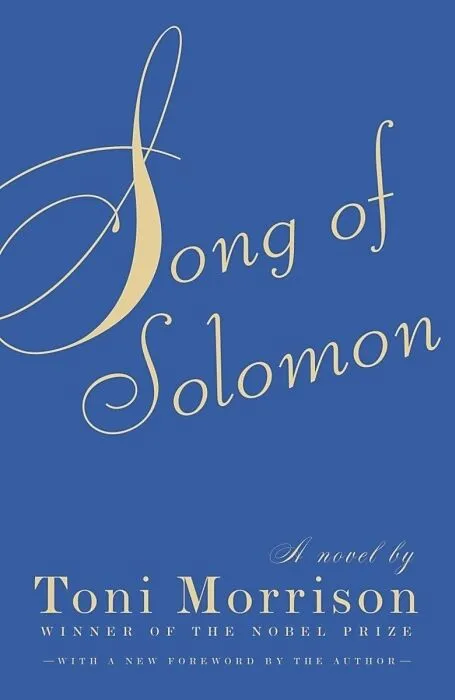
Song of Solomon
Beschreibung
Zusatztext A rich! full novel. . . . It lifts us up [and] impresses itself upon us like a love affair. The New York Times Book Review Exuberant. . . . An artistic vision that encompasses both a private and national heritage. A rhapsodic work. . . . Intricate a...Format auswählen
- Kartonierter EinbandCHF 19.20
- Fester EinbandCHF 37.50

Wird oft zusammen gekauft
Andere Kunden kauften auch
Beschreibung
Zusatztext A rich! full novel. . . . It lifts us up [and] impresses itself upon us like a love affair. The New York Times Book Review Exuberant. . . . An artistic vision that encompasses both a private and national heritage. A rhapsodic work. . . . Intricate and inventive. The New Yorker Stunningly beautiful. . . . Full of magnificent people. . . . They are still haunting my house. I suspect they will be with me forever. Anne Tyler! The Washington Post If Ralph Ellison's Invisible Man went underground! Toni Morrison's Milkman flies. John Leonard! The New York Times Book Review It places Toni Morrison in the front rank of contemporary American writers. She has written a novel that will endure. The Washington Post Lovely. . . . A delight! full of lyrical variety and allusiveness. . . . [An] exceptionally diverse novel. The Atlantic Monthly Morrison is a terrific storyteller. . . . Her writing evokes the joyful richness of life. Newsday Morrison dazzles. . . . She creates a black community strangely unto itself yet never out of touch with the white world. . . . With an ear as sharp as glass she has listened to the music of black talk and uses it as a palette knife to create black lives and to provide some of the best fictional dialogue around today. The Nation A marvelous novel! the most moving I have read in ten years of reviewing. Cleveland Plain Dealer Toni Morrison has created a fanciful world here. . . . She has an impeccable sense of emotional detail. She's the most sensible lyrical writer around today. The Philadelphia Inquirer A fine novel exuberantly constructed. . . . So rich in its use of common speech! so sophisticated in its use of literary traditions and language from the Bible to Faulkner . . . it is also extremely funny. The Hudson Review Toni Morrison is an extraordinarily good writer. Two pages into anything she writes one feels the power of her language and the emotional authority behind that language. . . . One closes the book warmed through by the richness of its sympathy! and by its breathtaking feel for the nature of sexual sorrow. The Village Voice Morrison moves easily in and out of the lives and thoughts of her characters! luxuriating in the diversity of circumstances and personality! and revelling in the sound of their voices and of her own! which echoes and elaborates theirs. The New Yorker Informationen zum Autor Toni Morrison Klappentext New York Times Bestseller Milkman Dead was born shortly after a neighborhood eccentric hurled himself off a rooftop in a vain attempt at flight. For the rest of his life he, too, will be trying to fly. With this brilliantly imagined novel, Toni Morrison transfigures the coming-of-age story as audaciously as Saul Bellow or Gabriel García Márquez. As she follows Milkman from his rustbelt city to the place of his family's origins, Morrison introduces an entire cast of strivers and seeresses, liars and assassins, the inhabitants of a fully realized black world. "You can't go wrong by reading or re-reading the collected works of Toni Morrison. Beloved, Song of Solomon, The Bluest Eye, Sula, everything else - they're transcendent, all of them. You'll be glad you read them."--Barack Obama Chapter 1 The North Carolina Mutual Life Insurance agent promised to fly from Mercy to the other side of Lake Superior at three o'clock. Two days before the event was to take place he tacked a note on the door of his little yellow house: At 3:00 p.m. on Wednesday the 18th of February, 1931, I will take off from Mercy and fly away on my own wings. Please forgive me. I loved you all. (signed) Robert Smith, Ins. agent Mr. Smith didn't draw a...
Autorentext
Toni Morrison
Klappentext
New York Times Bestseller
Milkman Dead was born shortly after a neighborhood eccentric hurled himself off a rooftop in a vain attempt at flight. For the rest of his life he, too, will be trying to fly. With this brilliantly imagined novel, Toni Morrison transfigures the coming-of-age story as audaciously as Saul Bellow or Gabriel García Márquez. As she follows Milkman from his rustbelt city to the place of his family's origins, Morrison introduces an entire cast of strivers and seeresses, liars and assassins, the inhabitants of a fully realized black world.
"You can't go wrong by reading or re-reading the collected works of Toni Morrison. Beloved, Song of Solomon, The Bluest Eye, Sula, everything else - they're transcendent, all of them. You'll be glad you read them."--Barack Obama
Zusammenfassung
NEW YORK TIMES BESTSELLER • An official Oprah Winfrey’s “The Books That Help Me Through” selection • The acclaimed Nobel Prize winner transfigures the coming-of-age story with this brilliantly imagined novel**. Includes a foreword by the author and a new introduction by Tayari Jones.**
**One of The Atlantic’s Great American Novels of the Past 100 Years
“A rhapsodic work. . . . Intricate and inventive.” —The New Yorker**
Milkman Dead was born shortly after a neighborhood eccentric hurled himself off a rooftop in a vain attempt at flight. For the rest of his life he, too, will be trying to fly. As Morrison follows Milkman from his rustbelt city to the place of his family’s origins, she introduces an entire cast of strivers and seeresses, liars and assassins, the inhabitants of a fully realized Black world.
Leseprobe
Chapter 1
The North Carolina Mutual Life Insurance agent promised to fly from Mercy to the other side of Lake Superior at three o'clock. Two days before the event was to take place he tacked a note on the door of his little yellow house:
At 3:00 p.m. on Wednesday the 18th of February, 1931, I will take off from Mercy and fly away on my own wings. Please forgive me. I loved you all.
(signed) Robert Smith,
Ins. agent
Mr. Smith didn't draw as big a crowd as Lindbergh had four years earlier--not more than forty or fifty people showed up--because it was already eleven o'clock in the morning, on the very Wednesday he had chosen for his flight, before anybody read the note. At that time of day, during the middle of the week, word-of-mouth news just lumbered along. Children were in school; men were at work; and most of the women were fastening their corsets and getting ready to go see what tails or entrails the butcher might be giving away. Only the unemployed, the self-employed, and the very young were available--deliberately available because they'd heard about it, or accidentally available because they happened to be walking at that exact moment in the shore end of Not Doctor Street, a name the post office did not recognize. Town maps registered the street as Mains Avenue, but the only colored doctor in the city had lived and died on that street, and when he moved there in 1896 his patients took to calling the street, which none of them lived in or near, Doctor Street. Later, when other Negroes moved there, and when the postal service became a popular means of transferring messages among them, envelopes from Louisiana, Virginia, Alabama, and Georgia began to arrive addressed to people at house numbers on Doctor Street. The post office workers returned these envelopes or passed them on to the Dead Letter Office. Then in 1918, when colored men were being drafted, a few gave their address at the recruitment office as Doctor Street. In that way, the name acquired a quasi-official status. But not for long. Some of the city legislators, whose concern for appropriate names and the maintenance of the city's landmarks was the principal part of their political life, saw to it that "Doctor Street" was never used in any official capacity. And since they knew that only Southside residents kept it up, they had notices posted in the stores, barbershops, and restaurants in that part of the city saying that the avenue running northerly and southerly from Shore Road fronting the l…