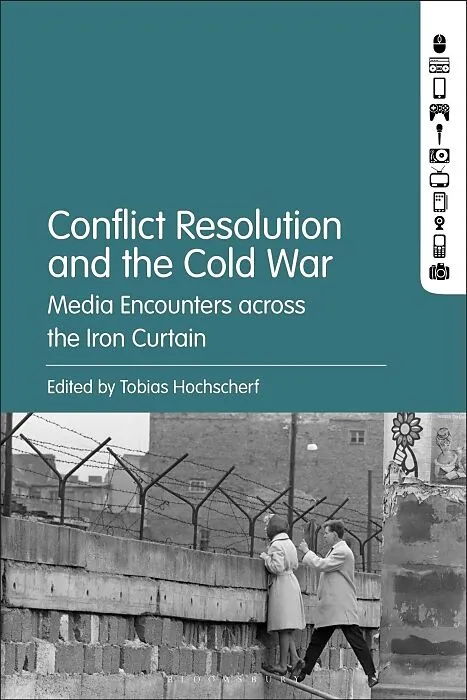
Conflict Resolution and the Cold War
Beschreibung
While existing publications on the Cold War tend to characterise this period exclusively in terms of conflict or on the basis of irreconcilable ideological differences, this book - through a number of fascinating international case studies - shows that there w...Format auswählen
- Fester EinbandCHF 138.00

Wird oft zusammen gekauft
Andere Kunden kauften auch
Beschreibung
While existing publications on the Cold War tend to characterise this period exclusively in terms of conflict or on the basis of irreconcilable ideological differences, this book - through a number of fascinating international case studies - shows that there were also many media-related examples of attempts for reconciliation on both sides of the Iron Curtain. Scholars of media history, more often than not, have looked at the role of media in times of conflict, war, crises, social and political upheaval. Yet, media such as film, radio and television have also played a decisive role in processes of conflict resolution. As such, media in one way or another affected nation building processes, the fight for civil rights, equality, the reconciliation of former enemies, the democratisation of totalitarian states and peacekeeping missions around the world. This was also true during the Cold War which could be considered the longest-simmering conflict of the 20th century with far-reaching consequences that could be felt to this day. Arguing that cultural politics were a vital part of the Cold War experience, Conflict Resolution and the Cold War: Media Encounters across the Iron Curtain brings together international scholars with expertise in different media to take a closer look at this often-overlooked role media played in conflict resolution and initiatives for reconciliation. Owing to the very few, if any, opportunities to meet people from the other side of the political divide in person, media often provided an important sphere where the East and the West could learn from one another. Examples include BBC broadcasts, films such as The Charterhouse of Parma (1948), television networks, television programs such as Doctor Who , and Danish journalists returning from exile in London and Stockholm, among others.
Autorentext
Tobias Hochscherf is Professor in Film, Radio and Television at the University of Applied Sciences in Kiel, Germany. He is associate editor of the Historical Journal of Film, Radio and Television, the Journal of Scandinavian Cinema and the Journal of Popular Television. He is author of The Continental Connection: German-speaking Émigrés and British Cinema, 1927-45 (2011), co-author of Beyond the Boundaries: Contemporary Danish Television Drama (2017), and he has co-edited the anthologies British Science Fiction Film and Television: Critical Essays (2011) and Divided, but not Disconnected: German Experiences of the Cold War (2010), as well as a themed issue for the Historical Journal of Film, Radio and Television
On 'Dissent and Dissidents in Central and Eastern European Film' (with Bjørn Sørenssen und Rolf Werenskjold, 2021).
Gintaras Aleknonis is Partnership Professor at the Faculty of Communication, Vilnius University, Lithuania. He is the author of The New Censorship (2011) and two other books on histories of Lithuanian Radio and Television: Lithuanian Radio: One Day and 80 Years (2006) and Lithuanian Television: The Colours and the Shadows of the Screen (2007). He was a broadcaster for international media organisations in Munich and Prague, and for the Lithuanian National Radio in Vilnius.
Inhalt
List of Illustrations
List of Pictures and Tables
Abbreviations
List of Contributors
Acknowledgements
Between Antagonism and Accord: Media and the Cold War - An Introduction
Gintaras Aleknonis (Muthesius Academy of Arts, Germany and Vilnius University, Lithuania) and Tobias Hochscherf (*Kiel University of Applied Sciences and the University, Germany)*
PART I: EARLY ENCOUNTERS
Doors to the Free World: Former Danish Journalists-in-Exile in the Proto-Cold War
Emil Eiby Seidenfaden (University of Copenhagen, Denmark)The Next Most Important British Personage in Moscow? The BBC and Soviet Union during the Early Decades of the Cold War
James Rodgers (City,University of London, UK)Local Media, Paradiplomacy and Conflict Resolution: The Journal of the Society of Friends of Coventry and (West) German-British Relations, 1947-49
Christoph Laucht (Swansea University, UK)Film Adaptation in the Cold War: The Charterhouse of Parma (1948)
Tadas Bugnevicius (*Yale University, USA)*PART II: COLD WAR NARRATIVES AND STABILISING TRANSFORMATIONS
Revisions. NS-Regime, Second World War and Holocaust in West-German Documentaries of the Cold War Era
Thomas Weber (University of Hamburg, Germany)When the Cold War Went on Holiday: A Look Behind the Iron Curtain in Richard Thorpe's The Golden Head (1964)
Balázs Varga (Eötvös Loránd University, Hungary)'A film about something else'. Dissemination of Czech Student Films at the Turn of the 1970s and 1980s
Tereza Czesany Dvoráková (*Charles University, Czech Republic)*Transnational Television Flow in East Europe in Times of Conflict
Yulia Yurtaeva-Martens (Film University Babelsberg*, Germany) & Lothar Mikos (Film University Babelsberg*, Germany)Time and Conflict Resolution in Space: Politics and Geopolitics in Classic Doctor Who
(1963-89)
James Chapman (*University of Leicester, UK)*PART III: LATE DÉTANTE POLICY, CRITICAL REFLECTIONS AND CULTURAL EXCHANGES
Spacebridges to Peace: Satellite Television Links, Citizen Diplomacy and US-Soviet Conflict Resolution in the 1980s.
Nicholas J. Cull (University of Southern California, USA)Semi-legal and Legal Local TV Programmes in the GDR and Unified Germany (1989- 1995): Motives of Early Post-Cold War TV Makers in Saxony
Rüdiger Steinmetz (Leipzig University, Germany) and Judith Kretzschmar (Leipzig University, Germany)Transformation of the Communist Media and its Anti-Communist Rhetoric During the Period of Social Revival: A Survival Strategy
Andrius Vaisnys (Vilnius University, Lithuania)Bibliography
Index