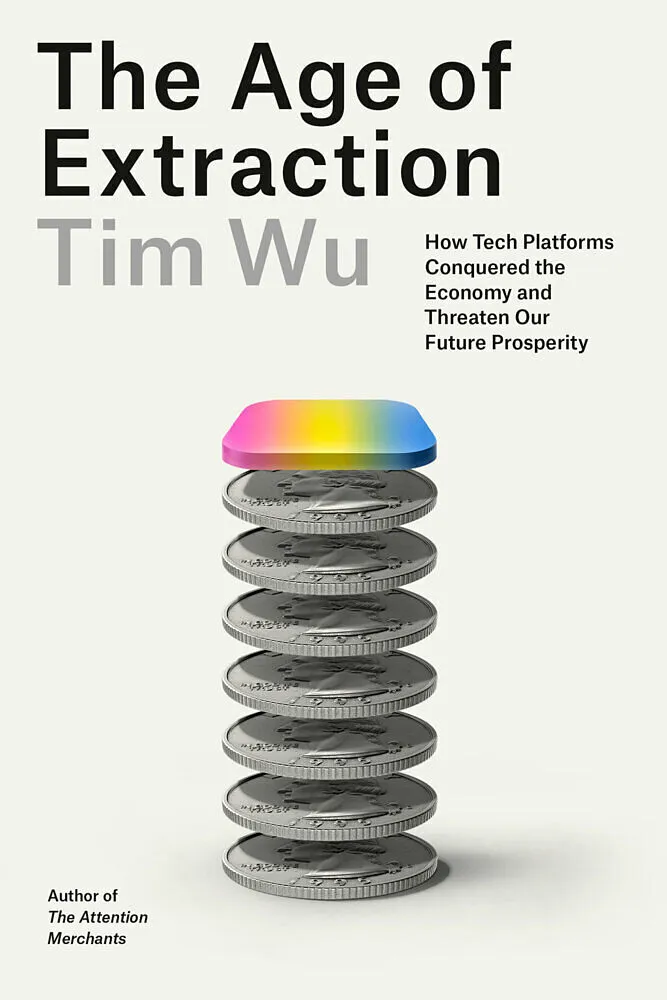
The Age of Extraction
Beschreibung
A concise yet century-spanning exploration of the power of platforms, what the future of capitalism will look like, and how to build economies that provide equality and lasting prosperity. In every society, there has been an essential platform--a central marke...Format auswählen
- Kartonierter EinbandCHF 20.30
- Fester EinbandCHF 33.20

Wird oft zusammen gekauft
Andere Kunden kauften auch
Beschreibung
A concise yet century-spanning exploration of the power of platforms, what the future of capitalism will look like, and how to build economies that provide equality and lasting prosperity. In every society, there has been an essential platform--a central marketplace--where people come to buy, sell, and make their living. While each culture and era are distinct, all have such a platform to serve as the beating heart of the economy. Over most of human history, these platforms have been public and physical: city centers, ports, shopping streets, and stock markets. Today, however, these arenas are more sophisticated, largely privatized, and virtual: they are digital, accessible anywhere, and anchored by the Internet itself. The way these platforms operate determines how the economy works, who it benefits and fails, and how society functions. Now, Tim Wu--the preeminent legal scholar who coined the phrase “net neutrality”--explores what these platforms tell us about our worlds, and why it is so crucial that they are fair and equal.
Autorentext
Tim Wu is Julius Silver Professor of Law, Science and Technology at Columbia Law School. He worked in the White House as special assistant to the President for technology and competition policy. The author of The Master Switch and The Attention Merchants, he lives in New York City.
Klappentext
**A NEW YORKER BEST BOOK OF 2025 • Tech platforms manipulate attention, extract wealth, and deepen inequality. In this new book, Tim Wu (The Attention Merchants) explains how we can reclaim control and create a balanced economy that works for everyone.
“The magic of Tim Wu’s The Age of Extraction is its simplicity. Wu deftly breaks down one of the greatest challenges of our age—the unaccountable power of tech platforms—into such digestible pieces that the solutions for what to do become dead obvious. Essential reading.”—Karen Hao, author of Empire of AI: Dreams and Nightmares in Sam Altman’s OpenAI
"It’s not just in your head—your online life is draining your wallet.... [The Age of Extraction is] a sharp and eye-opening introduction to how we arrived at platform capitalism—where no good click goes unmonetized.”—Kirkus Reviews **
Our world is dominated by a handful of tech platforms. They provide great conveniences and entertainment, but also stand as some of the most effective instruments of wealth extraction ever invented, seizing immense amounts of money, data, and attention from all of us. An economy driven by digital platforms and AI influence offers the potential to enrich us, and also threatens to marginalize entire industries, widen the wealth gap, and foster a two-class nation. As technology evolves and our markets adapt, can society cultivate a better life for everyone? Is it possible to balance economic growth and egalitarianism, or are we too far gone?
Tim Wu—the preeminent scholar and former White House official who coined the phrase “net neutrality”—explores the rise of platform power and details the risks and rewards of working within such systems. The Age of Extraction tells the story of an Internet that promised widespread wealth and democracy in the 1990s and 2000s, only to create new economic classes and aid the spread of autocracy instead. Wu frames our current moment with lessons from recent history—from generative AI and predictive social data to the antimonopoly and crypto movements—and envisions a future where technological advances can serve the greatest possible good. Concise and hopeful, The Age of Extraction offers consequential proposals for taking back control in order to achieve a better economic balance and prosperity for all.
Leseprobe
Chapter 1
The Genius of the Ancient City Square
Everything needs to happen somewhere. That is why every civilization has had specialized spaces that facilitate commerce, speech, and other activities. In ancient Greece, the town square, or “agora,” served not just for buying and selling stuff but also for religious festivals, entertainment, and government.1 The bazaar was invented in the Middle East and much of commerce in ancient China centered on the market-town, or 市. These are the ancestors of today’s tech platforms, and we need to understand what gave them their economic significance.
It might help to better define what we mean by a “platform.” (The English word comes from the French platte fourme or “flat form.”) It can be described as any space or structure that in one way or another brings together two or more groups to transact or interact while reducing the costs of doing so. They can be buyers and sellers, but also readers and publishers, listeners and speakers. And as the French word suggests, a platform usually implied a certain evenhandedness.
This definition of a platform covers a lot of ground. It covers the most ancient form of transactional platform just described: the city marketplace. The term encompasses more, including stock exchanges, suburban shopping malls, and the Tokyo fish market, all of which bring together buyers and sellers. And as we shall see later, it also includes so-called enabling platforms that allow their buyers and sellers to do things they otherwise could not.
A Catalytic Space
In chemistry, a catalyst is anything that initiates or accelerates a chemical reaction without being affected itself. The operation of many complex natural systems—like most of the biochemistry that keeps us alive—is largely a story of catalysis.
The same is true in the economy: it is the catalysts that matter most. Selling does not simply “happen” if the price is right. The conditions must be right. It is this power—a catalytic power—that platforms harness.
Stated more formally, the most basic function of the platform is to enable mutually beneficial transactions—and thereby generate wealth or the satisfaction of human wants and needs. Platforms do so by solving not just one but several barriers that otherwise prevent transactions from occurring. Consider four major challenges that a successful platform addresses.
First Problem: Matching
I used to have a fig tree in my backyard, and when the time came, it bore a lot of fruit. A good fig tree will actually produce far more output than any one family can eat. In economic terms, a fig tree creates a surplus. In fact, most agricultural holdings create a surplus relative to family consumption.
The existence of a surplus creates the potential for trade—here, selling excess produce to buyers. In a basic economics class, it is common to assume that the matching of buyers and sellers happens automatically, if the buyer values it more than the seller. If so, the transaction happens, as if by magic.
In real life, as it isn’t always easy to match buyers and sellers, extra produce is often just left to rot. It is the facilitation of such transactions—the existence of marketplaces—that makes all the difference. The successful matching of buyers and sellers is required to make transactions happen. That is why platforms and marketplaces are so key to successful economies.
In this matchmaking function lies much of the value in a platform. In the language of platform economics popularized by French economist Jean Tirole, the platform exists to bring two “sides” of a market together.2 The more buyers and sellers a platform can muster, the more valuable it is. More buyers and more sellers attract more of each, in a version of what is sometimes called “network effects.” As economist David Evans writes in Matchmakers, platform businesses have as “raw mat…