
IHR WARENKORB IST AKTUELL LEER.
Haben Sie noch nichts passendes gefunden? Stöbern Sie durch unser komplettes Sortiment.
Oder melden Sie sich an bzw. registrieren Sie sich.
- Kostenlose Lieferung
- Kauf auf Rechnung
- Ex Libris Tiefpreis
- Filiallieferung und 650+ Abholorte
- Rabatt-Bons als Club-Mitglied
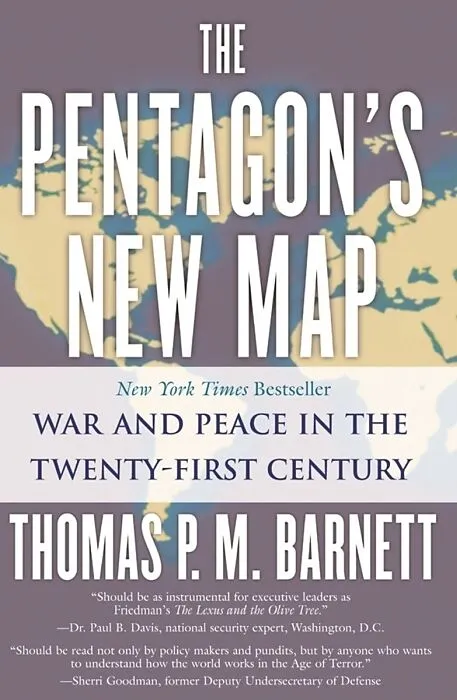
The Pentagon's New Map
Beschreibung
Informationen zum Autor Thomas P.M. Barnett Klappentext Since the end of the Cold War, America's national security establishment has been searching for a new operating theory to explain how this seemingly "chaotic" world actually works. Gone is the clash of bl...Format auswählen
- Kartonierter Einband (Kt)CHF 31.60

Wird oft zusammen gekauft
Andere Kunden kauften auch
Beschreibung
Informationen zum Autor Thomas P.M. Barnett Klappentext Since the end of the Cold War, America's national security establishment has been searching for a new operating theory to explain how this seemingly "chaotic" world actually works. Gone is the clash of blocs, but replaced by what? Thomas Barnett has the answers. A senior military analyst with the U.S. Naval War College, he has given a constant stream of briefings over the past few years, and particularly since 9/11, to the highest of high-level civilian and military policymakers-and now he gives it to you. The Pentagon's New Map is a cutting-edge approach to globalization that combines security, economic, political, and cultural factors to do no less than predict and explain the nature of war and peace in the twenty-first century. Building on the works of Friedman, Huntington, and Fukuyama, and then taking a leap beyond, Barnett crystallizes recent American military history and strategy, sets the parameters for where our forces will likely be headed in the future, outlines the unique role that America can and will play in establishing international stability-and provides much-needed hope at a crucial yet uncertain time in world history. For anyone seeking to understand the Iraqs, Afghanistans, and Liberias of the present and future, the intimate new links between foreign policy and national security, and the operational realities of the world as it exists today, The Pentagon's New Map is a template, a Rosetta stone. Agree with it, disagree with it, argue with it-there is no book more essential for 2004 and beyond.Preface An Operating Theory of the World WHEN THE COLD WAR ENDED, we thought the world had changed. It had-but not in the way we thought. When the Cold War ended, our real challenge began. The United States had spent so much energy during those years trying to prevent the horror of global war that it forgot the dream of global peace. As far as most Pentagon strategists were concerned, America's status as the world's sole military superpower was something to preserve, not something to exploit, and because the future was unknowable, they assumed we needed to hedge against all possibilities, all threats, and all futures. America was better served adopting a wait-and-see strategy, they decided, one that assumed some grand enemy would arise in the distant future. It was better than wasting precious resources trying to manage a messy world in the near term. The grand strategy...was to avoid grand strategies. I know that sounds incredible, because most people assume there are all sorts of "master plans" being pursued throughout the U.S. Government. But, amazingly, we are still searching for a vision to replace the decades-long containment strategy that America pursued to counter the Soviet threat. Until September 11, 2001, the closest thing the Pentagon had to a comprehensive view of the world was simply to call it "chaos" and "uncertainty," two words that implied the impossibility of capturing a big-picture perspective of the world's potential futures. Since September 11, at least we have an enemy to attach to all this "chaos" and "uncertainty," but that still leaves us describing horrible futures to be prevented, not positive ones to be created. Today the role of the Defense Department in U.S. national security is being radically reshaped by new missions arising in response to a new international security environment. It is tempting to view this radical redefinition of the use of U.S. military power around the world as merely the work of senior officials in the Bush Administration, but that is to confuse the midwife with the miracle of birth. This Administration is only doing what any other administration would eventually have had to do: recast America's national security strategy from its Cold War, balance-of-power mind-set to one that reflects the new s...
Autorentext
Thomas P.M. Barnett
Klappentext
Since the end of the Cold War, America's national security establishment has been searching for a new operating theory to explain how this seemingly "chaotic" world actually works. Gone is the clash of blocs, but replaced by what?
Thomas Barnett has the answers. A senior military analyst with the U.S. Naval War College, he has given a constant stream of briefings over the past few years, and particularly since 9/11, to the highest of high-level civilian and military policymakers-and now he gives it to you. The Pentagon's New Map is a cutting-edge approach to globalization that combines security, economic, political, and cultural factors to do no less than predict and explain the nature of war and peace in the twenty-first century.
Building on the works of Friedman, Huntington, and Fukuyama, and then taking a leap beyond, Barnett crystallizes recent American military history and strategy, sets the parameters for where our forces will likely be headed in the future, outlines the unique role that America can and will play in establishing international stability-and provides much-needed hope at a crucial yet uncertain time in world history.
For anyone seeking to understand the Iraqs, Afghanistans, and Liberias of the present and future, the intimate new links between foreign policy and national security, and the operational realities of the world as it exists today, The Pentagon's New Map is a template, a Rosetta stone. Agree with it, disagree with it, argue with it-there is no book more essential for 2004 and beyond.
Leseprobe
Preface
An Operating Theory of the World
WHEN THE COLD WAR ENDED, we thought the world had changed. It had-but not in the way we thought.
When the Cold War ended, our real challenge began.
The United States had spent so much energy during those years trying to prevent the horror of global war that it forgot the dream of global peace. As far as most Pentagon strategists were concerned, America's status as the world's sole military superpower was something to preserve, not something to exploit, and because the future was unknowable, they assumed we needed to hedge against all possibilities, all threats, and all futures. America was better served adopting a wait-and-see strategy, they decided, one that assumed some grand enemy would arise in the distant future. It was better than wasting precious resources trying to manage a messy world in the near term. The grand strategy...was to avoid grand strategies.
I know that sounds incredible, because most people assume there are all sorts of "master plans" being pursued throughout the U.S. Government. But, amazingly, we are still searching for a vision to replace the decades-long containment strategy that America pursued to counter the Soviet threat. Until September 11, 2001, the closest thing the Pentagon had to a comprehensive view of the world was simply to call it "chaos" and "uncertainty," two words that implied the impossibility of capturing a big-picture perspective of the world's potential futures. Since September 11, at least we have an enemy to attach to all this "chaos" and "uncertainty," but that still leaves us describing horrible futures to be prevented, not positive ones to be created.
Today the role of the Defense Department in U.S. national security is being radically reshaped by new missions arising in response to a new international security environment. It is tempting to view this radical redefinition of the use of U.S. military power around the world as merely the work of senior officials in the Bush Administration, but that is to confuse the midwife with the miracle of birth. This Administration is only doing what any other administration would eventually have had to do: recast America's national security strategy from its Cold War, balance-of-power mind-set to one that reflects the new strategic environment. The terrorist attacks of 9/11 simply revealed the yawning gap between the military we built to win the Cold War and the different…