Beschreibung
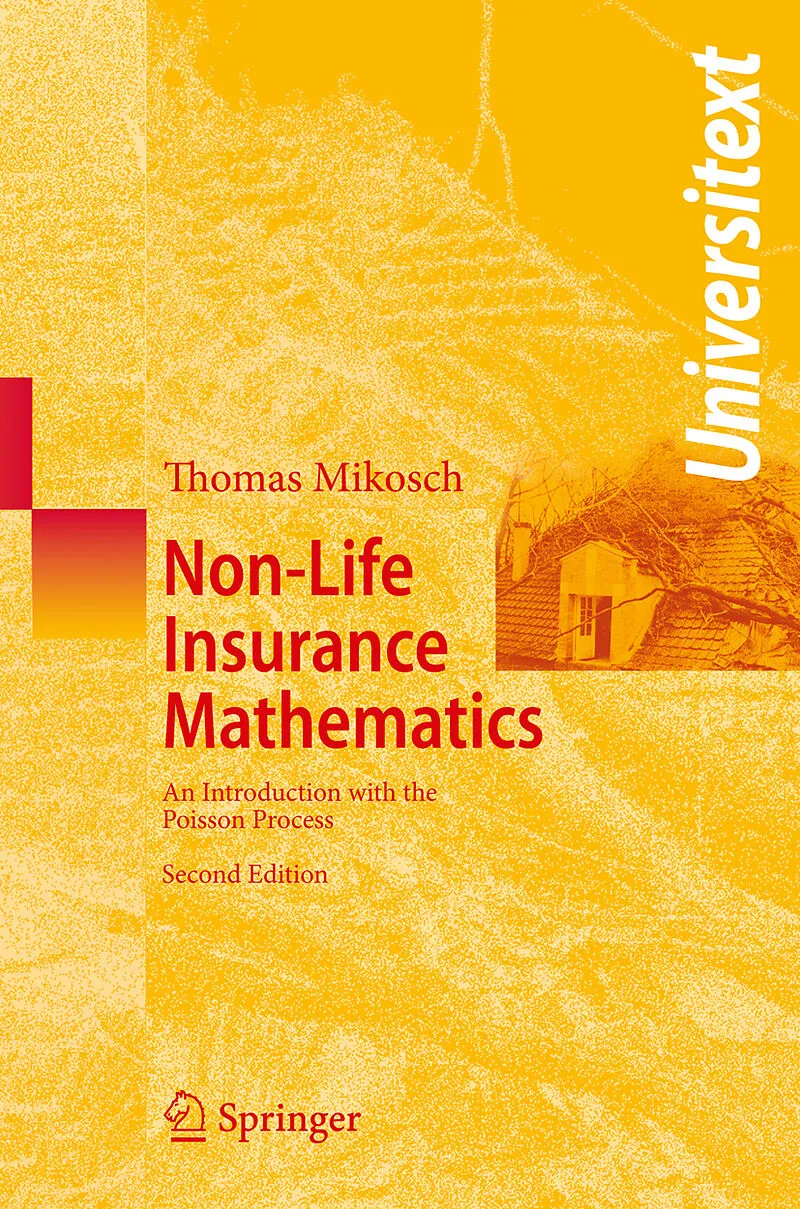
A mathematical introduction to non-life insurance and, at the same time, to a multitude of applied stochastic processes. It gives detailed discussions of the fundamental models for claim sizes, claim arrivals, the total claim amount, and their probabilistic p...A mathematical ** introduction to non-life insurance and, at the same time, to a multitude of applied stochastic processes. It gives detailed discussions of the fundamental models for claim sizes, claim arrivals, the total claim amount, and their probabilistic properties. What makes this book special are more than 100 figures and tables illustrating and visualizing the theory. Every section ends with extensive exercises. The book can serve either as a text for an undergraduate/graduate course on non-life insurance mathematics or applied stochastic processes.
Rigorous mathematical introduction and as such quite a unique textbook which can be used not only by a specialised audience More than 100 figures and tables illustrating and visualizing the theory Every section ends with extensive exercises Book's content is in agreement with the European Group Consultatif standards An extensive bibliography, annotated by various comments sections with references to more advanced relevant literature, make the book broadly and easily accessible Includes supplementary material: sn.pub/extras
Autorentext
Thomas Mikosch has been professor at the Laboratory of Actuarial Mathematics of the University of Copenhagen since January 2001. Before this, he held positions in Dresden (Germany), Wellington (New Zealand) and Groningen (Netherlands). His special interests are applied probability theory and stochastic processes. Over the last few years his research has focused on extremal events in finance, insurance and telecommunications. His earlier very successful book, written jointly with Paul Embrechts and Claudia Klüppelberg, Modelling Extremal Events for Finance and Insurance (1997), is also published by Springer.
Klappentext
The volume offers a mathematical introduction to non-life insurance and, at the same time, to a multitude of applied stochastic processes. It includes detailed discussions of the fundamental models regarding claim sizes, claim arrivals, the total claim amount, and their probabilistic properties. Throughout the volume the language of stochastic processes is used for describing the dynamics of an insurance portfolio in claim size, space and time. Special emphasis is given to the phenomena which are caused by large claims in these models. The reader learns how the underlying probabilistic structures allow determining premiums in a portfolio or in an individual policy.
The second edition contains various new chapters that illustrate the use of point process techniques in non-life insurance mathematics. Poisson processes play a central role. Detailed discussions show how Poisson processes can be used to describe complex aspects in an insurance business such as delays in reporting, the settlement of claims and claims reserving. Also the chain ladder method is explained in detail.
More than 150 figures and tables illustrate and visualize the theory. Every section ends with numerous exercises. An extensive bibliography, annotated with various comments sections with references to more advanced relevant literature, makes the volume broadly and easily accessible.
Zusammenfassung
A mathematical ** introduction to non-life insurance and, at the same time, to a multitude of applied stochastic processes. It gives detailed discussions of the fundamental models for claim sizes, claim arrivals, the total claim amount, and their probabilistic properties. What makes this book special are more than 100 figures and tables illustrating and visualizing the theory. Every section ends with extensive exercises. The book can serve either as a text for an undergraduate/graduate course on non-life insurance mathematics or applied stochastic processes.
Inhalt
Collective Risk Models.- The Basic Model.- Models for the Claim Number Process.- The Total Claim Amount.- Ruin Theory.- Experience Rating.- Bayes Estimation.- Linear Bayes Estimation.- A Point Process Approach to Collective Risk Theory.- The General Poisson Process.- Poisson Random Measures in Collective Risk Theory.- Weak Convergence of Point Processes.- Special Topics.- An Excursion to L#x00E9;vy Processes.- Cluster Point Processes.
Tief- preis