
IHR WARENKORB IST AKTUELL LEER.
Haben Sie noch nichts passendes gefunden? Stöbern Sie durch unser komplettes Sortiment.
Oder melden Sie sich an bzw. registrieren Sie sich.
- Kostenlose Lieferung
- Kauf auf Rechnung
- Ex Libris Tiefpreis
- Filiallieferung und 650+ Abholorte
- Rabatt-Bons als Club-Mitglied
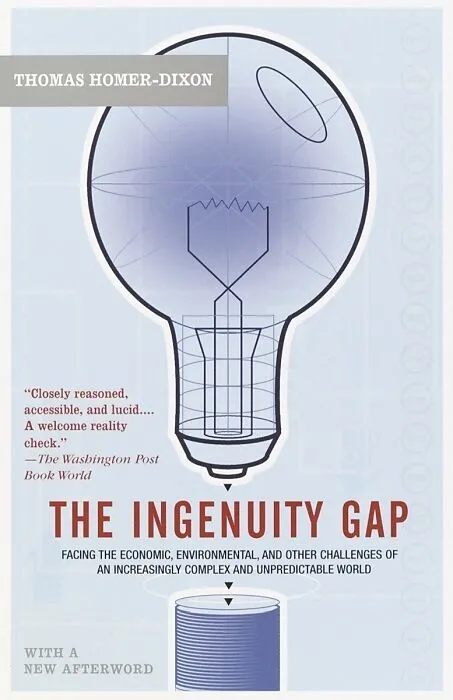
The Ingenuity Gap
Beschreibung
Zusatztext [C]losely reasoned! accessible! and lucid . . . . [A] welcome reality check. -- The Washington Post No other new concept . . . so fully condenses all of the challenges we face as a human civilization as does 'ingenuity gap.' [Homer-Dixon] is one of ...Format auswählen
- Kartonierter EinbandCHF 21.10

Wird oft zusammen gekauft
Andere Kunden kauften auch
Beschreibung
Zusatztext [C]losely reasoned! accessible! and lucid . . . . [A] welcome reality check. -- The Washington Post No other new concept . . . so fully condenses all of the challenges we face as a human civilization as does 'ingenuity gap.' [Homer-Dixon] is one of an elite group of academics who can write for a mass audience. --Robert D. Kaplan This remarkable work! based on an impressive amount of scholarship! travel! and interviews! is the most persuasive forecast of the twenty-first century I have seen.--Edward O. Wilson [R]emarkable . . . compelling! original . . . . This book's intellectual scope is truly sweeping. The Memphis Commercial Appeal Informationen zum Autor Thomas Homer-Dixon is Director of the Peace and Conflict Studies Program and Associate Professor in the Department of Political Science at the University of Toronto. He is the author of Environment, Scarcity, and Violence. He lives in Toronto. Klappentext Despite all of society's advances, our problems proliferate. Wars abound, environmental degradation accelerates, economies topple overnight, and pandemics such as AIDS and tuberculosis continue to spread. The Internet and other media help to disseminate knowledge, but they've also created an "info-glut and left us too little time to process it. What's more, advances in technology have made the world so bewilderingly fast-paced and complex that fewer people are able even to grasp the problems, let alone generate solutions. That space between the problems that arise and our ability to solve them is "the ingenuity gap, and as we careen towards an increasingly harried and hectic future, the gap seems only to widen. As he explores the possible consequences of this gap, Thomas Homer-Dixon offers an absorbing assessment of the state of the world and our ability to fix it. Culling from an astounding array of fields-from economics to evolution, political science to paleontology, computers to communications -he integrates his vast knowledge into an accessible and engaging argument. This is a book with profound implications for everyone that we can ill afford to ignore. CAREENING INTO THE FUTURE At 3:16 p.m. on 19 July, 1989, the jet's tail engine blew apart. Twelve thousand meters above the U.S. Midwest, shards of the engine's fan rotor cut through the rear of the aircraft, shredding its hydraulic systems. As fluid bled from hydraulic tubing, the pilots in the front of the plane lost command of the rudder, elevators, and ailerons essential to stabilizing and guiding the craft. Immediately, the plane twisted into a downward right turn. United Airlines Flight 232 from Denver to Chicago--with 296 people aboard--was out of control. By itself, the failure of the tail engine was not catastrophic: the dc-10 had two other engines, one under each wing. But cockpit gauges showed a complete loss of hydraulic quantity and pressure. When the first officer tried to halt the right turn, the plane didn't respond. As the rightward bank became critical, the captain took over, pulling back on the control column and turning the wheel hard left--but still there was no response. In a last-ditch effort to regain command, he cut power to the left engine and boosted it to the right one. The right wing slowly came up, and the plane rolled back to a horizontal position. The right turn stopped. Yet the situation remained critical. The plane was no longer turning, but it was still losing altitude. The captain sent crew members to look out of the windows in the passenger cabin. They saw that the inboard ailerons were slightly up, the spoilers were locked down, and the horizontal stabilizers were damaged. None of the main flight-control surfaces were moving. And it appeared that the airframe might have suffered structural damage severe enough to cause it to break apart in flight. Back in the cockpit, the captain and first...
#8220;[C]losely reasoned, accessible, and lucid . . . . [A] welcome reality check.” --*The Washington Post
- “No other new concept . . . so fully condenses all of the challenges we face as a human civilization as does ‘ingenuity gap.’ [Homer-Dixon] is one of an elite group of academics who can write for a mass audience.” --Robert D. Kaplan
“This remarkable work, based on an impressive amount of scholarship, travel, and interviews, is the most persuasive forecast of the twenty-first century I have seen.”--Edward O. Wilson
“[R]emarkable . . . compelling, original . . . . This book’s intellectual scope is truly sweeping.” *The Memphis Commercial Appeal
*
Autorentext
Thomas Homer-Dixon is Director of the Peace and Conflict Studies Program and Associate Professor in the Department of Political Science at the University of Toronto. He is the author of Environment, Scarcity, and Violence. He lives in Toronto.
Klappentext
Despite all of society's advances, our problems proliferate. Wars abound, environmental degradation accelerates, economies topple overnight, and pandemics such as AIDS and tuberculosis continue to spread. The Internet and other media help to disseminate knowledge, but they've also created an "info-glut” and left us too little time to process it. What's more, advances in technology have made the world so bewilderingly fast-paced and complex that fewer people are able even to grasp the problems, let alone generate solutions. That space between the problems that arise and our ability to solve them is "the ingenuity gap,” and as we careen towards an increasingly harried and hectic future, the gap seems only to widen.
As he explores the possible consequences of this gap, Thomas Homer-Dixon offers an absorbing assessment of the state of the world and our ability to fix it. Culling from an astounding array of fields-from economics to evolution, political science to paleontology, computers to communications -he integrates his vast knowledge into an accessible and engaging argument. This is a book with profound implications for everyone that we can ill afford to ignore.
Zusammenfassung
Despite all of society’s advances, our problems proliferate. Wars abound, environmental degradation accelerates, economies topple overnight, and pandemics such as AIDS and tuberculosis continue to spread. The Internet and other media help to disseminate knowledge, but they’ve also created an “info-glut” and left us too little time to process it. What’s more, advances in technology have made the world so bewilderingly fast-paced and complex that fewer people are able even to grasp the problems, let alone generate solutions. That space between the problems that arise and our ability to solve them is “the ingenuity gap,” and as we careen towards an increasingly harried and hectic future, the gap seems only to widen.
As he explores the possible consequences of this gap, Thomas Homer-Dixon offers an absorbing assessment of the state of the world and our ability to fix it. Culling from an astounding array of fields–from economics to evolution, political science to paleontology, computers to communications –he integrates his vast knowledge into an accessible and engaging argument. This is a book with profound implications for everyone that we can ill afford to ignore.
Leseprobe
CAREENING INTO THE FUTURE
At 3:16 p.m. on 19 July, 1989, the jet's tail engine blew apart. Twelve thousand meters above the U.S. Midwest, shards of the engine's fan rotor cut through the rear of the aircraft, shredding its hydraulic systems. As fluid bled from hydraulic tubing, the pilots in the front of the plane lost command of the rudder, elevators, and ailerons essential to stabilizing and guiding the craft. Immediately, the plane twisted into a downward right turn. United Airlines Flight 232 from Denver to Chicago--with 296 people aboard--was out of control.
By itself, the failu…