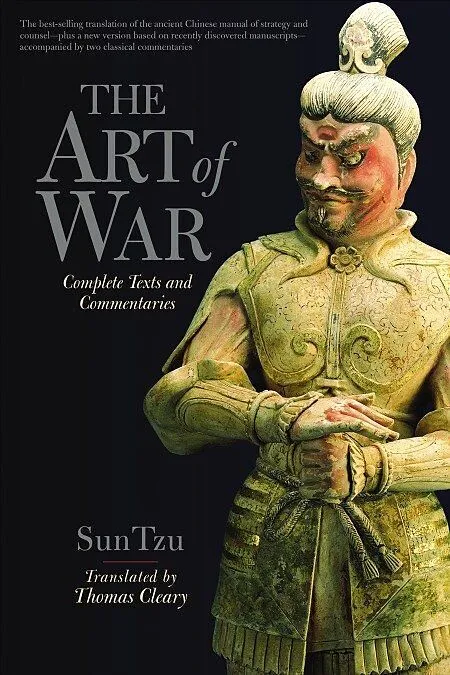
Art of War
Beschreibung
Zusatztext "Thomas Cleary's translation of The Art of War makes immediately relevant one of the greatest Chinese classical texts. There's not a dated maxim or vague prescription in it. . . .You can throw out all those contemporary books about management and le...Format auswählen
- BroschiertCHF 39.90
- E-Book (epub)CHF 6.30

Wird oft zusammen gekauft
Andere Kunden kauften auch
Beschreibung
Zusatztext "Thomas Cleary's translation of The Art of War makes immediately relevant one of the greatest Chinese classical texts. There's not a dated maxim or vague prescription in it. . . .You can throw out all those contemporary books about management and leadership." Newsweek Informationen zum Autor Sun Tzu; translated by Thomas Cleary Klappentext Sun Tzu's Art of War , compiled more than two thousand years ago, is a study of the anatomy of organizations in conflict. It is perhaps the most prestigious and influential book of strategy in the world today. Now, this unique volume brings together the essential versions of Sun Tzu's text, along with illuminating commentaries and auxiliary texts written by distinguished strategists. The translations, by the renowned translator Thomas Cleary, have all been published previously in book form, except for The Silver Sparrow Art of War, which is available here for the first time. This comprehensive collection contains: The Art of War: This edition of Sun Tzu's text includes the classic collection of commentaries by eleven interpreters. Mastering the Art of War: Consisting of essays by two prominent statesmen-generals of Han dynasty China, Zhuge Liang and Liu Ji, this book develops the strategies of Sun Tzu's classic into a complete handbook of organization and leadership. It draws on episodes from Chinese history to show in concrete terms the proper use of Sun Tzu's principles. The Lost Art of War: Written more than one hundred years after Sun Tzu's text, by Sun Bin, a linear descendant of Sun Tzu, this classic of political and military strategy is faithful to the principles of The Art of War , while developing their practical application much further. The Silver Sparrow Art of War: A version of Sun Tzu's Art of War based on a manuscript of the classic text discovered at a Chinese archeological site in China's Shandong Province in 1972, which contains previously unknown fragments. Leseprobe I: LAYING PLANS Sun Tzu said: The art of war is of vital importance to the state. It is a matter of life and death, a road either to safety or to ruin. Hence under no circumstances can it be neglected. The art of war is governed by five constant factors, all of which need to be taken into account. They are: the Moral Law; Heaven; Earth; the Commander; Method and discipline. The Moral Law causes the people to be in complete accord with their ruler, so that they will follow him regardless of their lives, undismayed by any danger. Heaven signifies night and day, cold and heat, times and seasons. Earth comprises distances, great and small; danger and security; open ground and narrow passes; the chances of life and death. The Commander stands for the virtues of wisdom, sincerity, benevolence, courage, and strictness. By Method and discipline are to be understood the marshaling of the army in its proper subdivisions, the gradations of rank among the officers, the maintenance of roads by which supplies may reach the army, and the control of military expenditure. These five factors should be familiar to every general. He who knows them will be victorious; he who knows them not will fail. Therefore, when seeking to determine your military conditions, make your decisions on the basis of a comparison in this wise: Which of the two sovereigns is imbued with the Moral Law? Which of the two generals has the most ability? With whom lie the advantages derived from Heaven and Earth? On which side is discipline most rigorously enforced? Tu Mu alludes to the remarkable story of Ts'ao Ts'ao (A.D. I55 - 220), who was such a strict disciplinarian that once, in accordance with his own...
"Thomas Cleary's translation of The Art of War makes immediately relevant one of the greatest Chinese classical texts. There's not a dated maxim or vague prescription in it. . . .You can throw out all those contemporary books about management and leadership."—Newsweek
Autorentext
Sun Tzu; translated by Thomas Cleary
Klappentext
Sun Tzu's Art of War, compiled more than two thousand years ago, is a study of the anatomy of organizations in conflict. It is perhaps the most prestigious and influential book of strategy in the world today. Now, this unique volume brings together the essential versions of Sun Tzu's text, along with illuminating commentaries and auxiliary texts written by distinguished strategists. The translations, by the renowned translator Thomas Cleary, have all been published previously in book form, except for The Silver Sparrow Art of War, which is available here for the first time. This comprehensive collection contains:
The Art of War: This edition of Sun Tzu's text includes the classic collection of commentaries by eleven interpreters.
Mastering the Art of War: Consisting of essays by two prominent statesmen-generals of Han dynasty China, Zhuge Liang and Liu Ji, this book develops the strategies of Sun Tzu's classic into a complete handbook of organization and leadership. It draws on episodes from Chinese history to show in concrete terms the proper use of Sun Tzu's principles.
The Lost Art of War: Written more than one hundred years after Sun Tzu's text, by Sun Bin, a linear descendant of Sun Tzu, this classic of political and military strategy is faithful to the principles of The Art of War, while developing their practical application much further.
The Silver Sparrow Art of War: A version of Sun Tzu's Art of War based on a manuscript of the classic text discovered at a Chinese archeological site in China's Shandong Province in 1972, which contains previously unknown fragments.
Leseprobe
I: LAYING PLANS
Sun Tzu said:
The art of war is of vital importance to the state. It is a matter of life and death, a road either to safety or to ruin. Hence under no circumstances can it be neglected.
The art of war is governed by five constant factors, all of which need to be taken into account. They are: the Moral Law; Heaven; Earth; the Commander; Method and discipline.
The Moral Law causes the people to be in complete accord with their ruler, so that they will follow him regardless of their lives, undismayed by any danger.
Heaven signifies night and day, cold and heat, times and seasons.
Earth comprises distances, great and small; danger and security; open ground and narrow passes; the chances of life and death.
The Commander stands for the virtues of wisdom, sincerity, benevolence, courage, and strictness.
By Method and discipline are to be understood the marshaling of the army in its proper subdivisions, the gradations of rank among the officers, the maintenance of roads by which supplies may reach the army, and the control of military expenditure.
These five factors should be familiar to every general. He who knows them will be victorious; he who knows them not will fail.
Therefore, when seeking to determine your military conditions, make your decisions on the basis of a comparison in this wise:
Which of the two sovereigns is imbued with the Moral Law?
Which of the two generals has the most ability?
With whom lie the advantages derived from Heaven and Earth?
On which side is discipline most rigorously enforced?
Tu Mu alludes to the remarkable story of Ts'ao Ts'ao (A.D. I55 - 220), who was such a strict disciplinarian that once, in accordance with his own severe regulations against injury to standing crops, he condemned himself to death for having allowed his horse to stray into a field of corn! However, in lieu of losing his head, he was persuaded to satisfy his sense of justice by cutting off his hair. "When you lay down a law, see that it is not disobeyed; if it is disobeyed, the offender must be put to death."
Which army is the stronger?
On which side are officers and men more highly trained?
In which army is there the mos…