
IHR WARENKORB IST AKTUELL LEER.
Haben Sie noch nichts passendes gefunden? Stöbern Sie durch unser komplettes Sortiment.
Oder melden Sie sich an bzw. registrieren Sie sich.
- Kostenlose Lieferung
- Kauf auf Rechnung
- Ex Libris Tiefpreis
- Filiallieferung und 650+ Abholorte
- Rabatt-Bons als Club-Mitglied
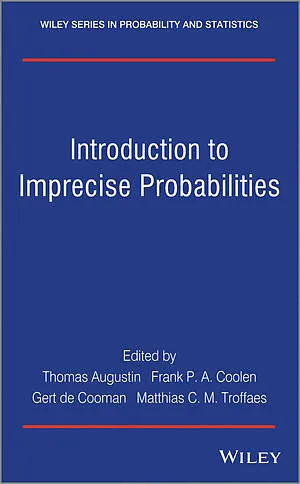
Introduction to Imprecise Probabilities
Beschreibung
Informationen zum Autor Thomas Augustin, Department of Statistics, University of Munich, Germany. Frank Coolen, Department of Mathematical Sciences, Durham University, UK. Gert de Cooman, Research Professor in Uncertainty Modelling and Systems Science, Ghent U...Format auswählen
- Fester EinbandCHF 144.40

Wird oft zusammen gekauft
Andere Kunden kauften auch
Beschreibung
Informationen zum Autor Thomas Augustin, Department of Statistics, University of Munich, Germany. Frank Coolen, Department of Mathematical Sciences, Durham University, UK. Gert de Cooman, Research Professor in Uncertainty Modelling and Systems Science, Ghent University, Belgium. Matthias Troffaes, Department of Mathematical Sciences, Durham University, UK. Klappentext In recent years, the theory has become widely accepted and has been further developed, but a detailed introduction is needed in order to make the material available and accessible to a wide audience. This will be the first book providing such an introduction, covering core theory and recent developments which can be applied to many application areas. All authors of individual chapters are leading researchers on the specific topics, assuring high quality and up-to-date contents.An Introduction to Imprecise Probabilities provides a comprehensive introduction to imprecise probabilities, including theory and applications reflecting the current state if the art. Each chapter is written by experts on the respective topics, including: Sets of desirable gambles; Coherent lower (conditional) previsions; Special cases and links to literature; Decision making; Graphical models; Classification; Reliability and risk assessment; Statistical inference; Structural judgments; Aspects of implementation (including elicitation and computation); Models in finance; Game-theoretic probability; Stochastic processes (including Markov chains); Engineering applications.Essential reading for researchers in academia, research institutes and other organizations, as well as practitioners engaged in areas such as risk analysis and engineering. Zusammenfassung In recent years, the theory has become widely accepted and has been further developed, but a detailed introduction is needed in order to make the material available and accessible to a wide audience. This will be the first book providing such an introduction, covering core theory and recent developments which can be applied to many application areas. All authors of individual chapters are leading researchers on the specific topics, assuring high quality and up-to-date contents.An Introduction to Imprecise Probabilities provides a comprehensive introduction to imprecise probabilities, including theory and applications reflecting the current state if the art. Each chapter is written by experts on the respective topics, including: Sets of desirable gambles; Coherent lower (conditional) previsions; Special cases and links to literature; Decision making; Graphical models; Classification; Reliability and risk assessment; Statistical inference; Structural judgments; Aspects of implementation (including elicitation and computation); Models in finance; Game-theoretic probability; Stochastic processes (including Markov chains); Engineering applications.Essential reading for researchers in academia, research institutes and other organizations, as well as practitioners engaged in areas such as risk analysis and engineering. Inhaltsverzeichnis Introduction xiii A brief outline of this book xv Guide to the reader xvii Contributors xxi Acknowledgements xxvii 1 Desirability 1 Erik Quaeghebeur 1.1 Introduction 1 1.2 Reasoning about and with sets of desirable gambles 2 1.2.1 Rationality criteria 2 1.2.2 Assessments avoiding partial or sure loss 3 1.2.3 Coherent sets of desirable gambles 4 1.2.4 Natural extension 5 1.2.5 Desirability relative to subspaces with arbitrary vector orderings 5 1.3 Deriving and combining sets of desirable gambles 6 1.3.1 Gamble space transformations 6 1.3.2 Derived coherent sets of desirable gambles 7 1.3.3 Conditional sets of desirable gambles 8 1.3.4 Marginal sets of desirable gambles 8 1.3.5 Combining sets of desir...
Autorentext
Thomas Augustin, Department of Statistics, University of Munich, Germany. Frank Coolen, Department of Mathematical Sciences, Durham University, UK. Gert de Cooman, Research Professor in Uncertainty Modelling and Systems Science, Ghent University, Belgium. Matthias Troffaes, Department of Mathematical Sciences, Durham University, UK.
Klappentext
In recent years, the theory has become widely accepted and has been further developed, but a detailed introduction is needed in order to make the material available and accessible to a wide audience. This will be the first book providing such an introduction, covering core theory and recent developments which can be applied to many application areas. All authors of individual chapters are leading researchers on the specific topics, assuring high quality and up-to-date contents. An Introduction to Imprecise Probabilities provides a comprehensive introduction to imprecise probabilities, including theory and applications reflecting the current state if the art. Each chapter is written by experts on the respective topics, including: Sets of desirable gambles; Coherent lower (conditional) previsions; Special cases and links to literature; Decision making; Graphical models; Classification; Reliability and risk assessment; Statistical inference; Structural judgments; Aspects of implementation (including elicitation and computation); Models in finance; Game-theoretic probability; Stochastic processes (including Markov chains); Engineering applications. Essential reading for researchers in academia, research institutes and other organizations, as well as practitioners engaged in areas such as risk analysis and engineering.
Inhalt
Introduction xiii
A brief outline of this book xv
Guide to the reader xvii
Contributors xxi
Acknowledgements xxvii
**1 Desirability 1
** Erik Quaeghebeur
1.1 Introduction 1
1.2 Reasoning about and with sets of desirable gambles 2
1.2.1 Rationality criteria 2
1.2.2 Assessments avoiding partial or sure loss 3
1.2.3 Coherent sets of desirable gambles 4
1.2.4 Natural extension 5
1.2.5 Desirability relative to subspaces with arbitrary vector orderings 5
1.3 Deriving and combining sets of desirable gambles 6
1.3.1 Gamble space transformations 6
1.3.2 Derived coherent sets of desirable gambles 7
1.3.3 Conditional sets of desirable gambles 8
1.3.4 Marginal sets of desirable gambles 8
1.3.5 Combining sets of desirable gambles 9
1.4 Partial preference orders 11
1.4.1 Strict preference 12
1.4.2 Nonstrict preference 12
1.4.3 Nonstrict preferences implied by strict ones 14
1.4.4 Strict preferences implied by nonstrict ones 15
1.5 Maximally committal sets of strictly desirable gambles 16
1.6 Relationships with other, nonequivalent models 18
1.6.1 Linear previsions 18
1.6.2 Credal sets 19
1.6.3 To lower and upper previsions 21
1.6.4 Simplified variants of desirability 22
1.6.5 From lower previsions 23
1.6.6 Conditional lower previsions 25
1.7 Further reading 26
Acknowledgements 27
**2 Lower previsions 28
** Enrique Miranda and Gert de Cooman
2.1 Introduction 28
2.2 Coherent lower previsions 29
2.2.1 Avoiding sure loss and coherence 31
2.2.2 Linear previsions 35
2.2.3 Sets of desirable gambles 39
2.2.4 Natural extension 40
2.3 Conditional lower previsions 42
2.3.1 Coherence of a finite number of conditional lower previsions 45
2.3.2 Natural extension of conditional lower previsions 47
2.3.3 Coherence of an unconditional and a conditional lower prevision 49
2.3.4 Updating with the regular extension 52
2.4 Further reading 53
2.4.1 The work of Williams 53
2.4.2 The work of Kuznetsov 54
2.4.3 The work of Weichselberger 54
Acknowledgements 55
**3 Structural judgements 56
** Enrique Miranda and Gert de Cooman
3.1 Introduction 56
3.2 Irrelevance and independence 57
3.2.1 Epistemic irrelevance 59
3.2.2 Epistemic independence 61
3.2.3 Envelopes of independent precise models 63
3.2.4 Strong independence 65
3.2.5 The formalist approach to independence 66
3.3 Invariance 67
3.3.1 Weak invariance 68
3.3.2 Str…