China and the International Astronomical Union
Beschreibung
Seen from inside the IAU, this book tells the in-depth story of a major crisis in which China divorced from the International Astronomical Union in 1960 as a protest against the admission of Taiwan. This happened to all the scientific unions at the same time,...Format auswählen
- Kartonierter EinbandCHF 156.40
- Fester EinbandCHF 141.15
- E-Book (pdf)CHF 165.50

Wird oft zusammen gekauft
Andere Kunden kauften auch
Beschreibung
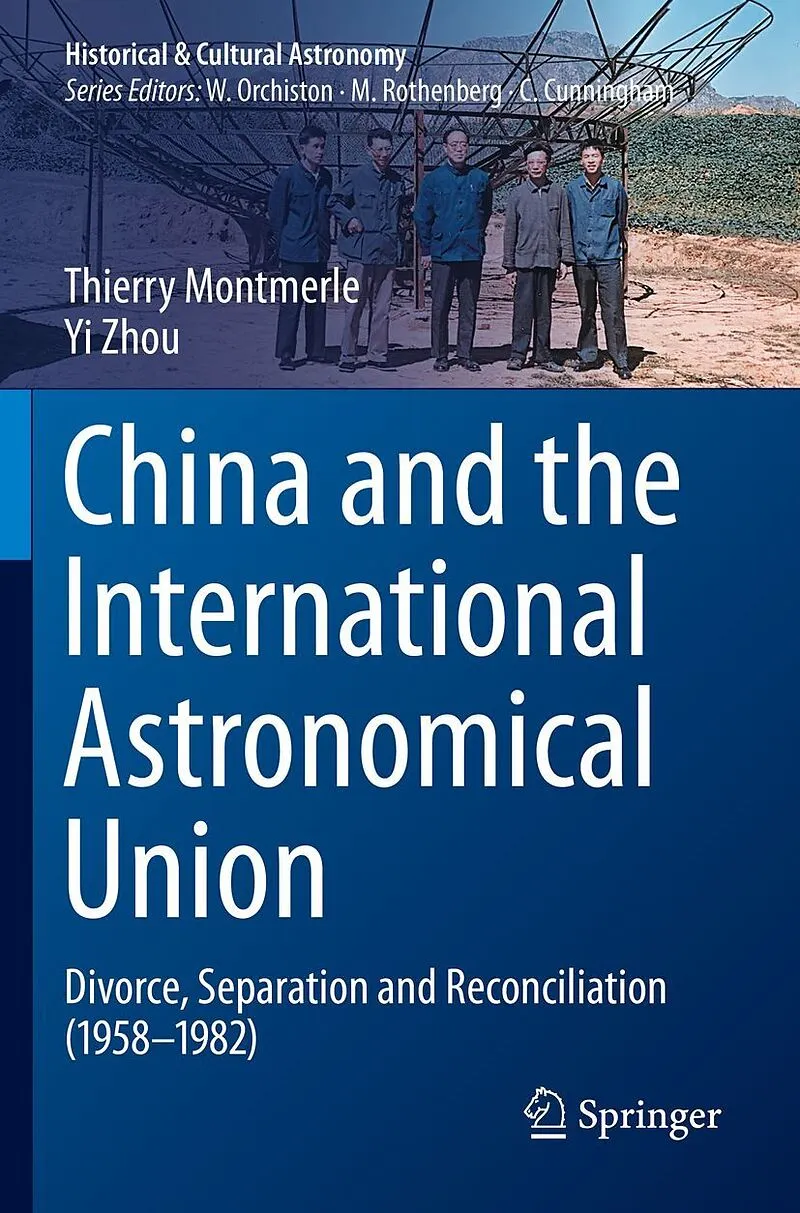
Seen from inside the IAU, this book tells the in-depth story of a major crisis in which China divorced from the International Astronomical Union in 1960 as a protest against the admission of Taiwan. This happened to all the scientific unions at the same time, and to the Olympic Games, which, unexpectedly, would serve as a laboratory for the reconciliation which took place following the re-opening of China to the world 20 years later.
The so-called China conflict is the most important crisis in the post-WWII history of the IAU. Yet, many details about this conflict and its links to broader geopolitical events have long remained unsettled, obscure, or altogether absent. In particular, the book describes for the first time the separation period, which covered the Cultural Revolution, and in which the IAU made desperate official efforts to reach out to China, while some groups of Western and Chinese astronomers managed to keep contact at times. On the occasion of the IAU Centenary celebrations in 2019, the book revisits this painful succession of events using unpublished documents from the IAU Archives and the International Council of Scientific Unions. The book also contains supplementary typescripts of selected handwritten correspondences and the full translation of key original Chinese documents unknown to readers outside China.
What emerges is a complex and fascinating story of human relations and science diplomacy under the shadow of the Cold War. Readers will learn how the 20-year China conflict as lived by astronomers and scientists is important not only for the history of the IAU, but also for the history of contemporary China.
This book is full of so many original documents of the IAU office, very reliable and good to open to the public readers. Shuhua Ye, Shanghai Observatory (IAU Vice-President, 1988-1994)
This book is a companion book to "Astronomers as Diplomats," published at the same time in the same series.
Tells the full history of the 20-year crisis in which China withdrew from the IAU Based on unpublished documents from the IAU Archives and from previously untranslated Chinese original documents Contains typescripts of selected handwritten correspondences and the full translation of key Chinese documents
Autorentext
Thierry Montmerle is currently Director of Research with the Institut d'Astrophysique de Paris. His main area of scientific expertise can be summarized as "High-energy phenomena in star-forming regions", but he also has interest in planet formation and astrobiology. He has published nearly 400 papers and organized many international conferences, serving as Co-Editor of their proceedings. A graduate of the Ecole Normale Supéreure in Paris, he obtained his Ph.D. in astrophysics in 1975. He spent most of his career as staff member of CEA, the French Atomic Energy Commission (Service d'Astrophysique), and took a leave as Director of the Laboratoire d'Astrophysique de Grenoble from 2006 to 2010. He has been General Secretary of the International Astronomical Union (IAU) from 2012 to 2015. During the IAU General Assembly in Vienna (2018), he participated actively in the Symposium celebrating the IAU Centenary (the Union had been created in 1919 along with several other scientific Unions), and he organized an international conference in Paris in October 2019, entitled "Astronomers as Diplomats", focusing on the role of the IAU in scientific diplomacy in the times of international crises. He edited and authored several books including part of the Proceedings and "IAU Transactions" of the Beijing (2012) and Honolulu (2015) General Assemblies, as well as "Young Sun, Early Earth, and the Origin of Life" (2012) and the Encyclopedia of Astrobiology (2015+). Based on the Paris "Astronomers as Diplomats" conference, he has co-authored two books for Springer's Historical and Cultural Astronomy Series: (i) "Astronomers as Diplomats: When the IAU builds bridges between nations", co-edited with Danielle Fauque (Orsay); (ii) "China and the IAU: Divorce, Separation, and Reconciliation (1958-1982)", with a Chinese co-author (Yi Zhou). The present book ("The two lives of Cheng Maolan") is the third volume of the "trilogy" stemming from the Paris Conference. Yi Zhou (first name: Yi, family name: Zhou) is a seasoned Journalist/Translator/Researcher, born in Xi'an, China. He is now based in Paris, where he is a "curious observer" of current world events. He is passionate about contemporary history and investigative journalism. He has worked for the Chinese service of the French public radio station "Radio France International" (RFI) since 2015. Previously, he finished high school in Columbus, Ohio, USA, and he went on studying in France at "Sciences Po" (the Institut d'Etudes Politiques de Paris) for both his Bachelor's and Master's degrees, specializing in political and social sciences. He obtained a Master's degree in International Affairs and Development from the Paris School of International Affairs (PSIA) of Sciences Po. Coming from China and having studied in the USA, France and the Netherlands, this has given him a special set of understanding skills and rare experience in dealing with cross regional and international political and social subjects. Yves Gomas is a former high school physics and chemistry teacher and middle school headmaster. He obtained his PhD in 2017 in History of Science from Lyon University, with a biography of Jean Dufay (1896-1967), Director of the Lyon Observatory and founder of the Haute-Provence Observatory. Yves Gomas is now an associate researcher in history of science at University of Lyon 1. He is studying the history of observatories, astronomers and astronomical instrumentation, particularly in Lyon and Haute Provence. He is currently writing articles for Springer's Biographical Encyclopedia of Astronomers.
Klappentext
- Introduction and Outline. - 2. Historical and Geopolitical Background. - 3. The Divorce. - 4. China vs. Taiwan: A General Problem for Scientific Unions. - 5. Living in Separate Worlds. - 6. The Question of Taiwan: Pressure from UNESCO. - 7. The Uncertain Road to Reconciliation. - 8. Conclusions. - 9. Epilogue. - Appendix A: A "Personal Account" by D. Sadler (1976) of the Admission of Taiwan to the IAU. - Appendix B: IAU Archival Documents (1958-1979). - Appendix C: A Visit to China Astronomy in 1979. - Appendix D: Under One Starry Sky-The History of the International Astronomy Union (IAU).
Inhalt
- Introduction and Outline. - 2. Historical and Geopolitical Background. - 3. The Divorce. - 4. China vs. Taiwan: A General Problem for Scientific Unions. - 5. Living in Separate Worlds. - 6. The Question of Taiwan: Pressure from UNESCO. - 7. The Uncertain Road to Reconciliation. - 8. Conclusions. - 9. Epilogue. - Appendix A: A Personal Account by D. Sadler (1976) of the Admission of Taiwan to the IAU. - Appendix B: IAU Archival Documents (19581979). - Appendix C: A Visit to China Astronomy in 1979. - Appendix D: Under One Starry SkyThe History of the International Astronomy Union (IAU).


