
IHR WARENKORB IST AKTUELL LEER.
Haben Sie noch nichts passendes gefunden? Stöbern Sie durch unser komplettes Sortiment.
Oder melden Sie sich an bzw. registrieren Sie sich.
- Kostenlose Lieferung
- Kauf auf Rechnung
- Ex Libris Tiefpreis
- Filiallieferung und 650+ Abholorte
- Rabatt-Bons als Club-Mitglied
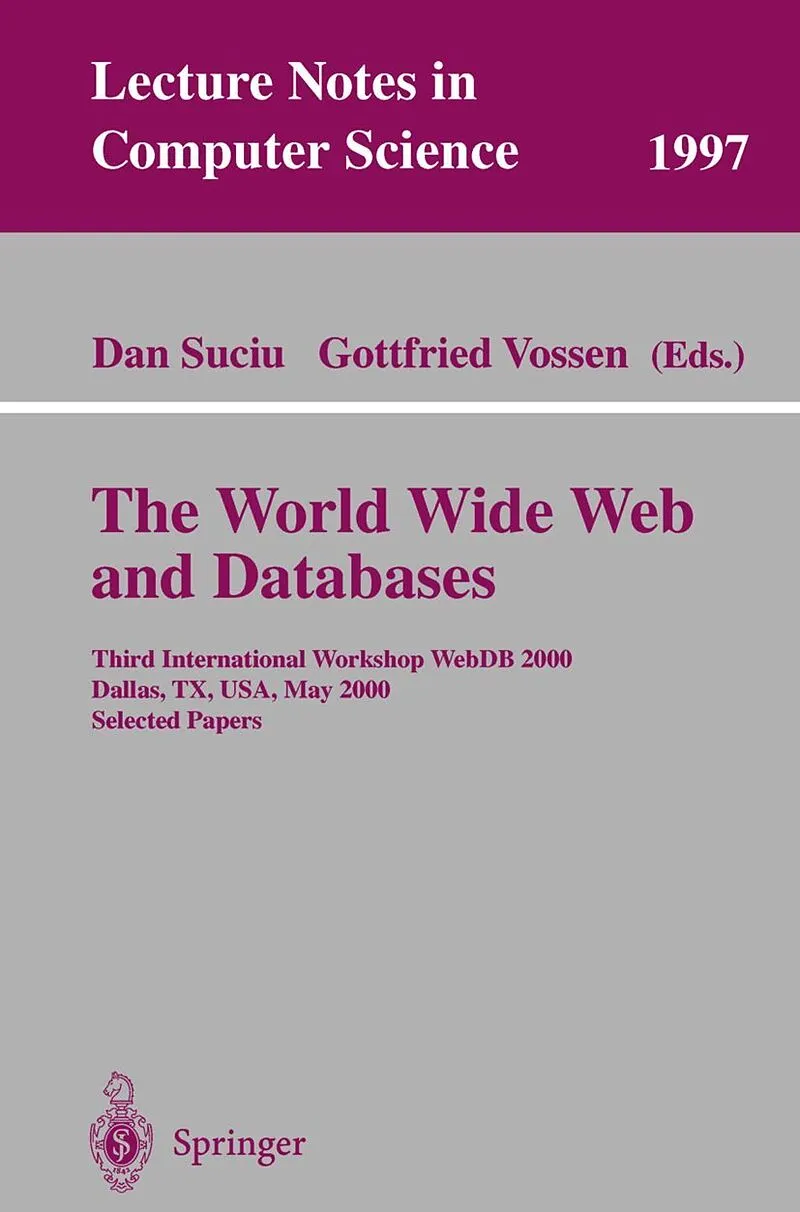
The World Wide Web and Databases
Beschreibung
With the development of the World-Wide Web, data management problems have branched out from the traditional framework in which tabular data is processed under the strict control of an application, and address today the rich variety of information that is found...Format auswählen
- Kartonierter EinbandCHF 84.80
- E-Book (pdf)CHF 47.50

Wird oft zusammen gekauft
Andere Kunden kauften auch
Beschreibung
With the development of the World-Wide Web, data management problems have branched out from the traditional framework in which tabular data is processed under the strict control of an application, and address today the rich variety of information that is found on the Web, considering a variety of ?exible envir- ments under which such data can be searched, classi ed , and processed. Da- base systems are coming forward today in a new role as the primary backend for the information provided on the Web. Most of today's Web accesses trigger some form of content generation from a database, while electronic commerce often triggers intensive DBMS-based applications. The research community has begun to revise data models, query languages, data integration techniques, - dexes, query processing algorithms, and transaction concepts in order to cope with the characteristics and scale of the data on the Web. New problems have been identi ed , among them goal-oriented information gathering, management of semi-structured data, or database-style query languages for Web data, to name just a few. The International Workshop on the Web and Databases (WebDB) is a series of workshops intended to bring together researchers interested in the interaction between databases and the Web. This year's WebDB 2000 was the third in the series, and was held in Dallas, Texas, in conjunction with the ACM SIGMOD International Conference on Management of Data.
Includes supplementary material: sn.pub/extras
Autorentext
Dan Suciu is a Professor in Computer Science at the University of Washington. He received his Ph.D. from the University of Pennsylvania in 1995, then was a principal member of the technical staff at AT&T Labs until he joined the University of Washington in 2000. Professor Suciu is conducting research in data management, with an emphasis on topics that arise from sharing data on the Internet, such as management of semistructured and heterogeneous data, data security, and managing data with uncertainties. He is a co-author of the book Data on the Web: from Relations to Semistructured Data and XML. He holds twelve US patents, received the 2000 ACM SIGMOD Best Paper Award, the 2010 PODS Ten Years Best paper award, and is a recipient of the NSF Career Award and of an Alfred P. Sloan Fellowship. Suciu's PhD students Gerome Miklau and Christopher Re received the ACM SIGMOD Best Dissertation Award in 2006 and 2010, respectively, and Nilesh Dalvi was a runner up in 2008. Dan Olteanu is a University Lecturer (equivalent of Assistant Professor in North America) in the Department of Computer Science at the University of Oxford and Fellow of St. Cross College since September 2007. He received his Dr. rer. nat. in Computer Science from Ludwig Maximilian University of Munich in 2005. Before joining Oxford, he was post-doctoral researcher with Professor Christoph Koch at Saarland University, visiting scientist at Cornell University, and temporary professor at Ruprecht Karl University in Heidelberg. His main research is on theoretical and system aspects of data management, with a current focus on Web data, provenance information, and probabilistic databases. Christopher (Chris) Re is currently an Assistant Professor in the department of Computer Sciences at the University of Wisconsin-Madison. The goal of his work is to enable users and developers to build applications that more deeply understand data. In many applications, machines can only understand the meaning of data statistically, e.g., user-generated text or data from sensors. To attack this challenge, Chris's recent work is to build a system, Hazy, that integrates a handful of statistical operators with a standard relational database management system. To support this work, Chris received the NSF CAREER Award in 2011. Chris received his PhD from the University of Washington, Seattle under the supervision of Dan Suciu. For his PhD work in the area of probabilistic data management, Chris received the SIGMOD 2010 Jim Gray Dissertation Award. His PhD work produced two systems: Mystiq, a system to manage relational probabilistic data, and Lahar, a streaming probabilistic database. Christoph Koch is a Professor of Computer Science at Ecole Polytechnique Federale de Lausanne (EPFL) in Lausanne, Switzerland. He is interested in both the theoretical and systems-oriented aspects of data management, and he currently works on managing uncertain and probabilistic data, research at the intersection of databases, programming languages, and compilers, community data management systems, and data-driven games. He received his PhD from TU Vienna, Austria, in 2001, for research done at CERN, Switzerland and subsequently held positions at TU Vienna (2001-2002; 2003-2005), the University of Edinburgh (2002-2003), Saarland University (2005-2007), and Cornell University (2006; 2007-2010), before joining EPFL in 2010. He won best paper awards at PODS 2002, and SIGMOD 2011, a Google Research Award (2009), and has been PC co-chair of DBPL 2005, WebDB 2008, and ICDE 2011. Frank Schönthaler is managing partner and CEO of the PROMATIS group. He is responsible for corporate and product strategies and manages the core operating business. As Executive Consultant, he advises international clients in strategy development and business reengineering. He is the leader of the Business solutions community at the DOAG - German Oracle users group.Gottfried Vossen is a Professor of Computer Science in the Department of Information Systems at the University of Münster in Germany. Since 2004 he has been a Director of the European Research Center for Information Systems (ERCIS) in Muenster. His research interests include conceptual as well as application-oriented problems concerning databases, information systems, process modeling, and various forms of Web 2.0 applications as well as implications. Andreas Oberweis is Professor for Applied Informatics at the Karlsruhe Institute of Technology (KIT). Since 2004 he is also Director at the Research Center for Information Technology (FZI) Karlsruhe. He received a Doctoral Degree in Informatics from University of Mannheim in 1990 and a Habilitation Degree in Applied Informatics from University of Karlsruhe in 1995. From 1995 to 2003 he was Professor for Information Systems Development at Goethe University in Frankfurt/Main. His research interests are in the field of business process engineering and information systems development.Thomas Karle manages the business applications division at PROMATIS software GmbH. In this role, he is responsible for international customer projects implementing Oracle Applications and Oracle BPM solutions. He also advises large and medium-sized enterprises in the creation of comprehensive business process management systems and in IT strategy and architecture issues. Thomas Karle manages the business applications division at PROMATIS software GmbH. In this role, he is responsible for international customer projects implementing OracleApplications and Oracle BPM solutions. He also advises large and medium-sized enterprises in the creation of comprehensive business process management systems and in IT strategy and architecture issues.
Inhalt
Invited Contribution.- Quilt: An XML Query Language for Heterogeneous Data Sources.- Information Gathering.- Theme-Based Retrieval of Web News.- Using Metadata to Enhance Web Information Gathering.- Architecting a Network Query Engine for Producing Partial Results.- Caching.- Argos: Efficient Refresh in an XQL-Based Web Caching System.- Active Query Caching for Database Web Servers.- Querying XML.- Adding Relevance to XML.- Evaluating Queries on Structure with eXtended Access Support Relations.- Efficient Relational Storage and Retrieval of XML Documents.- XML Structuring and Versioning.- XML and Object-Relational Database Systems Enhancing Structural Mappings Based on Statistics.- Everything You Ever Wanted to Know About DTDs, …
Produktinformationen
Weitere Produkte aus der Reihe "Lecture Notes in Computer Science"


Tief- preis
- The World Wide Web and Databases