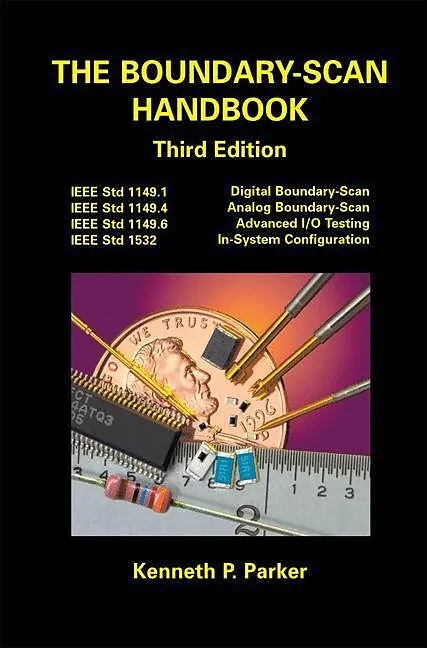
The Boundary - Scan Handbook
Beschreibung
In February of 1990, the balloting process for the IEEE proposed standard P1149.1 was completed creating IEEE Std 1149.1-1990. Later that summer, in record time, the standard won ratification as an ANSI standard as well. This completed over six years of intens...Format auswählen

Wird oft zusammen gekauft
Andere Kunden kauften auch
Beschreibung
In February of 1990, the balloting process for the IEEE proposed standard P1149.1 was completed creating IEEE Std 1149.1-1990. Later that summer, in record time, the standard won ratification as an ANSI standard as well. This completed over six years of intensive cooperative effort by a diverse group of people who share a vision on solving some of the severe testing problems that exist now and are steadily getting worse. Early in this process, someone asked me if 1 thought that the P1l49.l effort would ever bear fruit. 1 responded somewhat glibly that "it was anyone's guess". Well, it wasn't anyone's guess, but rather the faith of a few individuals in the proposition that many testing problems could be solved if a multifaceted industry could agree on a standard for all to follow. Four of these individuals stand out; they are Harry Bleeker, Colin Maunder, Rodham Tulloss, and Lee Whetsel. In that I am convinced that the 1149.1 standard is the most significant testing development in the last 20 years, I personally feel a debt of gratitude to them and all the people who labored on the various Working Groups in its creation.
Klappentext
The fundamental 1149.1 standard is now over 13 years old and has a large infrastructure of support in the electronics industry. Today, a majority of custom ICs and Programmable Logic Devices have 1149.1 implementations. The Boundary-Scan Handbook, Third Edition updates the information about 1149.1, which has been revised as recently as 2001. It contains a description of the 1149.4 "Analog Boundary-Scan" standard, and gives a tutorial on analog testing technology. It then introduces the recently released IEEE 1149.6 "Advanced I/O" standard, which extends Boundary-Scan to deal with AC-coupled differential signaling now becoming common in higher performance system. Finally, since a board test system provides a suitable environment for programming non-volatile Programmable Logic Devices, the IEEE 1532 standard is described which extends the 1149.1 access protocol into the device programming domain. This forms an essential tools for testing boards and systems of the future.
Zusammenfassung
Boundary-Scan, formally known as IEEE/ANSI Standard 1149.1-1990, is a collection of design rules applied principally at the Integrated Circuit (IC) level. This book intends to describe these standards in simple English, rather than the strict and pedantic legalese encountered in the standards.
Inhalt
1 Boundary-Scan Basics and Vocabulary.- 1.1 Digital Test Before Boundary-Scan.- 1.1.1 Edge-Connector Functional Testing.- 1.1.2 In-Circuit Testing.- 1.2 The Philosophy of 1149.1.- 1.3 Basic Architecture.- 1.3.1 The TAP Controller.- 1.3.2 The Instruction Register.- 1.3.3 Data Registers.- 1.3.4 The Boundary Register.- 1.3.5 Optimizing a Boundary Register Cell Design.- 1.3.6 Architecture Summary.- 1.3.7 Field-Programmable IC Devices.- 1.3.8 Boundary-Scan Chains.- 1.4 Non-Invasive Operational Modes.- 1.4.1 BYPASS.- 1.4.2 IDCODE.- 1.4.3 USERCODE.- 1.4.4 SAMPLE.- 1.4.5 PRELOAD.- 1.5 Pin-Permission Operational Modes.- 1.5.1 EXTEST.- 1.5.2 INTEST.- 1.5.3 RUNBIST.- 1.5.4 HIGHZ.- 1.5.5 CLAMP.- 1.5.6 Exceptions Due to Clocking.- 1.6 Extensibility.- 1.7 Subordination of IEEE 1149.1.- 1.8 Costs and Benefits.- 1.8.1 Costs.- 1.8.2 Benefits.- 1.8.3 Trends.- 1.9 Other Testability Standards.- 2 Boundary-Scan Description Language (BSDL).- 2.1 The Scope of BSDL.- 2.1.1 Testing.- 2.1.2 Compliance Assurance.- 2.1.3 Synthesis.- 2.2 Structure of BSDL.- 2.3 Entity Descriptions.- 2.3.1 Generic Parameter.- 2.3.2 Logical Port Description.- 2.3.3 Standard USE Statement.- 2.3.4 Use Statements.- 2.3.5 Component Conformance Statement.- 2.3.6 Device Package Pin Mappings.- 2.3.7 Grouped Port Identification.- 2.3.8 TAP Port Identification.- 2.3.9 Compliance Enable Description.- 2.3.10 Instruction Register Description.- 2.3.11 Optional Register Description.- 2.3.12 Register Access Description.- 2.3.13 Boundary-Scan Register Description.- 2.3.14 RUNBIST Execution Description.- 2.3.15 INTEST Execution Description.- 2.3.16 User Extensions to BSDL.- 2.3.17 Design Warnings.- 2.4 Some advanced BSDL Topics.- 2.4.1 Merged Cells.- 2.4.2 Asymmetrical Drivers.- 2.5 BSDL Description of 74BCT8374.- 2.6 Packages and Package Bodies.- 2.6.1 STD_1149_1_2001.- 2.6.2 Cell Description Constants.- 2.6.3 Basic Cell Definitions BCO to BC7.- 2.6.4 Cells BC_8 to BC_10 Introduced in 2001.- 2.6.5 User-Defined Boundary Cells.- 2.6.6 Definition of BSDL Extensions.- 2.7 Writing BSDL.- 2.8 Summary.- 3 Boundary-Scan Testing.- 3.1 Basic Boundary-Scan Testing.- 3.1.1 The 1149.1 Scanning Sequence.- 3.1.2 Basic Test Algorithm.- 3.1.3 The "Personal Tester" Versus ATE.- 3.1.4 In-Circuit Boundary-Scan.- 3.1.5 IC Test.- 3.1.6 ICBIST.- 3.2 Testing with Boundary-Scan Chains.- 3.2.1 1149.1 Chain Integrity.- 3.2.2 Interconnect Test.- 3.2.3 Connection Tests.- 3.2.4 Interaction Tests.- 3.2.5 BIST and Custom Tests.- 3.3 Porting Boundary-Scan Tests.- 3.4 Boundary-Scan Test Coverage.- 3.5 Summary.- 4 Advanced Boundary-Scan Topics.- 4.1 DC Parametric IC Tests.- 4.2 Sample Mode Tests.- 4.3 Concurrent Monitoring.- 4.4 Non-Scan IC Testing.- 4.5 Non-Digital Device Testing.- 4.6 Mixed Digital/Analog Testing.- 4.7 Multi-Chip Module Testing.- 4.8 Firmware Development Support.- 4.9 In-System Configuration.- 4.10 Flash Programming.- 4.11 Hardware Fault Insertion.- 4.12 Power Pin Testing.- 5 Design for Boundary-Scan Test.- 5.1 Integrated Circuit Level DFT.- 5.1.1 TAP Pin Placement.- 5.1.2 Power and Ground Distribution.- 5.1.3 Instruction Capture Pattern.- 5.1.4 Damage Resistant Drivers.- 5.1.5 Output Pins.- 5.1.6 Bidirectional Pins.- 5.1.7 Post-Lobotomy Behavior.- 5.1.8 IDCODEs.- 5.1.9 User-Defined Instructions.- 5.1.10 Creation and Verification of BSDL.- 5.2 Board-Level DFT.- 5.2.1 Chain Configurations.- 5.2.2 TCK/TMS Distribution.- 5.2.3 Mixed Logic Families.- 5.2.4 Board Level Conflicts.- 5.2.5 Control of Critical Nodes.- 5.2.6 Power Distribution.- 5.2.7 Boundary-Scan Masters.- 5.2.8 Post-Lobotomy Board Behavior.- 5.3 System-Level DFT.- 5.3.1 The MultiDrop Problem.- 5.3.2 Coordination with Other Standards.- 5.4 Summary.- 6 Analog Measurement Basics.- 6.1 Analog In-Circuit Testing.- 6.1.1 Analog Failures.- 6.1.2 Measuring an Impedance.- 6.1.3 Errors and Corrections.- 6.1.4 Measurement Hardware.- 6.2 Limited Access Testing.- 6.2.1 Node Voltage Analysis.- 6.2.2 Testing With Node Voltages.- 6.2.3 Limited Access Node Voltage Testing.- 6.2.4 The Mixed-Signal Test Environment.- 6.2.5 Summary.- 7 IEEE 1149.4: Analog Boundary-Scan.- 7.1 1149.4 Vocabulary and Basics.- 7.1.1 The Target Fault Spectrum.- 7.1.2 Extended Interconnect.- 7.1.3 Digital Pins.- 7.1.4 Analog Pins.- 7.2 General Architecture of an 1149.4 IC.- 7.2.1 Silicon "Switches".- 7.2.2 The Analog Test Access Port (ATAP).- 7.2.3 The Test Bus Interface Circuit (TBIC).- 7.2.4 The Analog Boundary Module (ABM).- 7.2.5 The Digital Boundary Module (DBM).- 7.3 The 1149.4 Instruction Set.- 7.3.1 The EXTEST Instruction.- 7.3.2 The CLAMP Instruction.- 7.3.3 The HIGHZ Instruction.- 7.3.4 The PROBE Instruction.- 7.3.5 The RUNBIST Instruction.- 7.3.6 The INTEST Instruction.- 7.4 Other Provisions of 1149.4.- 7.4.1 Differential ATAP Port.- 7.4.2 Differential I/O.- 7.4.3 Partitioned Internal Test Buses.- 7.4.4 Specifications and Limits.- 7.5 Design for 1149.4 Testability.- 7.5.1 Integrated Circuit Level.- 7.5.2 Board Level.- 7.5.3 System Level.- 7.6 Summary.- 8 IEEE 1149.6: Testing Advanced I/O.- 8.1 The Advanced I/O Problem.- 8.1.1 Traditional Inter-IC Communication.- 8.1.2 Advanced Inter-IC Communication.- 8.1.3 AC Coupled Signal Paths.- 8.1.4 Testing Advanced I/O.- 8.2 1149.6 Vocabulary and Basics.- 8.2.1 Advanced I/O.- 8.2.2 Signal Pin Categories.- 8.2.3 Operational Modes.- 8.3 Test Facilities for Ac Pins.- 8.3.1 Provisions for All Signal Pins.- 8.3.2 Provisions for AC Pin Drivers.- 8.3.3 AC/DC Selection Cells.- 8.3.4 Provisions for AC…