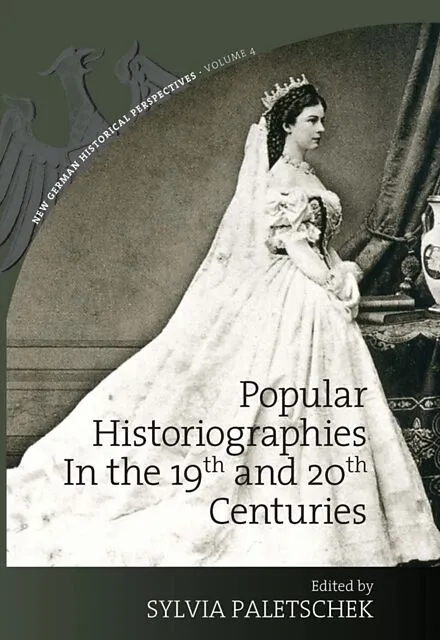
Popular Historiographies in the 19th and 20th Centuries
Beschreibung
Zusatztext This volume of essays provides a fine overview of research on popular history, one of the most methodologically innovative and exciting areas of research on German historyThe authors maintain a high level of reflection in their articles, but also se...Format auswählen
- Kartonierter EinbandCHF 49.50

Wird oft zusammen gekauft
Andere Kunden kauften auch
Beschreibung
Zusatztext This volume of essays provides a fine overview of research on popular history, one of the most methodologically innovative and exciting areas of research on German historyThe authors maintain a high level of reflection in their articles, but also seem to have learned from popular history that historians must express themselves clearly, cogently, and in an enjoyable prose style. Specialists and students alike will find this volume highly useful. · Central European History an important attempt within the German context to bridge this gulf [between popular and academic history] or at least to bring popular historiographies under academic scrutiny and to recognize their highly significant contribution to the development of modern culture. This interdisciplinary collection of uniformly impressive essays explores a wide range of topicsreinforces the degree to which history, in its myriad forms, shapes our identities and our understanding of the world in which we live. · German History These 12 contributions analyze topics ranging from soccer to world history, in the new spirit of popular historiographies. With their wide range of topics and publics, the essays can be seen as a democratization of the understanding of history . · Choice This book opens up an important new field of study (popular histories) which promises to contribute in a major way to the investigation of broader historical cultures. Its intertextuality and interdisciplinarity point the way for future research in this area. · Stefan Berger , University of Manchester Informationen zum Autor Sylvia Paletschek has been Professor in Modern History at the University of Freiburg (Germany) since 2001 and was Visiting Fellow at St. Antony's College at Oxford University in 20062007. Her research interests include women's and gender history, history of universities, memory culture, and history of historiography. Her publications include Women's Emancipation Movements in the 19th Century: A European Perspective (with Bianka Pietrow-Ennker, Stanford University Press, 2004) and The Gender of Memory. Cultures of Remembrance in Nineteenth- and Twentieth-Century Europe , (with Sylvia Schraut, Campus/Chicago University Press, 2008). Klappentext Popular presentations of history have recently been discovered as a new field of research, and even though interest in it has been growing noticeably very little has been published on this topic. This volume is one of the first to open up this new area of historical research, introducing some of the work that has emerged in Germany over the past few years. While mainly focusing on Germany (though not exclusively), the authors analyze different forms of popular historiographies and popular presentations of history since 1800 and the interrelation between popular and academic historiography, exploring in particular popular histories in different media and popular historiography as part of memory culture. Zusammenfassung Opens up new field of study (popular histories) which promises to contribute in major way to investigation of broader historical cultures Intertextuality and interdisciplinarity point the way for future research in the area Explores popular histories in different media and popular historiography as part of memory culture Inhaltsverzeichnis List of Figures Introduction: Why Analyse Popular Historiographies? Sylvia Paletschek Part I: Popular and Academic Historiographies in the 19th Century
Autorentext
Sylvia Paletschek has been Professor in Modern History at the University of Freiburg (Germany) since 2001 and was Visiting Fellow at St. Antony's College at Oxford University in 20062007. Her research interests include women's and gender history, history of universities, memory culture, and history of historiography. Her publications include Women's Emancipation Movements in the 19th Century: A European Perspective (with Bianka Pietrow-Ennker, Stanford University Press, 2004) and The Gender of Memory. Cultures of Remembrance in Nineteenth- and Twentieth-Century Europe, (with Sylvia Schraut, Campus/Chicago University Press, 2008).
Klappentext
Popular presentations of history have recently been discovered as a new field of research, and even though interest in it has been growing noticeably very little has been published on this topic. This volume is one of the first to open up this new area of historical research, introducing some of the work that has emerged in Germany over the past few years. While mainly focusing on Germany (though not exclusively), the authors analyze different forms of popular historiographies and popular presentations of history since 1800 and the interrelation between popular and academic historiography, exploring in particular popular histories in different media and popular historiography as part of memory culture.
Zusammenfassung
Opens up new field of study (popular histories) which promises to contribute in major way to investigation of broader historical cultures Intertextuality and interdisciplinarity point the way for future research in the area Explores popular histories in different media and popular historiography as part of memory culture
Inhalt
List of Figures
Introduction: Why Analyse Popular Historiographies?
Sylvia Paletschek
Part I: Popular and Academic Historiographies in the 19th Century
Chapter 1. Questioning the Canon: Popular Historiography by Women in Britain and Germany (17501850)
Angelika Epple
Chapter 2. Popular Presentations of History in the 19th Century: The Example of Die Gartenlaube
Sylvia Paletschek
Chapter 3. Understanding the World around 1900: Popular Universal Histories in Germany
Hartmut Bergenthum
Part II: Popular Presentations of History in Different Medias in the 20th Century
Chapter 4. History for Readers: Popular Historiography 20th Century Germany
Wolfgang Hardtwig
Chapter 5. Between Political Coercion and Popular Expectations: Contemporary History in the Radio of the German Democratic Republic
Christoph Classen
Chapter 6. Moving History: Fictional Films and the Nazi Past in Germany since the late 1970s
Frank Bösch
Part III: Memory Culture and Popular Historiographies: Case Studies
Chapter 7. Memory History and the Standardization of History
Dieter Langewiesche
Chapter 8. The Second World War in the Popular Culture of Memory in Norway
Claudia Lenz
Chapter 9. Sissi: Popular Representations of an Empress
Sylvia Schraut
Chapter 10. **Scientists as Heroes? Einstein, Curie, and the Popular Historiography of Science
Beat Ceranski
Chapter 11. 'Das Wunder von Bern'. The Football World Cup 1954, the German Nation and Popular Histories
Franz-Josef Brüggemeier
Notes on Contributors
Bibliography