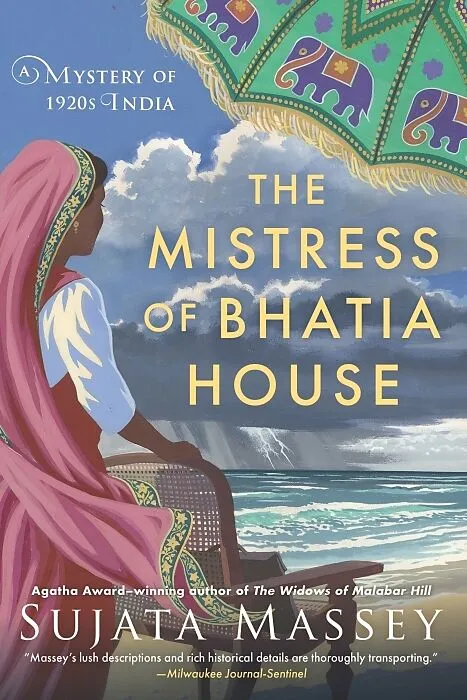
The Mistress of Bhatia House
Beschreibung
Informationen zum Autor Sujata Massey was born in England to parents from India and Germany, grew up in St. Paul, Minnesota, and lives in Baltimore, Maryland. She was a features reporter for the Baltimore Evening Sun before becoming a full-time novelist. The f...Format auswählen
- Kartonierter EinbandCHF 21.90
- E-Book (epub)CHF 10.90

Wird oft zusammen gekauft
Andere Kunden kauften auch
Beschreibung
Informationen zum Autor Sujata Massey was born in England to parents from India and Germany, grew up in St. Paul, Minnesota, and lives in Baltimore, Maryland. She was a features reporter for the Baltimore Evening Sun before becoming a full-time novelist. The first Perveen Mistry novel, The Widows of Malabar Hill, was an international bestseller and won the Agatha, Macavity, and Mary Higgins Clark Awards. Visit her website at sujatamassey.com. Klappentext "India, 1922: Perveen Mistry is the only female lawyer in Bombay, a city where child mortality is high, birth control is unavailable and very few women have ever seen a doctor. Perveen is attending a lavish fundraiser for a new women's hospital specializing in maternal health issues when she witnesses an accident. The grandson of an influential Gujarati businessman catches fire-but a servant, his young ayah, Sunanda, rushes to save him, selflessly putting herself in harm's way. Later, Perveen learns that Sunanda, who's still ailing from her burns, has been arrested on trumped-up charges made by a man who doesn't seem to exist. Perveen cannot stand by while Sunanda languishes in jail with no hope of justice. She takes Sunanda as a client, even inviting her to live at the Mistry home in Bombay's Dadar Parsi colony. But the joint family household is already full of tension. Perveen's father worries about their law firm taking so much personal responsibility for a client, and her brother and sister-in-law are struggling to cope with their new baby. Perveen herself is going through personal turmoil as she navigates a taboo relationship with a handsome former civil service officer. When the hospital's chief donor dies suddenly, Miriam Penkar, a Jewish-Indian obstetrician, and Sunanda become suspects. Perveen's original case spirals into a complex investigation taking her into the Gujarati strongholds of Kalbadevi and Ghatkopar, and up the coast to Juhu Beach, where a decadent nawab lives with his Australian trophy wife. Then a second fire erupts, and Perveen realizes how much is at stake. Has someone powerful framed Sunanda to cover up another crime? Will Perveen be able to prove Sunanda's innocence without endangering her own family?"-- Leseprobe Prologue Thursday, June 1, 1922 Sisters will fight. It's true whether they are raised together or meet as sisters-in-law in a joint family household. Sisters fight for the better sari, for the chance to do the shopping, for the spot as the parents' favorite. Such rivalry, followed by reconciliation, is as natural as the way summer's punishing heat is chased off by monsoon. For Oshadi, it was easier to think about the weather. Even in pastoral Ghatkopar, ten miles north of Bombay, the air felt blisteringly humid. The rain was only a few weeks awayit was a shame the party couldn't have waited for the first few days of monsoon, when drops danced lightly. Such a change in weather could have brought forward some harmony between Uma and Mangala Bhatia. As Oshadi slowly proceeded toward Bhatia House, she waved her walking stick at the wild dogs that congregated on the property across the street, waiting for the daily feeding that the rich Jain family provided. Oshadi wouldn't let the dogs wander near Bhatia House; she had worked there longer than anyone and knew what it meant to protect. When Sir Dwarkanath's wife had died ten years earlier, Uma, the senior daughter-in-law, had promoted Oshadi to housemistress over all six female servants at Bhatia House. For this, Oshadi was grateful; but it meant that Uma-bhabhu asked her to do many things that had nothing to do with ordinary service. Today she'd been sent out to walk to the shops in search of extra candles for the many lanterns set out around the courtyard. She'd gone to three shops before finding what was needed. As Oshadi limped up the gravel driveway...
Zusammenfassung
Bombay’s only female solicitor, Perveen Mistry, grapples with class divisions, sexism, and complex family dynamics as she seeks justice for a mistreated young woman in this thrilling fourth installment in Sujata Massey’s award-winning series.
India, 1922: Perveen Mistry is the only female lawyer in Bombay, a city where child mortality is high, birth control is unavailable and very few women have ever seen a doctor.
Perveen is attending a lavish fundraiser for a new women’s hospital specializing in maternal health issues when she witnesses an accident. The grandson of an influential Gujarati businessman catches fire—but a servant, his young ayah, Sunanda, rushes to save him, selflessly putting herself in harm’s way. Later, Perveen learns that Sunanda, who’s still ailing from her burns, has been arrested on trumped-up charges made by a man who doesn’t seem to exist.
Perveen cannot stand by while Sunanda languishes in jail with no hope of justice. She takes Sunanda as a client, even inviting her to live at the Mistry home in Bombay’s Dadar Parsi colony. But the joint family household is already full of tension. Perveen’s father worries about their law firm taking so much personal responsibility for a client, and her brother and sister-in-law are struggling to cope with their new baby. Perveen herself is going through personal turmoil as she navigates a taboo relationship with a handsome former civil service officer.
When the hospital’s chief donor dies suddenly, Miriam Penkar, a Jewish-Indian obstetrician, and Sunanda become suspects. Perveen’s original case spirals into a complex investigation taking her into the Gujarati strongholds of Kalbadevi and Ghatkopar, and up the coast to Juhu Beach, where a decadent nawab lives with his Australian trophy wife. Then a second fire erupts, and Perveen realizes how much is at stake. Has someone powerful framed Sunanda to cover up another crime? Will Perveen be able to prove Sunanda’s innocence without endangering her own family?