
IHR WARENKORB IST AKTUELL LEER.
Haben Sie noch nichts passendes gefunden? Stöbern Sie durch unser komplettes Sortiment.
Oder melden Sie sich an bzw. registrieren Sie sich.
- Kostenlose Lieferung
- Kauf auf Rechnung
- Ex Libris Tiefpreis
- Filiallieferung und 650+ Abholorte
- Rabatt-Bons als Club-Mitglied
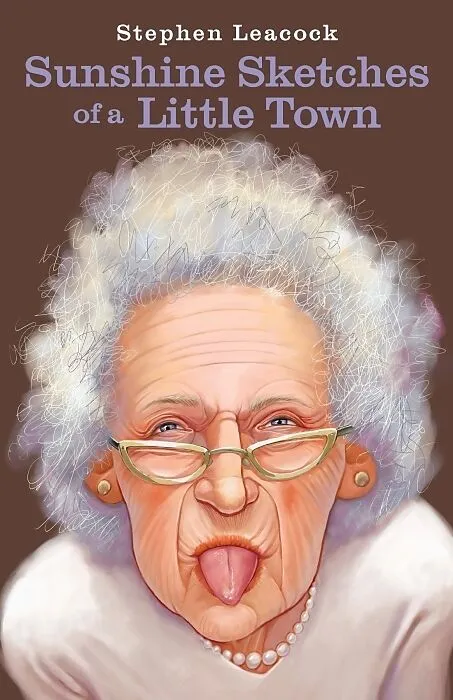
Sunshine Sketches of a Little Town
Beschreibung
Affectionately combining both the idyllic and ironic, Sunshine Sketches of a Little Town is a colourful, imaginative, and thoroughly entertaining portrait of small town Ontario. This is Stephen Leacock at his best--now available as a Penguin Modern Classic. Su...Format auswählen
- TaschenbuchCHF 19.20
- E-Book (epub)CHF 10.90

Wird oft zusammen gekauft
Andere Kunden kauften auch
Beschreibung
Affectionately combining both the idyllic and ironic, Sunshine Sketches of a Little Town is a colourful, imaginative, and thoroughly entertaining portrait of small town Ontario. This is Stephen Leacock at his best--now available as a Penguin Modern Classic. Sunshine Sketches of a Little Town , which first appeared as a newspaper serial, chronicles life in the fictional community of Mariposa, modelled on Orillia, Ontario, where Stephen Leacock spent many summers. It's a brilliant satire about small towns, small-town people, and small-town occurrences. Life in Mariposa is never dull or ordinary. It's a town full of eccentrics, where boats sent to rescue passengers from a sinking steamer have to be rescued themselves, where the leading citizen is a 280-pound illiterate saloonkeeper, and where a barber who stumbles into a fortune is heralded as a financial wizard.
Praise for Sunshine Sketches of a Little Town: "Leacock had a wonderful ear for dialogue and was superbly skilled in creating polished, self-contained scenes and in evoking character with a few sure strokes." -- Will Ferguson
Praise for Seth: "To read a book by Seth is to enter an oddly cozy, perfectly designed world where humor, nostalgia, and a gentle sadness pervade like the last autumnal rays of sunlight on a quiet afternoon." -- San Francisco Weekly
Autorentext
STEPHEN LEACOCK was born in Swanmore, Hampshire, England, in 1869. His family emigrated to Canada in 1876 and settled on a farm north of Toronto. Educated at Upper Canada College and the University of Toronto, Leacock pursued graduate studies in economics at the University of Chicago, where he studied under Thorstein Veblen. Even before he completed his doctorate, Leacock accepted a position as sessional lecturer in political science and economics at McGill University. From 1908 until his retirement in 1936, he chaired the Department of Political Science and Economics. The author of nineteen books and countless articles on economics, history, and political science, Leacock turned to the writing of humour as his beloved avocation. His first collection of comic stories, Literary Lapses, appeared in 1910, and from that time until his death in 1944 he published a volume of humour almost every year.
Klappentext
**Affectionately combining both the idyllic and ironic, Sunshine Sketches of a Little Town is a colourful, imaginative, and thoroughly entertaining portrait of small town Ontario. This is Stephen Leacock at his best.
**
Sunshine Sketches of a Little Town, which first appeared as a newspaper serial, chronicles life in the fictional community of Mariposa, modelled on Orillia, Ontario, where Stephen Leacock spent many summers. It's a brilliant satire about small towns, small-town people, and small-town occurrences.
Life in Mariposa is never dull or ordinary. It's a town full of eccentrics, where boats sent to rescue passengers from a sinking steamer have to be rescued themselves, where the leading citizen is a 280-pound illiterate saloonkeeper, and where a barber who stumbles into a fortune is heralded as a financial wizard.
Leseprobe
**The Hostelry of Mr. Smith
**
I don’t know whether you know Mariposa. If not, it is of no consequence, for if you know Canada at all, you are probably well acquainted with a dozen towns just like it.
There it lies in the sunlight, sloping up from the little lake that spreads out at the foot of the hillside on which the town is built. There is a wharf beside the lake, and lying alongside of it a steamer that is tied to the wharf with two ropes of about the same size as they use on the Lusitania. The steamer goes nowhere in particular, for the lake is landlocked and there is no navigation for the Mariposa Belle except to “run trips” on the first of July and the Queen’s Birthday, and to take excursions of the Knights of Pythias and the Sons of Temperance to and from the Local Option Townships.
In point of geography the lake is called Lake Wissanotti and the river running out of it the Ossawippi, just as the main street of Mariposa is called Missinaba Street and the county Missinaba County. But these names do not really matter. Nobody uses them. People simply speak of the “lake” and the “river” and the “main street,” much in the same way as they always call the Continental Hotel, “Pete Robinson’s” and the Pharmaceutical Hall, “Eliot’s Drug Store.” But I suppose this is just the same in every one else’s town as in mine, so I need lay no stress on it.
The town, I say, has one broad street that runs up from the lake, commonly called the Main Street. There is no doubt about its width. When Mariposa was laid out there was none of that shortsightedness which is seen in the cramped dimensions of Wall Street and Piccadilly. Missinaba Street is so wide that if you were to roll Jeff Thorpe’s barber shop over on its face it wouldn’t reach half way across. Up and down the Main Street are telegraph poles of cedar of colossal thickness, standing at a variety of angles and carrying rather more wires than are commonly seen at a transatlantic cable station.
On the Main Street itself are a number of buildings of extraordinary importance, – Smith’s Hotel and the Continental and the Mariposa House, and the two banks (the Commercial and the Exchange), to say nothing of McCarthy’s Block (erected in 1878), and Glover’s Hardware Store with the Oddfellows’ Hall above it. Then on the “cross” street that intersects Missinaba Street at the main corner there is the Post Office and the Fire Hall and the Young Men’s Christian Association and the office of the Mariposa Newspacket, – in fact, to the eye of discernment a perfect jostle of public institutions comparable only to Threadneedle Street or Lower Broadway. On all the side streets there are maple trees and broad sidewalks, trim gardens with upright calla lilies, houses with verandahs, which are here and there being replaced by residences with piazzas.
To the careless eye the scene on the Main Street of a summer afternoon is one of deep and unbroken peace. The empty street sleeps in the sunshine. There is a horse and buggy tied to the hitching post in front of Glover’s hardware store. proprietor of Smith’s Hotel, standing in his chequered waistcoat on the steps of his hostelry, and perhaps, further up the street, Lawyer Macartney going for his afternoon mail, or the Rev. Mr. Drone, the Rural Dean of the Church of England Church, going home to get his fishing rod after a mothers’ auxiliary meeting.
But this quiet is mere appearance. In reality, and to those who know it, the place is a perfect hive of activity. Why, at Netley’s butcher shop (established in 1882) there are no less than four men working on the sausage machines in the basement; at the Newspacket office there are as many more jobprinting; there is a long distance telephone with four distracting girls on high stools wearing steel caps and talking incessantly; in the offices in McCarthy’s block are dentists and lawyers with their coats off, ready to work at any moment; and from the big planing factory down beside the lake where the railroad siding is, you may hear all through the hours of the summer afternoon the long-drawn music of the running saw.
Busy – well, I should think so! Ask any of its inhabitants if Mariposa isn’t a busy, hustling, thriving town. Ask Mullins, the manager of the Exchange Bank, who comes hustling over to his office from the Mariposa House every day at 10.30 and has scarcely time all morning to go out and take a drink with the manager of the Commercial; or ask – well, for the matter of that, ask any of them if they eve…