
IHR WARENKORB IST AKTUELL LEER.
Haben Sie noch nichts passendes gefunden? Stöbern Sie durch unser komplettes Sortiment.
Oder melden Sie sich an bzw. registrieren Sie sich.
- Kostenlose Lieferung
- Kauf auf Rechnung
- Ex Libris Tiefpreis
- Filiallieferung und 650+ Abholorte
- Rabatt-Bons als Club-Mitglied
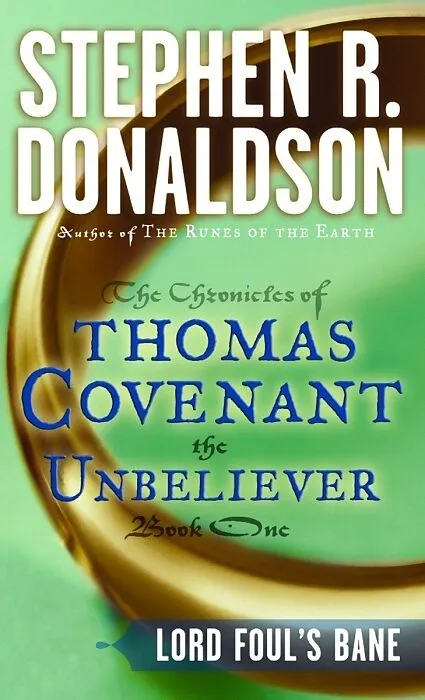
Lord Foul's Bane
Beschreibung
Informationen zum Autor Stephen R. Donaldson is the bestselling author of the series The Gap Cycle, Mordant's Need, and the Chronicles of Thomas Covenant the Unbeliever, including Lord Foul's Bane and The Second Chronicles of Thomas Covenant ; and other works,...Format auswählen
- TaschenbuchCHF 14.10

Wird oft zusammen gekauft
Andere Kunden kauften auch
Beschreibung
Informationen zum Autor Stephen R. Donaldson is the bestselling author of the series The Gap Cycle, Mordant's Need, and the Chronicles of Thomas Covenant the Unbeliever, including Lord Foul's Bane and The Second Chronicles of Thomas Covenant ; and other works, such as Daughter of Regals and Other Tales and a mystery series under the pseudonym Reed Stephens. He is the recipient of the first prize of the British Science Fiction Society and the John W. Campbell Memorial Award. Klappentext "Covenant is [Stephen R.] Donaldson's genius!"-The Village Voice He called himself Thomas Covenant the Unbeliever, because he dared not believe in this strange alternate world on which he suddenly found himself. Yet the Land tempted him. He had been sick; now he seemed better than ever before. Through no fault of his own, he had been outcast, unclean, a pariah. Now he was regarded as a reincarnation of the Land's greatest hero-Berek Halfhand-armed with the mystic power of White Gold. That power alone could protect the Lords of the Land from the ancient evil of the Despiser, Lord Foul. Except that Covenant had no idea how to use that power. . . . Zusammenfassung Covenant is [Stephen R.] Donaldson's genius! The Village Voice He called himself Thomas Covenant the Unbeliever! because he dared not believe in this strange alternate world on which he suddenly found himself. Yet the Land tempted him. He had been sick; now he seemed better than ever before. Through no fault of his own! he had been outcast! unclean! a pariah. Now he was regarded as a reincarnation of the Land's greatest heroBerek Halfhandarmed with the mystic power of White Gold. That power alone could protect the Lords of the Land from the ancient evil of the Despiser! Lord Foul. Except that Covenant had no idea how to use that power. . . .
Autorentext
Stephen R. Donaldson is the bestselling author of the series The Gap Cycle, Mordant's Need, and the Chronicles of Thomas Covenant the Unbeliever, including Lord Foul's Bane and The Second Chronicles of Thomas Covenant; and other works, such as Daughter of Regals and Other Tales and a mystery series under the pseudonym Reed Stephens. He is the recipient of the first prize of the British Science Fiction Society and the John W. Campbell Memorial Award.
Klappentext
"Covenant is [Stephen R.] Donaldson's genius!"-The Village Voice
He called himself Thomas Covenant the Unbeliever, because he dared not believe in this strange alternate world on which he suddenly found himself.
Yet the Land tempted him. He had been sick; now he seemed better than ever before. Through no fault of his own, he had been outcast, unclean, a pariah. Now he was regarded as a reincarnation of the Land's greatest hero-Berek Halfhand-armed with the mystic power of White Gold. That power alone could protect the Lords of the Land from the ancient evil of the Despiser, Lord Foul. Except that Covenant had no idea how to use that power. . . .
Zusammenfassung
“Covenant is [Stephen R.] Donaldson's genius!”—The Village Voice
He called himself Thomas Covenant the Unbeliever, because he dared not believe in this strange alternate world on which he suddenly found himself.
Yet the Land tempted him. He had been sick; now he seemed better than ever before. Through no fault of his own, he had been outcast, unclean, a pariah. Now he was regarded as a reincarnation of the Land's greatest hero—Berek Halfhand—armed with the mystic power of White Gold. That power alone could protect the Lords of the Land from the ancient evil of the Despiser, Lord Foul. Except that Covenant had no idea how to use that power. . . .
Leseprobe
ONE: Golden Boy
She came out of the store just in time to see her young son playing on the sidewalk directly in the path of the gray, gaunt man who strode down the center of the walk like a mechanical derelict. For an instant, her heart quailed. Then she jumped forward, gripped her son by the arm, snatched him out of harm’s way.
The man went by without turning his head. As his back moved away from her, she hissed at it, “Go away! Get out of here! You ought to be ashamed!”
Thomas Covenant’s stride went on, as unfaltering as clockwork that had been wound to the hilt for just this purpose. But to himself he responded, Ashamed? Ashamed? His face contorted in a wild grimace. Beware! Outcast unclean!
But he saw that the people he passed, the people who knew him, whose names and houses and handclasps were known to him—he saw that they stepped aside, gave him plenty of room. Some of them looked as if they were holding their breath. His inner shouting collapsed. These people did not need the ancient ritual of warning. He concentrated on restraining the spasmodic snarl which lurched across his face, and let the tight machinery of his will carry him forward step by step.
As he walked, he flicked his eyes up and down himself, verifying that there were no unexpected tears or snags in his clothing, checking his hands for scratches, making sure that nothing had happened to the scar which stretched from the heel of his right palm across where his last two fingers had been. He could hear the doctors saying, “VSE, Mr. Covenant. Visual Surveillance of Extremities. Your health depends upon it. Those dead nerves will never grow back—you’ll never know when you’ve hurt yourself unless you get in the habit of checking. Do it all the time—think about it all the time. The next time you might not be so lucky.”
VSE. Those initials comprised his entire life.
Doctors! he thought mordantly. But without them, he might not have survived even this long. He had been so ignorant of his danger. Self-neglect might have killed him.
Watching the startled, frightened or oblivious faces—there were many oblivious faces, though the town was small—that passed around him, he wished he could be sure that his face bore a proper expression of disdain. But the nerves in his cheeks seemed only vaguely alive, though the doctors had assured him that this was an illusion at the present stage of his illness, and he could never trust the front which he placed between himself and the world. Now, as women who had at one time chosen to discuss his novel in their literary clubs recoiled from him as if he were some kind of minor horror or ghoul, he felt a sudden treacherous pang of loss. He strangled it harshly, before it could shake his balance.
He was nearing his destination, the goal of the affirmation or proclamation that he had so grimly undertaken. He could see the sign two blocks ahead of him: Bell Telephone Company. He was walking the two miles into town from Haven Farm in order to pay his phone bill. Of course, he could have mailed in the money, but he had learned to see that act as a surrender, an abdication to the mounting bereavement which was being practiced against him.
While he had been in treatment, his wife, Joan, had divorced him—taken their infant son and moved out of the state. The only thing in which he, Thomas Covenant, had a stake that she had dared handle had been the car; she had taken it as well. Most of her clothing she had left behind. Then his nearest neighbors, half a mile away on either side, had complained shrilly about his presence among them; and when he had refused to sell his property, one of them moved from the county. Next, within three weeks of his return home, the grocery store—he was walking past it now, its windows full of frenetic advertisements had begun delivering his supplies, whether or not he ordered them—and, he suspected, whether or not he was willing to pay.
Now he strode past the courthouse, its old gray columns looking proud of their burde…