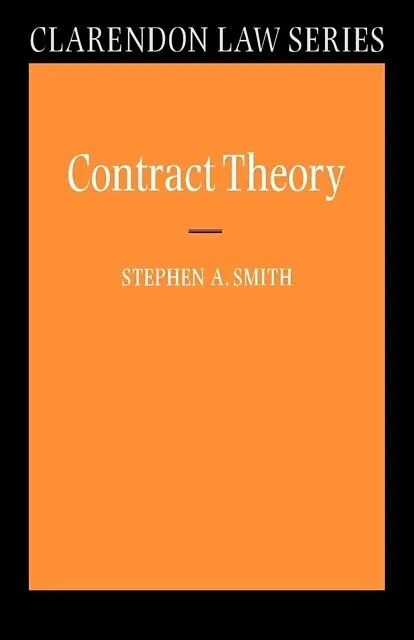
Contract Theory
Beschreibung
Informationen zum Autor Prof Stephen Smith is Professor of Law at McGill University, Montreal and former Tutor and Fellow in Law at St Anne's College, Oxford. Klappentext This book is both an examination of! and a contribution to! our understanding of the theo...Format auswählen
- Kartonierter EinbandCHF 104.00

Wird oft zusammen gekauft
Andere Kunden kauften auch
Beschreibung
Informationen zum Autor Prof Stephen Smith is Professor of Law at McGill University, Montreal and former Tutor and Fellow in Law at St Anne's College, Oxford. Klappentext This book is both an examination of! and a contribution to! our understanding of the theoretical foundations of the common law of contract. Focusing on contemporary debates in contract theory! Introduction to Contract Theory aims to help readers better understand the nature and justification of the general idea of contractual obligation! as well as the nature and justification of the particular rules that make up the law of contract. Zusammenfassung An examination of the theoretical foundations of the common law of contract. Focusing on contemporary debates in contract theory, this book aims to help readers understand the nature and justification of the general idea of contractual obligation, as well as the nature and justification of the particular rules that make up the law of contract. Inhaltsverzeichnis I: METHODOLOGY II: GENERAL THEORIES OF CONTRACT 3: The Nature of Contractual Obligations: The Analytic Question 4: The Justification of Contractual Obligations: The Normative Question III: CONTRACT LAW DOCTRINES 6: The Kinds of Agreements that are Enforced: Formalities, Intention to Create Legal Relations, Consideration, and Estoppel 7: The Kinds of Agreements not Enforced: Substantive Limitations on Enforceability 8: The Content of the Contract: Interpreting and Implying Terms 9: Excuses for Non-Performance: Duress, Unconscionability, Mistake, Misrepresentation, Frustration, and Discharge for Breach 10: Breach of Contract: The Puzzle of Strict Liability 11: Remedies for Breach
Autorentext
Prof Stephen Smith is Professor of Law at McGill University, Montreal and former Tutor and Fellow in Law at St Anne's College, Oxford.
Klappentext
This book is both an examination of, and a contribution to, our understanding of the theoretical foundations of the common law of contract. Focusing on contemporary debates in contract theory, Contract Theory aims to help readers better understand the nature and justification of the general idea of contractual obligation, as well as the nature and justification of the particular rules that make up the law of contract. The book is in three parts.
Part I introduces the idea of 'contract theory', and presents a framework for identifying, classifying, and evaluating contract theories.
Part II describes and evaluates the most important general theories of contract; examples include promissory theories, reliance-based theories, and economic theories.
In Part III, the theoretical issues raised by the various specific doctrines that make up the law of contract (e.g., offer and acceptance, consideration, mistake, remedies, etc.) are examined in separate chapters. The legal focus of the book is the common law of the United Kingdom, but the theoretical literature discussed is international in origin; the arguments discussed are thus relevant to understanding the law of other common law jurisdictions and, in many instances, to understanding the law of civil law jurisdictions as well.
Zusammenfassung
An examination of the theoretical foundations of the common law of contract. Focusing on contemporary debates in contract theory, this book aims to help readers understand the nature and justification of the general idea of contractual obligation, as well as the nature and justification of the particular rules that make up the law of contract.
Inhalt
I: METHODOLOGY
II: GENERAL THEORIES OF CONTRACT
3: The Nature of Contractual Obligations: The Analytic Question
4: The Justification of Contractual Obligations: The Normative Question
III: CONTRACT LAW DOCTRINES
6: The Kinds of Agreements that are Enforced: Formalities, Intention to Create Legal Relations, Consideration, and Estoppel
7: The Kinds of Agreements not Enforced: Substantive Limitations on Enforceability
8: The Content of the Contract: Interpreting and Implying Terms
9: Excuses for Non-Performance: Duress, Unconscionability, Mistake, Misrepresentation, Frustration, and Discharge for Breach
10: Breach of Contract: The Puzzle of Strict Liability
11: Remedies for Breach