
IHR WARENKORB IST AKTUELL LEER.
Haben Sie noch nichts passendes gefunden? Stöbern Sie durch unser komplettes Sortiment.
Oder melden Sie sich an bzw. registrieren Sie sich.
- Kostenlose Lieferung
- Kauf auf Rechnung
- Ex Libris Tiefpreis
- Filiallieferung und 650+ Abholorte
- Rabatt-Bons als Club-Mitglied
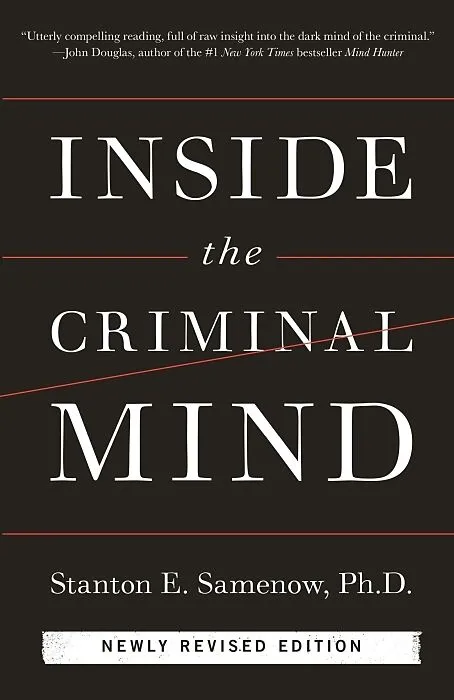
Inside the Criminal Mind (Newly Revised Edition)
Beschreibung
Informationen zum Autor Stanton E. Samenow, Ph.D., is a clinical psychologist who has spent fifty years as a researcher, clinician, consultant, and expert witness specializing in criminal behavior. He has been appointed to three presidential task forces on law...Format auswählen
- BroschiertCHF 25.90

Wird oft zusammen gekauft
Andere Kunden kauften auch
Beschreibung
Informationen zum Autor Stanton E. Samenow, Ph.D., is a clinical psychologist who has spent fifty years as a researcher, clinician, consultant, and expert witness specializing in criminal behavior. He has been appointed to three presidential task forces on law enforcement, victims' rights, and a drug-free America. He has appeared on 60 Minutes, The Oprah Winfrey Show, Good Morning America , and Today . Stanton is also the author of Before It's Too Late and Straight Talk About Criminals. Klappentext A brilliant, no-nonsense profile of the criminal mind, newly updated in 2022 to include the latest research, effective methods for dealing with hardened criminals, and an urgent call to rethink criminal justice from expert witness Stanton E. Samenow, Ph.D. Utterly compelling reading, full of raw insight into the dark mind of the criminal.John Douglas, author of the #1 New York Times bestseller Mind Hunter Long-held myths defining the sources of and remedies for crime are shattered in this groundbreaking bookand a chilling profile of today's criminal emerges. In 1984, Stanton Samenow changed the way we think about the workings of the criminal mind, with a revolutionary approach to habilitation. In 2014, armed with thirty years of additional knowledge and insight, Samenow explored the subject afresh, explaining criminals' thought patterns in the new millennium, such as those that lead to domestic violence, internet victimization, and terrorism. Since then the arenas of criminal behavior have expanded even further, demanding this newly updated version, which includes an exploration of social media as a vehicle for criminal conduct, new pharmaceutical influences and the impact of the opioid crisis, recent genetic and biological research into whether some people are wired to become criminals, new findings on the effectiveness of cognitive behavioral therapy, and a fresh take on criminal justice reform. Throughout, we learn from Samenow's five decades of experience how truly vital it is to know who the criminals are and how they think. If equipped with that crucial understanding, we can reach reasonable, compassionate, and effective solutions. From expert witness Dr. Stanton E. Samenow, a brilliant, no-nonsense profile of the criminal mind, updated to include new influences and effective methods for dealing with hardened criminals The Basic Myths About Criminals In nearly a half-century, little has changed in terms of deeply ingrained beliefs about the causes of crime. In the classic, still often performed, 1957 musical West Side Story, Stephen Sondheim parodied what then was the current thinking about juvenile delinquency in the song "Gee, Officer Krupke." Delinquents were punks because their fathers were drunks. They were misunderstood rather than no good. They were suffering from a "social disease," and society "had played [them] a terrible trick." They needed an analyst, not a judge, because it was "just [their] neurosis" acting up. In short, their criminal behavior was regarded as symptomatic of a deep-seated psychological or sociological problem. In this chapter I shall briefly discuss this proposition. In subsequent chapters I shall examine them in greater detail and show that the prevalent thinking about crime has been and still is loaded with fundamental misconceptions resulting in devastating consequences for society. A man abducts, rapes, and murders a little girl. We, the public, may be so revolted by the gruesomeness of the crime that we conclude only a sick person could be capable of such an act. But our personal gut reaction shows no insight into, or understanding of, what really went on in this individual's mind as he planned and executed the crime. True, what the perpetrator inflicted upon this child is not "normal" beh...
Autorentext
Stanton E. Samenow, Ph.D., is a clinical psychologist who has spent fifty years as a researcher, clinician, consultant, and expert witness specializing in criminal behavior. He has been appointed to three presidential task forces on law enforcement, victims’ rights, and a drug-free America. He has appeared on 60 Minutes, The Oprah Winfrey Show, Good Morning America, and Today. Stanton is also the author of Before It’s Too Late and Straight Talk About Criminals.
Klappentext
**A brilliant, no-nonsense profile of the criminal mind, newly updated in 2022 to include the latest research, effective methods for dealing with hardened criminals, and an urgent call to rethink criminal justice from expert witness Stanton E. Samenow, Ph.D.
**“Utterly compelling reading, full of raw insight into the dark mind of the criminal.”—John Douglas, author of the #1 New York Times bestseller Mind Hunter
Long-held myths defining the sources of and remedies for crime are shattered in this groundbreaking book—and a chilling profile of today’s criminal emerges. In 1984, Stanton Samenow changed the way we think about the workings of the criminal mind, with a revolutionary approach to “habilitation.” In 2014, armed with thirty years of additional knowledge and insight, Samenow explored the subject afresh, explaining criminals’ thought patterns in the new millennium, such as those that lead to domestic violence, internet victimization, and terrorism.
Since then the arenas of criminal behavior have expanded even further, demanding this newly updated version, which includes an exploration of social media as a vehicle for criminal conduct, new pharmaceutical influences and the impact of the opioid crisis, recent genetic and biological research into whether some people are “wired” to become criminals, new findings on the effectiveness of cognitive behavioral therapy, and a fresh take on criminal justice reform. Throughout, we learn from Samenow’s five decades of experience how truly vital it is to know who the criminals are and how they think. If equipped with that crucial understanding, we can reach reasonable, compassionate, and effective solutions.
From expert witness Dr. Stanton E. Samenow, a brilliant, no-nonsense profile of the criminal mind, updated to include new influences and effective methods for dealing with hardened criminals
**
**
Leseprobe
The Basic Myths About Criminals
In nearly a half-century, little has changed in terms of deeply ingrained beliefs about the causes of crime. In the classic, still often performed, 1957 musical West Side Story, Stephen Sondheim parodied what then was the current thinking about juvenile delinquency in the song "Gee, Officer Krupke." Delinquents were punks because their fathers were drunks. They were misunderstood rather than no good. They were suffering from a "social disease," and society "had played [them] a terrible trick." They needed an analyst, not a judge, because it was "just [their] neurosis" acting up. In short, their criminal behavior was regarded as symptomatic of a deep-seated psychological or sociological problem. In this chapter I shall briefly discuss this proposition. In subsequent chapters I shall examine them in greater detail and show that the prevalent thinking about crime has been and still is loaded with fundamental misconceptions resulting in devastating consequences for society.
A man abducts, rapes, and murders a little girl. We, the public, may be so revolted by the gruesomeness of the crime that we conclude only a sick person could be capable of such an act. But our personal gut reaction shows no insight into, or understanding of, what really went on in this individual's mind as he planned and executed the crime. True, what the perpetrator inflicted upon this child is not "normal" behavior. But what does "sick" really mean? A detailed and lengthy examination of the mind of a criminal will reveal that, no matter how bizarre or repugnant the cri…