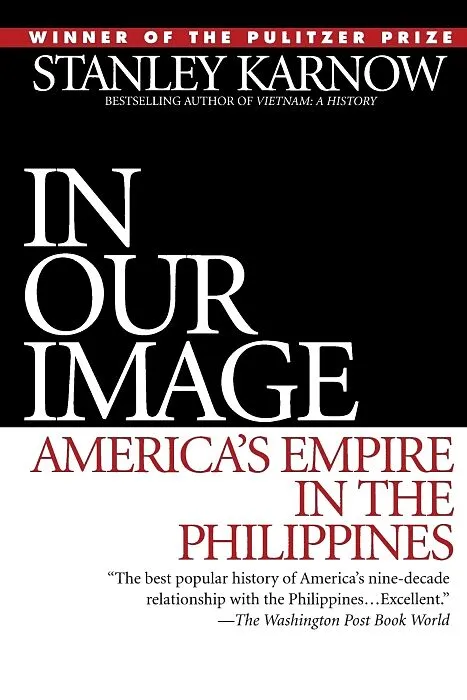
In Our Image
Beschreibung
Zusatztext "Stanley Karnow Has Written The Ultimate Bookbrilliant! panoramic! engrossingabout American behavior overseas in the twentieth century." The Boston Sunday Globe "A Page-Turning Story and Authoritative History." The New York Times "Perhaps The Best J...Format auswählen
- Kartonierter Einband (Kt)CHF 31.10

Wird oft zusammen gekauft
Andere Kunden kauften auch
Beschreibung
Zusatztext "Stanley Karnow Has Written The Ultimate Bookbrilliant! panoramic! engrossingabout American behavior overseas in the twentieth century." The Boston Sunday Globe "A Page-Turning Story and Authoritative History." The New York Times "Perhaps The Best Journalist Writing On Asian Affairs." Newsweek Informationen zum Autor Stanley Karnow won the Pulitzer Prize for this account of America's imperial experience in the Philippines. In a swiftly paced, brilliantly vivid narrative, Karnow focuses on the relationship that has existed between the two nations since the United States acquired the country from Spain in 1898, examining how we have sought to remake the Philippines "in our image," an experiment marked from the outset by blundering, ignorance, and mutual misunderstanding. Klappentext "A brilliant, coherent social and political overview spanning three turbulent centuries."-San Francisco Chronicle Stanley Karnow won the Pulitzer Prize for this account of America's imperial experience in the Philippines. In a swiftly paced, brilliantly vivid narrative, Karnow focuses on the relationship that has existed between the two nations since the United States acquired the country from Spain in 1898, examining how we have sought to remake the Philippines "in our image," an experiment marked from the outset by blundering, ignorance, and mutual misunderstanding. "Stanley Karnow has written the ultimate book-brilliant, panoramic, engrossing-about American behavior overseas in the twentieth century."-The Boston Sunday Globe "A page-turning story and authoritative history."-The New York Times "Perhaps the best journalist writing on Asian affairs."-Newsweek Leseprobe By September 1986, after four years as secretary of state, George Shultz had grown accustomed to presiding over official dinners for foreign dignitaries visiting Washington: the rigorous protocol, the solemn oratory, the contrived cordiality. But he could not recall an occasion equal to this night. He was honoring Corazon Cojuangco Aquino, the new president of the Philippines, and a spontaneous charge of emotion electrified the affair. Americans and Filipinos had shared history, tragedy, triumph, idealsexperiences that had left them with a sense of kinship. Shultz captured that spirit exactly: A Cory doll pinned to his lapel, his Buddha-like face beamed and his nasal voice lilted with rare elation. Breaking with routine, he delivered his toast before the banquetin effect telling the guests to relax and enjoy. This, he said, is a family evening. Cory's appeal transcended her American connections. Seven months earlier, she had toppled Ferdinand Marcos in an episode almost too melodramatic to be truea morality play, a reenactment of the Passion: The pious widow of Marcos's chief opponent, the martyred Benigno Ninoy Aquino, she had risen from his death to rally her people against the corrupt despot, his egregious wife and their wicked regime. Throughout the world she became an instant celebrity, a household icon: the saintly Cory who, perhaps through divine intervention, had emerged from obscurity to exorcise evil. Elsewhere in Asia, in Taiwan and in South Korea, demonstrators invoked her name in their protests against autocracy. Most Americans may have forgotten, perhaps never even knew, that the Philippines had been a U.S. possession; for those who remembered, Cory symbolized anew that special relationship. During its half-century of colonial tutelage, America had endowed the Filipinos with universal education, a common language, public hygiene, roads, bridges and, above all, republican institutions. Americans and Filipinos had fought and died side by side at Bataan and Corregidor and perished together on the ghastly Death March. The United States was still in the Philippines, the site o...
"Stanley Karnow Has Written The Ultimate Book—brilliant, panoramic, engrossing—about American behavior overseas in the twentieth century."**—**The Boston Sunday Globe
"A Page-Turning Story and Authoritative History."—The New York Times
"Perhaps The Best Journalist Writing On Asian Affairs."—Newsweek
Autorentext
Stanley Karnow won the Pulitzer Prize for this account of America's imperial experience in the Philippines. In a swiftly paced, brilliantly vivid narrative, Karnow focuses on the relationship that has existed between the two nations since the United States acquired the country from Spain in 1898, examining how we have sought to remake the Philippines "in our image," an experiment marked from the outset by blundering, ignorance, and mutual misunderstanding.
Klappentext
"A brilliant, coherent social and political overview spanning three turbulent centuries."-San Francisco Chronicle
Stanley Karnow won the Pulitzer Prize for this account of America's imperial experience in the Philippines. In a swiftly paced, brilliantly vivid narrative, Karnow focuses on the relationship that has existed between the two nations since the United States acquired the country from Spain in 1898, examining how we have sought to remake the Philippines "in our image," an experiment marked from the outset by blundering, ignorance, and mutual misunderstanding.
"Stanley Karnow has written the ultimate book-brilliant, panoramic, engrossing-about American behavior overseas in the twentieth century."-The Boston Sunday Globe
"A page-turning story and authoritative history."-The New York Times
"Perhaps the best journalist writing on Asian affairs."-Newsweek
Leseprobe
By September 1986, after four years as secretary of state, George Shultz had grown accustomed to presiding over official dinners for foreign dignitaries visiting Washington: the rigorous protocol, the solemn oratory, the contrived cordiality. But he could not recall an occasion equal to this night. He was honoring Corazon Cojuangco Aquino, the new president of the Philippines, and a spontaneous charge of emotion electrified the affair. Americans and Filipinos had shared history, tragedy, triumph, ideals—experiences that had left them with a sense of kinship. Shultz captured that spirit exactly: A “Cory” doll pinned to his lapel, his Buddha-like face beamed and his nasal voice lilted with rare elation. Breaking with routine, he delivered his toast before the banquet—in effect telling the guests to relax and enjoy. “This,” he said, “is a family evening.”
Cory’s appeal transcended her American connections. Seven months earlier, she had toppled Ferdinand Marcos in an episode almost too melodramatic to be true—a morality play, a reenactment of the Passion: The pious widow of Marcos’s chief opponent, the martyred Benigno “Ninoy” Aquino, she had risen from his death to rally her people against the corrupt despot, his egregious wife and their wicked regime. Throughout the world she became an instant celebrity, a household icon: the saintly Cory who, perhaps through divine intervention, had emerged from obscurity to exorcise evil. Elsewhere in Asia, in Taiwan and in South Korea, demonstrators invoked her name in their protests against autocracy.
Most Americans may have forgotten, perhaps never even knew, that the Philippines had been a U.S. possession; for those who remembered, Cory symbolized anew that special relationship. During its half-century of colonial tutelage, America had endowed the Filipinos with universal education, a common language, public hygiene, roads, bridges and, above all, republican institutions. Americans and Filipinos had fought and died side by side at Bataan and Corregidor and perished together on the ghastly Death March. The United States was still in the Philippines, the site of its two largest overseas bases, and more than a million Filipinos lived in America. By backing Marcos, even as an expedient, the United States…