
IHR WARENKORB IST AKTUELL LEER.
Haben Sie noch nichts passendes gefunden? Stöbern Sie durch unser komplettes Sortiment.
Oder melden Sie sich an bzw. registrieren Sie sich.
- Kostenlose Lieferung
- Kauf auf Rechnung
- Ex Libris Tiefpreis
- Filiallieferung und 650+ Abholorte
- Rabatt-Bons als Club-Mitglied
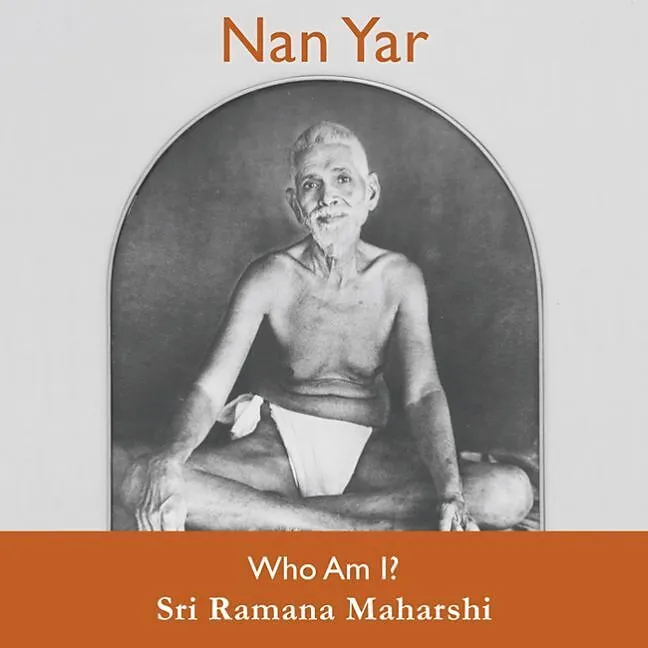
Nan Yar -- Who Am I?
Beschreibung
Nan Yar, meaning 'Who am I?', was originally spoken by Bhagavan Sri Ramana Maharshi in 1901, when he was twenty-one years old. Following his spontaneous moment of realisation as a sixteen- year-old school boy, Sri Ramana was drawn to Arunachala, a ho...Format auswählen
- Kartonierter EinbandCHF 19.90

Wird oft zusammen gekauft
Andere Kunden kauften auch
Beschreibung
Nan Yar, meaning 'Who am I?', was originally spoken by Bhagavan Sri Ramana Maharshi in 1901, when he was twenty-one years old. Following his spontaneous moment of realisation as a sixteen- year-old school boy, Sri Ramana was drawn to Arunachala, a holy mountain in South India, which he never left. It was while he was living in a cave on the mountain's slopes that he was questioned
by a man called Sivaprakasam Pillai.'Sri Ramana wrote his answers with his finger in the sand
because this was the period in which he found it difficult to speak. Naturally this writing medium produced short, concise answers. 'Sivaprakasam Pillai didn't write down these answers.
After each new question was asked, Sri Ramana wiped out his previous reply and wrote a new one in the sand. When he went home, Sivaprakasam Pillai wrote down what he could remember of this silent conversation.'About twenty years later Sivaprakasam Pillai published these questions and answers as an appendix to a biography of Sri Ramana that he had written and published. There were thirteen questions and answers in this first published version.'Sri Ramana's devotees appreciated this particular presentation. Ramana Ashram published it as a separate booklet, and with each edition more and more questions and answers were added. The longest version has about thirty.'At some point in the 1920s Sri Ramana himself rewrote this series of questions and answers as a prose essay, elaborating on some answers and deleting others. This is now published under the title Who Am I? in Sri Ramana's Collected Works and separately as this small book. It is Sri Ramana's summary of answers written more than twenty years before.'
Nan Yar, or Who Am I? contains the core of Sri Ramana's teachings with a focus on Self-inquiry. Although Sri Ramana had not studied the scriptures when he first answered the questions, it is a spiritual classic that is in line with both the Vedanta [Indian philosophy] and Yoga traditions. He answered the questions posed to him that day from the Self, reflecting the ancient wisdom of India and the contemporary wisdom of his time.
There is no doubt that the importance Sri Ramana gave to Self-inquiry as the most direct route to Self-realisation has attracted enormous attention from serious Western seekers of Truth in the last years. Not only his teachings have attracted attention but also his exemplary lifestyle and the sattvic [pure] nature of his mind - which are visibly reflected in the architecture of his ashram.
The paragraph that begins his essay was not given out in response to a question. It was composed by Sri Ramana when he was rewriting the work in the 1920s. Many philosophical works begin with a statement about the nature of happiness and the means by which it can be attained or discovered. Sri Ramana has followed this tradition.
It is with great pleasure that Open Sky Press has decided to make this classic text available in new translations in several European languages, ably supported by a host of recently digitally re-mastered photographs for which we thank Mr. Sundaram, President of Sri Ramana Ashram. A number of Sri Ramana's more important teaching quotations have been included.
John David (formarly Premananda) 2015 Open Sky Press
In 1901, a young man was sitting on the holy mountain Arunachala in South India, when a scholar came to him with burning questions about the nature of Truth. As he was not speaking at that time, the answers were given in silence, written in the sand.
The young man was to become the renowned Saint Sri Ramana Maharshi. Twenty years after the initial interview, in the early days of the Ramana Ashram, he himself edited his answers given that day, which became the first ashram publication setting out his essential teachings.
Sri Ramana Maharshi
The Indian Saint was born in 1879. After coming to the holy mountain Arunachala aged seventeen, his early years there were alone and silent.
In the 1920s he moved to a permanent place at the foot of Arunachala and the present ashram was constructed. Here he lived and taught until his death in 1950.
Many people from all over the world visited Sri Ramana at the ashram, coming to directly experience his spiritual power and the profound peace and simplicity of the ashram.
Autorentext
Bhagavan Sri Ramana Maharshi, the Sage of Arunachala, born in 1878, is one of the most famous and most recent of India's wealth of sages, Saints and spiritual Masters. As a young man of sixteen he had a spontaneous awakening. He left his home in Madurai and made his way to Tiruvannamalai and the holy mountain, Arunachala. He lived for many years, alone and in silence, on and around the mountain, which he never left.
In the 1920s the present ashram was constructed. Here he lived and taught until his death in 1950. Many of this Maha Rishi's (Great Seer) students and devotees, who, through him gained Self-realisation, passed on to their own students Sri Ramana Maharshi's practice of Self-enquiry, using the question, 'Who am I?'
Klappentext
Book & DVD. Nan Yar is a classic spiritual text from one of the greatest Indian teachers, Sri Ramana Maharshi, and one of the most important books of the 20th Century. Containing the essence of his teachings, it lights the way for a clear, practical understanding and realization of spiritual awakening. A beautifully designed edition, the original text has been set to touching quotes and wonderful digital remastered photographs of Sri Ramana Maharshi. Trailer DVD included in the back for the films of Open Sky Press.
Leseprobe
Who am I?
When other thoughts arise, one should not pursue them, but should inquire: 'To whom do they arise?' It does not matter how many thoughts arise . As each thought arises, one should inquire with diligence,'To whom has this thought arisen?'The answer that would emerge would be 'to me' .
Thereupon if one inquires 'Who am I?', the mind will go back to its source; and the thought that arose will become quiescent [still] . With repeated practice in this manner, the mind will develop the skill to stay in its source.
All living beings desire to be happy always, without any misery. In everyone there is observed supreme love for oneself. And happiness alone is the cause of love. In order therefore, to gain that happiness which is one's nature and which is experienced in the state of deep sleep, where there is no mind, one should know oneself. To achieve this, the Path of Knowledge, the inquiry in the form of 'Who am I?', is the principal means.
Question 1. Who am I?
The gross [physical] body which is composed of the seven humours (dhatus) [body tissues], I am not; the five cognitive sense organs, such as the senses of hearing, touch, sight, taste and smell, which apprehend their respective objects, namely sound, touch, colour, taste and odour, I am not; the five cognitive sense organs, such as the organs of speech, locomotion, grasping, excreting and enjoying, I am not; the five vital airs, such as prana [life force], which perform respectively the five functions of in-breathing, I am not; even the mind which thinks, I am not; the nescience [ignorance] too, which is endowed only with the residual impressions of objects and in which there are no objects and no functions, I am not.
[I am not the physical body, nor the five senses, nor the thinking mind. I am not the unconscious mind containing the tendencies of mind, which remain even in deep sleep.]