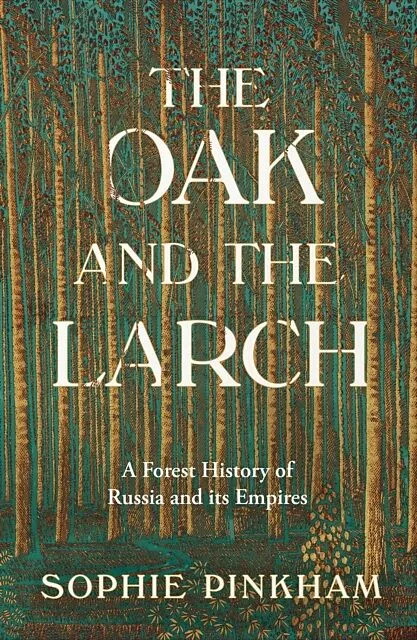
The Oak and The Larch
Beschreibung
There''s a Russian saying: ''The heart of another is like a dark forest.'' This book explores the forest as Russia''s heart - throughout history, and now in an ailing state. Russia has three times as many trees as we have stars in our galaxy. The Amazon might ...Format auswählen
- Kartonierter EinbandCHF 25.90
- Fester EinbandCHF 38.80
- Kartonierter Einband (Kt)CHF 17.30

Wird oft zusammen gekauft
Andere Kunden kauften auch
Beschreibung
There''s a Russian saying: ''The heart of another is like a dark forest.'' This book explores the forest as Russia''s heart - throughout history, and now in an ailing state. Russia has three times as many trees as we have stars in our galaxy. The Amazon might be considered the world''s lungs but Russia''s colder, less celebrated forests are just as vital; they provide nearly one-fifth of the world''s forest cover, and they have been the inspiration for cultural expression over the centuries. Russian forests are home to both mythical creatures - vexatious wood sprites and sinister mermaids - and animals whose pelts are coveted around the world. Russia''s greatest writers and artists have enshrined the forests in works like Anna Karenina and The Brothers Karamazov. Today, the forests are in peril. In Putin''s leadership alone, nearly 10% has been lost through logging, fire and climate change. This will have unavoidable consequences for the world''s climate. Drawing on literature, art, music, and original reportage, this book will explore the significance of the Russian forest from medieval times to the present, from pre-Christian forest spirits to the canonical figures of Tolstoy, Dostoevsky, and Turgenev to modern tree-worshipping eco cults, examining the philosophical and environmental impact - and political power - of the vast Russian wilderness. It will encompass Indigenous traditions and folklore, Soviet visions of communist trees, daring moments of activism and intense political repression. Nature nourishes art even in the darkest of times. This book pays attention to all that we stand to lose in nature''s undoing.
Autorentext
Sophie Pinkham
Klappentext
**'A towering achievement'**MERVE EMRE
NYT Best New Books of 2026
A majestic cultural and environmental history that reveals how forests have made - and resisted - Russia's many empires.
From the Baltic to the Pacific, from the Arctic to the Steppes of Central Asia, Russia's forests account for nearly one-fifth of the world's wooded lands. The Oak and the Larch is the first-ever English-language exploration of this vast expanse - a dazzling environmental history of Russia that offers an urgent new understanding of the nature of Russian power, and of Russia's ideas of itself.
Inspired by the majestic oak, which towers over the country's western heartland, and the hardy Siberian larch, an emblem of survival in the east, award winning scholar Sophie Pinkham's magisterial account spans centuries, revealing how forests have nourished ancient Siberian Indigenous societies, defended medieval Slavic settlements from Mongol invasion and served as both an essential natural resource and a potent cultural symbol for Russia in all its incarnations, from the days of the tsars to the Soviets to Putin's Federation.
By examining the country from the forest's perspective, Pinkham pushes far beyond the contemporary political environment in Russia. She draws on literature, history and art to connect the expanse of the Russian wilderness and the nature of Russian culture, with indelible portraits of the diverse figures who have inhabited and celebrated these forests: the legendary Indigenous guide Dersu Uzala, giants of literature like Tolstoy and Chekhov, political thinkers like Kropotkin and even Stalin. She confronts the forest's role in Russia's long history of imperial conquest, and in resistance to this conquest.
Gorgeously written and surprising at every turn, The Oak and the Larch offers a vision of Russia rarely seen in the West, as a land defined by its wilderness, shaped by its encounters with the frontier, and - much like our own - ultimately beholden to nature's whim.