
IHR WARENKORB IST AKTUELL LEER.
Haben Sie noch nichts passendes gefunden? Stöbern Sie durch unser komplettes Sortiment.
Oder melden Sie sich an bzw. registrieren Sie sich.
- Kostenlose Lieferung
- Kauf auf Rechnung
- Ex Libris Tiefpreis
- Filiallieferung und 650+ Abholorte
- Rabatt-Bons als Club-Mitglied
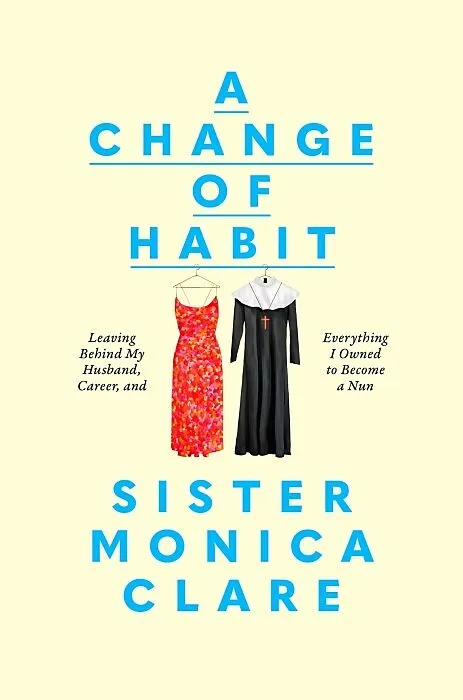
A Change of Habit
Beschreibung
The soulful, hilarious memoir of a chronic people pleaser who surprised everyone in her life by abandoning an unfulfilling career and marriage to join a convent—and learned how much we stand to gain when we fully embrace our authentic selves. In her ...Format auswählen
- Fester EinbandCHF 33.20

Wird oft zusammen gekauft
Andere Kunden kauften auch
Beschreibung
The soulful, hilarious memoir of a chronic people pleaser who surprised everyone in her life by abandoning an unfulfilling career and marriage to join a convent—and learned how much we stand to gain when we fully embrace our authentic selves.
In her twenties and thirties, Monica Clare was a talented but exhausted photo editor who spent her days getting yelled at by clients who were often strung out on cocaine and megalomania. For years, the voice calling her to a simpler, quieter life had been getting louder. As a little kid, she’d seen Audrey Hepburn in <The Nun''s Story<, and thought: <that’s me<. That’s how she found herself straightening her habit nervously as she walked into a convent, preparing to live alongside eleven other sisters who’d taken the same vow of poverty and celibacy…indefinitely. <Could a chronically fidgety, pop culture-obsessed woman of the world ever fit in<, she wondered? And why did the other nuns seem so cold and disapproving?
As the months went on, she realized the other nuns were shy, not unfriendly—much like herself. The culture at the convent discouraged giving compliments, or even saying “please” or “thank you,” since acts of generosity were to be freely given and received. But when Monica rose to the role of Sister Superior, she got the policy against compliments changed. Relationships started to blossom, first awkwardly and then more easily. Who would have predicted that Sister Christina, the one she thought had deeply disliked her from the start, would turn out to be a huge hugger? Or that they’d spend entire afternoons trying to keep a wild turkey from running amok in their community garden?
Equal parts tell-all and rallying cry, <A Change of Habit< reveals how much we can say yes to when we stop laboring to prove our worth to ourselves and others. In her role as a spiritual counselor, Sister Monica guides people from all walks of life towards resisting the false promises of capitalism, finding healing in small acts of nurture and connection, and ultimately, restoring themselves to a place of wholeness, all while living in this gorgeously messy world of ours....
Autorentext
Sister Monica Clare is the Sister Superior at the Community of St. John Baptist, an Episcopal convent based in New Jersey, and a spiritual counselor specializing in religious trauma, mental illness, and addiction. Before becoming a nun in 2012, she worked as a photo editor in L.A. and performed in an acoustic rock duo and an improv comedy troupe.
Leseprobe
ONE
In the Beginning
Much to my mother’s chagrin, the first time I fell in love, it wasn’t with a man, but with a movie, and that movie was The Nun’s Story.
My mother, Linda, had the soul of an artist and the look of Barbie—platinum blond hair, a petite frame, and fabulous clothes that she made herself. Mom wanted to be Brigitte Bardot. She wanted all her daughters to be Brigitte too. She wanted us to have romance and love and beauty. I wanted love too, only my idea of love was a little different.
I still remember the hot summer morning as The Nun’s Story played on my grandparents’ television. It starred Audrey Hepburn as a Belgian nun, and I don’t think any other five-year-old who ever watched that movie said, “Wow, that is what I want to do. Sign me up!,” but I did.
Watching the nuns move in their orderly lines, a sense of peace washed over me. Here was a world where everyone belonged, where your worth wasn’t determined by the neighborhood you lived in or the clothes you wore. I longed for that certainty, that sense of home. If I hadn’t been scolded for getting too close to the TV, I would have put my hands on the screen and rested my forehead on that beautiful world.
I told my mother that I loved the movie. That I loved the nuns’ dresses. That I thought the sisters were beautiful and that I wanted to be just like them when I grew up.
“Over mahh deeeead body, Claudette,” she drawled in her Alabama accent. She then explained that nuns were repressed and miserable and that Roman Catholicism is a terrible religion.
Our family was Southern Baptist, though Grandma, my mom’s mother, was the only one who went to church. Normally, on spiritual matters, I would turn to her, but I couldn’t discuss anything Roman Catholic with her because she believed all the Catholics were definitely going to hell.
So I did what I had to do. I ran breathlessly to the library and STOLE (God forgive me) the book that The Nun’s Story was based on, then proceeded to read it fifty times. Kathryn Hulme’s novel became my private manual for living. It presented a life of service, structure, and ritual—all things that I did not find in my modern, chaotic family of origin.
My mom and dad were rock and roll parents. Mom would slide behind the wheel of her purple MG Midget and turn the radio up. At stoplights, she waved her skinny arms above her head singing Fleetwood Mac, “And if I needed a little money, I know he would lend me, lend me a hand.” She looked like she was up onstage, which is where I believe she belonged. She should have been famous, only at sixteen she gave up everything for love, all her opportunities, all her dreams. She gave everything to my dad, even the grocery money.
My father, Clyde—we often called him Clyde—was very handsome, a combination of Elvis and James Dean, with a sweep of dark hair, hefty sideburns, and olive skin that made him look Italian. He was only five foot eight and trim, but to me he felt like a giant, and he always filled the room. Usually he filled it with his rage, but sometimes I would see him in public and there he could be charming and funny and brilliant. But at home, he was always on the fringes of our household, going to work mad, coming home mad, going out at night, sleeping all day, and waking up mad again.
Sometimes he’d be high on the hog—new job, more money, more time with friends—but then the money would dwindle, or something would happen at work, and we would have to move. I lived in seven houses or apartments by the time I was twelve. Sometimes we didn’t even get the pictures hung up on the walls before we left again.
There was one period where my father was always driving a different car—and the cars got junkier and junkier. The cars, like our homes, were symptoms of my father’s restlessness. He couldn’t sit still. His hands were always moving, his fingernails always bitten down to the quick. He often looked over my head as he spoke, as if there was something in the distance coming toward him. He even tugged at his long, beautiful eyelashes until he pulled them right out because he was such a nervous wreck.
My big sister, Autumn, on the other hand, was as cool as steel. Sixteen months older than I am, she was a scraggly kid, a little stick figure with enormous eyes, and long, tangled chestnut hair. Growing up, Autumn was my alter ego—where I was weak, she was strong. Where I was meek she was bold. She was tough and fiery and always did her best to protect me.
When I was eight my baby sister, India, was born. She had a cherubic face and just a few strands of tawny hair on her enormous head, and from the moment she arrived I wanted to take care of her.
After my younger sister was born, my parents moved us into a house on Piedmont Avenue in West Rome, Georgia, which was an up-and-coming suburb. This was the second house they’d bought; the first had been foreclosed on, but that was many moves ago. My mother had our new house painted mustard yellow with coral shutters—it was very 1974.
My parents went to…