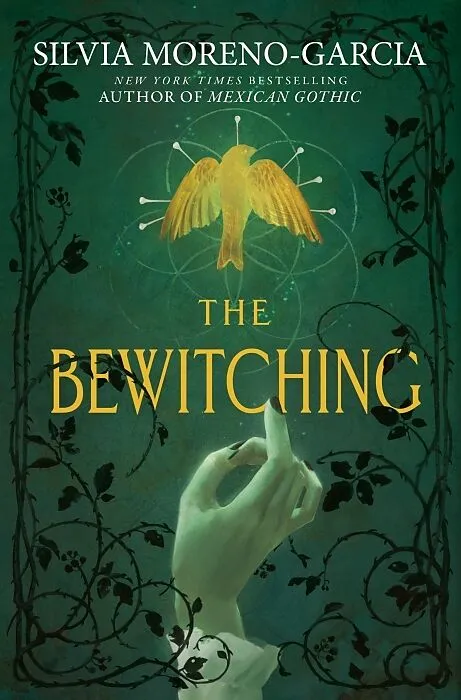
The Bewitching
Beschreibung
Three women in three different eras encounter danger and witchcraft in this eerie multigenerational horror saga from the “In Silvia Moreno-Garcia’s sure hands, every uncovered secret is fraught with intrigue and creeping horror.”--Tananarive ...Format auswählen
- Fester EinbandCHF 31.90

Wird oft zusammen gekauft
Andere Kunden kauften auch
Beschreibung
Three women in three different eras encounter danger and witchcraft in this eerie multigenerational horror saga from the “In Silvia Moreno-Garcia’s sure hands, every uncovered secret is fraught with intrigue and creeping horror.”--Tananarive Due, Bram Stoker Award–winning author of “Back then, when I was a young woman, there were still witches”: That was how Nana Alba always began the stories she told her great-granddaughter Minerva--stories that have stayed with Minerva all her life. Perhaps that’s why Minerva has become a graduate student focused on the history of horror literature and is researching the life of Beatrice Tremblay, an obscure author of macabre tales. In the course of assembling her thesis, Minerva uncovers information that reveals that Tremblay’s most famous novel, As Minerva descends ever deeper into Tremblay’s manuscript, she begins to sense that the malign force that stalked Tremblay and the missing girl might still walk the halls of the campus. These disturbing events also echo the stories Nana Alba told about her girlhood in 1900s Mexico, where she had a terrifying encounter with a witch. Minerva suspects that the same shadow that darkened the lives of her great-grandmother and Beatrice Tremblay is now threatening her own in 1990s Massachusetts. An academic career can be a punishing pursuit, but it might turn outright deadly when witchcraft is involved.
Autorentext
Silvia Moreno-Garcia
Klappentext
NATIONAL BESTSELLER • BRAM STOKER AWARD FINALIST • Three women in three different eras encounter danger and witchcraft in this eerie multigenerational horror saga from the New York Times bestselling author of Mexican Gothic.
“In Silvia Moreno-Garcia’s sure hands, every uncovered secret is fraught with intrigue and creeping horror.”—Tananarive Due, Bram Stoker Award–winning author of The Reformatory
A BEST BOOK OF THE YEAR: NPR, Elle, Kirkus Reviews, Book Riot, Library Journal, Crime Reads, She Reads
“Back then, when I was a young woman, there were still witches”: That was how Nana Alba always began the stories she told her great-granddaughter Minerva—stories that have stayed with Minerva all her life. Perhaps that’s why Minerva has become a graduate student focused on the history of horror literature and is researching the life of Beatrice Tremblay, an obscure author of macabre tales.
In the course of assembling her thesis, Minerva uncovers information that reveals that Tremblay’s most famous novel, The Vanishing, was inspired by a true story: Decades earlier, during the Great Depression, Tremblay attended the same university where Minerva is now studying and became obsessed with her beautiful and otherworldly roommate, who then disappeared under mysterious circumstances.
As Minerva descends ever deeper into Tremblay’s manuscript, she begins to sense that the malign force that stalked Tremblay and the missing girl might still walk the halls of the campus. These disturbing events also echo the stories Nana Alba told about her girlhood in 1900s Mexico, where she had a terrifying encounter with a witch.
Minerva suspects that the same shadow that darkened the lives of her great-grandmother and Beatrice Tremblay is now threatening her own in 1990s Massachusetts. An academic career can be a punishing pursuit, but it might turn outright deadly when witchcraft is involved.
Zusammenfassung
NATIONAL BESTSELLER • Three women in three different eras encounter danger and witchcraft in this eerie multigenerational horror saga from the New York Times bestselling author of Mexican Gothic.
“In Silvia Moreno-Garcia’s sure hands, every uncovered secret is fraught with intrigue and creeping horror.”—Tananarive Due, Bram Stoker Award–winning author of The Reformatory
A BEST BOOK OF THE YEAR: NPR, Elle, Kirkus Reviews, Book Riot, Library Journal, Crime Reads, She Reads
“Back then, when I was a young woman, there were still witches”: That was how Nana Alba always began the stories she told her great-granddaughter Minerva—stories that have stayed with Minerva all her life. Perhaps that’s why Minerva has become a graduate student focused on the history of horror literature and is researching the life of Beatrice Tremblay, an obscure author of macabre tales.
In the course of assembling her thesis, Minerva uncovers information that reveals that Tremblay’s most famous novel, The Vanishing, was inspired by a true story: Decades earlier, during the Great Depression, Tremblay attended the same university where Minerva is now studying and became obsessed with her beautiful and otherworldly roommate, who then disappeared under mysterious circumstances.
As Minerva descends ever deeper into Tremblay’s manuscript, she begins to sense that the malign force that stalked Tremblay and the missing girl might still walk the halls of the campus. These disturbing events also echo the stories Nana Alba told about her girlhood in 1900s Mexico, where she had a terrifying encounter with a witch.
Minerva suspects that the same shadow that darkened the lives of her great-grandmother and Beatrice Tremblay is now threatening her own in 1990s Massachusetts. An academic career can be a punishing pursuit, but it might turn outright deadly when witchcraft is involved.
Leseprobe
Back then, when I was a young woman, there were still witches. That was what Nana Alba used to say when she told Minerva bedtime stories; it was the preamble that led into a realm of shadows and mysteries.
Shortly after Minerva first arrived at Stoneridge, she’d looked toward the thick mass of trees that constituted Briar’s Commons and heard a shrill cry that sounded like an infant’s wail. For a moment she’d shivered in fear, thinking of her great-grandmother’s tales of witches who drank the blood of the innocent on moonless nights. But it had been only a peacock.
She was used to the birds now, the gray peahens and the beautiful males with their dazzling displays of iridescent feathers. They’d sun themselves on the lawn in front of Ledge House and sometimes they’d even sit on the porch of the old mansion. The story went that when the college acquired the building and turned it into a dorm, the peacocks had been part of the deal. A superstitious old dean reckoned they were lucky. Thus it had become tradition to keep a few of them by the dean’s house, though the birds liked to drift toward other buildings and roamed the campus with impunity.
Now as she stood near the window, she heard the same cry.
She couldn’t see where the peacock was stationed. It was likely somewhere by the entrance, watching the last of the students make their exodus from Ledge House.
Her friends had told her she’d never get used to the cold and the snow of New England, hailing as she did from the temperate climate of Mexico City, but she’d handled the winter without misfortunes. It was the summer that made her anxious.
The campus was closing for the season. Within twenty-four hours all the dorms and facilities would stand silent and still, with a few resident directors like herself left to oversee the buildings. The library would be open, albeit with reduced hours, serving the students—mostly grad students—who would not fly or drive home for the summer.
The campus by the sea, with its greenery and its beautiful Victorian houses, with the sun shining and the ducks swimming placidly in the lovely ponds, ought to have inspired joy and relaxation. But everything irritated her. The quiet of the summer was the perfect chance to work on her thesis, if she’d h…