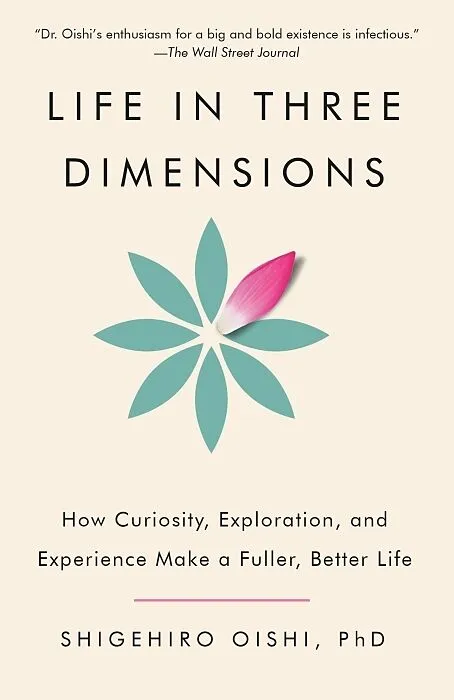
Life in Three Dimensions
Beschreibung
A NEXT BIG IDEA CLUB MUST-READ BOOK • From one of our foremost psychologists, a trailblazing book that turns the idea of a good life on its head and urges us to embrace the transformative power of variety and experience • The guidebook to the...Format auswählen
- Kartonierter EinbandCHF 21.10
- Fester EinbandCHF 30.00

Wird oft zusammen gekauft
Andere Kunden kauften auch
Beschreibung
**A NEXT BIG IDEA CLUB MUST-READ BOOK • From one of our foremost psychologists, a trailblazing book that turns the idea of a good life on its head and urges us to embrace the transformative power of variety and experience • The guidebook to the pyshologically rich life
“Dr. Oishi’s enthusiasm for a big and bold existence is infectious” — SHIGEHIRO OISHI is the Marshall Field IV Professor of Psychology at the University of Chicago. He is one of the foremost authorities on happiness, meaning, and culture. He is the author of The Psychological Wealth of Nations, and his research has been featured in major media outlets, including The New York Times and The Wall Street Journal.
Klappentext
**A NEXT BIG IDEA CLUB MUST-READ BOOK • From one of our foremost psychologists, a trailblazing book that turns the idea of a good life on its head and urges us to embrace the transformative power of variety and experience • The guidebook to the pyshologically rich life
“Dr. Oishi’s enthusiasm for a big and bold existence is infectious” —The Wall Street Journal
"Life in Three Dimensions will give you new insights into the many ways to live well, including advice on how to pick the one most likely to be right for you." —Jonathan Haidt, author of The Anxious Generation**
Shigehiro Oishi's father has lived his entire life in a small mountain town in Japan. But as a young man Oishi felt compelled to follow a winding road that led him far from home. He became an award-winning psychology professor, seeking to know which path—to stay or to go, the familiar or the unknown, his father’s path or his own—is the better path to a good life. In Life in Three Dimensions, Oishi shares his journey of discovery and offers readers a groundbreaking new understanding of happiness.
What makes for a good life, he asks? Is it the simple, predictable pleasures we call happiness? Or can happiness lead to complacency and regret? Is the answer a deep sense of meaning and purpose? Or can a life of purpose invite narrow or misplaced loyalties? Both happiness and meaning as paths to a good life have decades of scientific research to support them. But in recent years, Oishi has uncovered a third dimension to a good life, psychological richness. A psychologically rich life prioritizes curiosity, exploration, and a variety of experiences. These can be as simple as taking a walk, as complex as moving to a new country. Key to a psychologically rich experience is a shift in perspective that helps us grow.
Life in Three Dimensions explores lives defined by psychological richness: those of prominent people like Steve Jobs, Oliver Sacks and Alison Gopnik; characters from literature and film; and ordinary people who--in college, at midlife, and beyond--embraced uncertainty and challenge to deepen and enrich their lives. In this wise and delightful book, Oishi shows how anyone at any age can build a fuller, more authentic life.
Leseprobe
Chapter One
Should I Stay or Should I Go?
If I go there will be trouble
And if I stay it will be double.
—The Clash
- A Cozy Life
Yoshi was born in a small mountain town on the island of Kyushu, Japan, known for its green tea and clementines. Like his father, grandfather, and every male ancestor before him, Yoshi has lived his entire life there, cultivating rice and tea. He chose this path after just a year of agricultural high school, when he dropped out to become a farmer. At the age of twenty-seven, Yoshi married a woman from a neighboring town and had three children. He played in a neighborhood softball league into his fifties and enjoyed annual neighborhood association trips to various hot springs. He still lives in the same town; he still has the same wife; and he still has the same close friends he has known since elementary school. In making these choices, Yoshi followed the path laid out by his ancestors, connecting with them through common threads of not just blood, but occupation, place, expectations, and way of life.
Yoshi is my father, and I am his son a world away. After my eighteenth birthday, it took me exactly eighteen days to leave our small town for college in Tokyo. In my fourth year of college, I got a scholarship from Rotary International to study abroad in Maine. Before I started the program in Maine, I attended a summer English program on Staten Island in New York City. I had just broken up with my girlfriend in Tokyo and was tired of being in a relationship. I simply wanted to improve my English. Yet, I met a student from Korea and fell in love. She was about to start graduate school in Boston. I was about to start a year in Lewiston, Maine. During the 1991–1992 academic year, I took a Greyhound bus to Boston to see her every weekend. In May, I had to go back to Tokyo. Though my career plan before studying abroad was to work for the Ministry of Education in Japan, and I hadn’t had any intention of attending graduate school in the U.S., by then I was determined to come back. In June 1993, after graduation, I left Japan for good. Next were stops of varying lengths in New York City; Champaign, Illinois; Minneapolis, Minnesota; and Charlottesville, Virginia, before moving onward to Chicago. Along the way, I married the Korean woman I met on Staten Island and we had two children, born in two different cities. I have not seen any of my elementary school friends in years.
Three decades after leaving my hometown, as I get older and try to maintain what remains of our family connection, I often find myself wondering how my life could have diverged from my father’s to such an extraordinary extent. I wonder why he didn’t move away when he had the chance, and why, in contrast, I have moved so many times.
My father’s life has been stable, familiar, and comfortable. An annual cherry blossom party in spring, the Obon dance festival in summer, a foliage tour in fall, and hot springs in winter. It’s a cozy life, a good life. My life, on the other hand, has been far less stable, far less familiar, and far more stressful with constant deadlines for lecturing, grading, and writing mixed with countless rejections (e.g., grants, papers, book proposals, job applications). Though I love my job most days, I do envy my father’s simple, convivial life sometimes; I wish I could spend an evening drinking sake with my old friends every week, reminiscing about our school days and talking about life on the farm. But in my most honest moments, I know that I could not have lived like this: I had an intense yearning to see the outside world, too intense to follow the well-trodden life path of my ancestors.
- Happiness, Meaning, and Something Else
I think back to when I was graduating high school, when I was faced with the question framed in the immortal words of The Clash: “Should I stay or should I go?” It was easy, then. Just go. As I get older, though, it has become more and more difficult. This question has been at the center of both my personal life and my academic research for decades. I imagine most of you have also asked yourselves that very same question, not just once or twice, but many times over. Some of you might be like my father: loyal, prudent, and nostalgic, prioritizing a stable life. Others may be more like me: impressionable, whimsical, and risk-taking, embracing an adventurous life. There are, of course, trade-offs between a stable life and a mobile life, a simple life and a dramatic life, a comfortable life and a challenging life, a conventional life and an unconventional life. But which one gets us closer to a good life?
To answer this question, I will draw from decades of research in psychological science, supplementing the available data with examples …