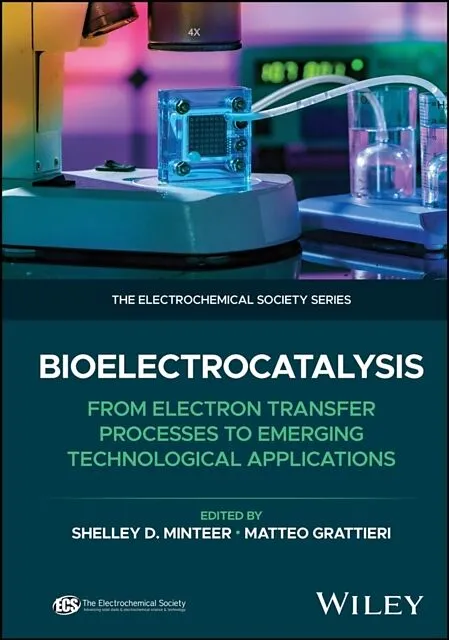
Bioelectrocatalysis
Beschreibung
Autorentext Shelley D. Minteer, PhD, is the Dr. Ken Robertson Memorial Professor of Chemistry and the Director of the Kummer Institute Center for Resource Sustainability at Missouri University of Science and Technology. She's also the Director of the NSF Cente...Format auswählen
- Fester EinbandCHF 206.00

Wird oft zusammen gekauft
Andere Kunden kauften auch
Beschreibung
Autorentext
Shelley D. Minteer, PhD, is the Dr. Ken Robertson Memorial Professor of Chemistry and the Director of the Kummer Institute Center for Resource Sustainability at Missouri University of Science and Technology. She's also the Director of the NSF Center for Synthetic Organic Electrochemistry. Matteo Grattieri, PhD, is an Assistant Professor of (Bio)Electrochemistry at the Chemistry Department of the Università degli Studi di Bari Aldo Moro. His research is focused on microbial electrochemical systems, semi-artificial photosynthesis, biomaterials, and biosensors development.
Klappentext
An authoritative resource introducing the fundamentals of enzymatic and microbial electrocatalysis In Bioelectrocatalysis: From Electron Transfer Processes to Emerging Technological Applications, a team of distinguished researchers delivers an up-to-date discussion of fundamental concepts in bioelectrocatalysis and its applications. The authors offer a comprehensive treatment of the foundations of bioelectrocatalysis. Beginning with a comparison of enzymatic and microbial electrocatalysis, the book goes on to explore the differences between direct and mediated bioelectrocatalysis and the challenges presented by promoting extracellular electron transfer. Bioelectrocatalysis presents detailed and accurate information on the approaches and techniques used to study the electron transfer processes and to confirm the type of electron transfer taking place. Readers will also find chapters dedicated to common and emerging applications of bioelectrocatalysis, including glucometers and glucose monitors, biosensors, and biofuel cells. Inside the book:
- A thorough introduction to electron transfer in enzymatic bioelectrocatalysis
- Comprehensive explorations of glucometers, continuous glucose monitors, ex-situ biosensors, biofuel cells, and biosolar cells
- Practical discussions of microbial electrochemical technologies for used water treatment
- Complete treatments of electrosynthesis and wearable and implantable devices Perfect for academic researchers and industrial scientists working in (bio)electrochemistry, catalysis, and chemical synthesis, energy materials, and sensors, Bioelectrocatalysis will also benefit advanced undergraduate and graduate students studying in any of those fields.
Inhalt
Preface ix
List of Contributors xi
1 Fundamentals of Bioelectrocatalysis 1
Matteo Grattieri and Shelley D. Minteer
1.1 Introduction 1
1.2 Bioelectrocatalysts and Electron Transfer 2
1.2.1 Enzymatic Bioelectrocatalysis 4
1.2.2 Microbial Bioelectrocatalysis 6
1.3 Conclusions and Outlook 8
Acknowledgments 9
References 9
2 Electron Transfer in Enzymatic Catalysis 17
Fred Lisdat and Daniel Schäfer
2.1 Introduction 17
2.2 Overview of Approaches 19
2.3 Mediated Electron Transfer 21
2.3.1 Concept 21
2.3.2 Reaction of the Mediator with the Electrode 22
2.3.2.1 Mediator in Solution 22
2.3.2.2 Mediator Immobilized 24
2.3.2.3 Mediators Operating in a Volume in Front of the Electrode 26
2.3.3 Reaction of the Mediator with the Enzyme 28
2.4 Direct Electron Transfer 30
2.5 Conducting Polymers 34
2.6 Application of Nanoparticles 37
2.7 Mass Transport Limited Systems 39
2.8 Protein Engineering 40
2.8.1 Truncation 43
2.8.2 Fusion Proteins 43
2.8.3 Point Mutations 44
2.8.4 Unnatural Amino Acids 45
2.9 Conclusions and Outlook 45
References 45
3 Extracellular Electron Transfer in Microbial Bioelectrocatalysis 59
César I. Torres, Christine Lewis, Juan F. Ortiz Medina, and Jesús A. Pérez García
3.1 Introduction 59
3.1.1 Electrons Through Insulating Cell Bodies 59
3.2 Electrochemical Responses of Electroactive Bacteria 62
3.2.1 Extracellular Electron Shuttle Transport Under Substrate Excess Conditions 62
3.2.2 Effects of Substrate Depletion, Redox Mediators, and Catalyst Wear on EES-Mediated Eet 65
3.2.3 Extracellular Electron Transfer Through a Solid Conductive Matrix 67
3.3 Shewanella sp. and its Extracellular Electron Shuttles 68
3.4 Phenazine-Mediated Extracellular Transfer in Pseudomonas aeruginosa 70
3.5 Aiding the Movement of Electrons with the Addition of Extracellular Electron Shuttles (EESs) 72
3.5.1 Characterization of EES Candidates 72
3.5.2 What Makes a Good EES Candidate? 73
3.5.2.1 An EES Must Reduce/Oxidize at the Correct Cellular Target Potential Within Its Given Chemical Environment 74
3.5.2.2 An EES Should be Both Electrochemically Reversible and Stable 74
3.5.2.3 An EES Must be Soluble and Diffusible with Limited Kinetic Loss to "Shuttle" 75
3.5.2.4 Ensure that an EES Addition is Nontoxic and Does Not Influence Other Cellular Processes 75
3.5.2.5 EES Must Function in Dynamic Systems 75
3.5.3 Examples of Exogenous Electron Shuttles Used in METs 75
3.5.3.1 Humic Acid [Eö ~ 200 to +300 mV vs. Standard Hydrogen Electrode (SHE)] 75
3.5.3.2 Quinones (Eö ~ 300 to +200 mV vs. SHE) 76
3.5.3.3 Phenazines, Flavins, and Dyes (Eö Range Approximately Between 100 and +500 mV) 79
3.5.3.4 Ferrocene Analogs (Eö ~ 200 to +500 mV vs. SHE) 81
3.5.3.5 EES-MET Systems, EES with Genetic Modifications, and EES Effects on Biofilms 82
3.5.4 Closing Perspective on Exogenous EES 82
3.6 Geobacter sulfurreducens and Nanowires 83
3.6.1 Components of Extracellular Conductive Matrix of G. sulfurreducens 84
3.6.1.1 Protein Filaments (pili) 84
3.6.1.2 Outer Membrane Cytochromes 84
3.6.1.3 Other Conductive Matrix Components in Anodic G. sulfurreducens Biofilms 86
3.6.2 Importance of Nanowire Conductivity in Establishing High-Current Biofilm Matrix 86
3.6.3 Current Efforts to Understand Nanowire Utilization 87
3.7 Final Perspective on EET Approaches in Microbial Electrochemistry 92
References 92
4 Glucometers and Continuous Glucose Monitors 107
Nunzio Giorgio G. Carducci and David P. Hickey
4.1 Introduction 107
4.1.1 Evolution of Modern Glucometers 108
4.2 Glucose Oxidation Catalysts in Glucometers 110
4.2.1 Glucose Oxidase 111
4.2.2 Glucose Dehydrogenase 111
4.2.3 Engineering Enzymes for Improved Glucometers 112
4.3 Operating Principles of Glucometers 113
4.3.1 Detection of H2 O2 from GOx/O2 Glucose Oxidation 113
4.3.2 Mediated Bioelectrocatalysis for Glucose Sensing 115
4.3.3 Electrical "Wiring" of GOx or GDH in Redox Hydrogels 116
4.3.4 DET Bioelectrocatalysis for Glucose Sensing 117
4.3.5 Glucose Concentrations and Forms in Clinically Relevant Conditions 117
4.3.6 Error Analysis and Sampling of Glucometers 119
4.4 From Single-Point Testing to Continuous Monitoring 120
4.4.1 POC Glucometers 120
4.4.2 Single-Point Test Glucometers 121
4.4.3 Continuous Glucose Monitoring 122
4.4.4 Interstitial Fluid 123
4.4.5 Tears, Saliva, and Sweat 124
4.5 Ongoing Challenges 125
References 125
5 Ex Situ Biosensors 135
Jacquelyn E. McBride and Michelle Rasmussen
5.1 Introduction 135
5.1.1 Background 135
5.2 Organic Carbon Load 136
5.2.1 BOD Determination by Oxygen Monitoring 137
5.2.2 Mediator-Based BOD Sensors 138
5.2.3 Microbial Fuel Cell BOD Sensors 139
5.3 Toxic Compounds 139
5.3.1 Pesticides 140
5.3.2 Phenolic Compounds 140
5.3.3 Heavy Metals 142
5.3.4 Explosives 142
5.4 Emerging Trends for Enhanced Performances 143
5.5 Conclusions and Future Outlook 143
References 144
6 Biofuel Cells and Biosolar Cells 149
Matteo Grattieri and Shelley D. Minteer
6.1 Introduction 149
6.2 Enzymatic Fuel Cells 150
6.2.1 Historical Overview: From Early Studies to Current Days 150
6.2.2 Deep Oxidation of Fuel 153
6.2.3 Substrate Channeling 153
6.2.4 Nanostructured Electrodes for High-Performance EFC 156
6.3 Microbial Fuel Cells 156
6.3.1 Complex Substrates and Microbial Species for Power Production 158
6.3.2 Current Approaches for Improving Power Density Production 159
6.4 Biosolar Cells 160
6.4.1 Biosolar Cells w…