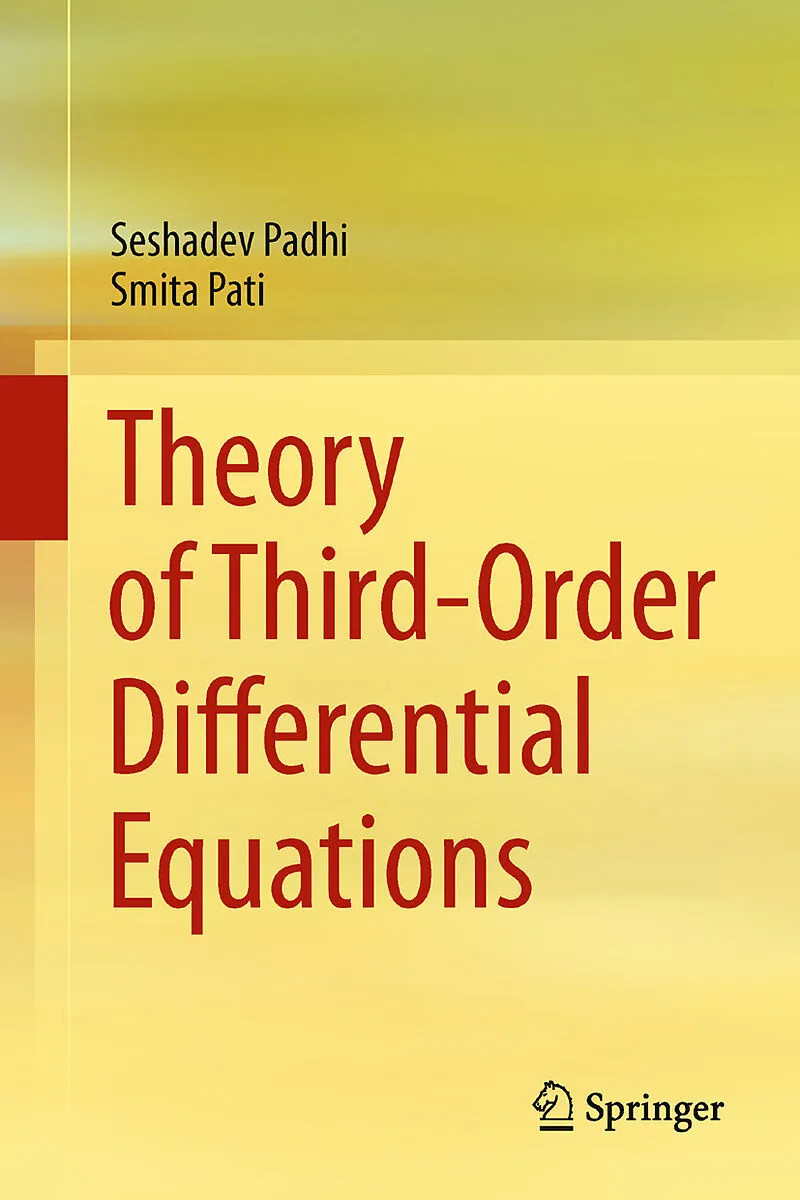
Theory of Third-Order Differential Equations
Beschreibung
As well as covering the latest results of proven effectiveness, this guide gives the reasons for their importance in the context of current theoretical approaches in third-order differential equations, including the hon-homogenous and non-linear varieties. Thi...Format auswählen
- Fester EinbandCHF 132.00
- E-Book (pdf)CHF 118.90
- Kartonierter EinbandCHF 132.00

Wird oft zusammen gekauft
Andere Kunden kauften auch
Beschreibung
As well as covering the latest results of proven effectiveness, this guide gives the reasons for their importance in the context of current theoretical approaches in third-order differential equations, including the hon-homogenous and non-linear varieties.
This book discusses the theory of third-order differential equations. Most of the results are derived from the results obtained for third-order linear homogeneous differential equations with constant coefficients. M. Gregus, in his book written in 1987, only deals with third-order linear differential equations. These findings are old, and new techniques have since been developed and new results obtained.
Chapter 1 introduces the results for oscillation and non-oscillation of solutions of third-order linear differential equations with constant coefficients, and a brief introduction to delay differential equations is given. The oscillation and asymptotic behavior of non-oscillatory solutions of homogeneous third-order linear differential equations with variable coefficients are discussed in Ch. 2. The results are extended to third-order linear non-homogeneous equations in Ch. 3, while Ch. 4 explains the oscillation and non-oscillation results for homogeneous third-order nonlinear differential equations. Chapter 5 deals with the z -type oscillation and non-oscillation of third-order nonlinear and non-homogeneous differential equations. Chapter 6 is devoted to the study of third-order delay differential equations. Chapter 7 explains the stability of solutions of third-order equations. Some knowledge of differential equations, analysis and algebra is desirable, but not essential, in order to study the topic.
Highlights the results that hold good for constant coefficient equations of third order linear differential equations Contains all the latest results, with the reasons for their importance in the present context Furthers the studies of M. Gregus, who first studied third order linear differential equations Includes supplementary material: sn.pub/extras
Autorentext
Seshadev Padhi is associate professor of mathematics at Birla Institute of Technology, Mesra, Ranchi, Jharkhand, India. He received his PhD on the topic on "oscillation theory of third order differential equations". He was awarded with the BOYSCAST (Better Opportunities for Young Scientists in Chosen Areas of Science and Technology) fellow by the Department of Science and Technology (DST), Government of India in 2004 to visit Mississippi State Univerisity, USA. Subsequently, Dr. Padhi did his post-doctoral work in Mississippi State University, USA. In addition, Dr. Padhi visited several Institutes of international repute: Florida Institute of Technology, Melbourna, Florida USA to work in Collaboration with Prof. T. Gnanabhakar in 2006; Texas State University at San Marcos, Texas, USA to work in collaboration with Prof. Julio G.Dix, in 2009; University of Tennessee at Chattanooga, Chattanooga, Tennessee, USA in 2011, 2012 and 2013 to work in collaboration with Prof. John R. Graef; University of Szeged, Szeged, Hungary in 2007 and 2011 to work in collaboration with Prof. Tibor Krisztin. Besides, he also visited ETH, Zurich, Switzerland under Borel Set Theory Programme in 2005, and also several countries to deliver lectures in different international conferences and workshops. Dr. Padhi got UNESCO travel and lodging grant to visit ICTP, Trieste, Italy in the year 2003. Dr. Padhi has published more than sixty research papers in international journals of repute. He has been working as referee for more than 30 international journals and a reviewer of Mathematical Review since 2006. John R. Graef is professor of mathematics at The University of Tennessee at Chattanooga. His research interests include ordinary and functional differential equations, difference equations, impulsive systems, differential inclusions, dynamic equations on time scales, fractional differential equations, and their applications. His special interests are in nonlinear oscillations, stability and other asymptotic properties of solutions, boundary value problems, and applications to biological systems. He has published more than 350 papers and authored or edited five books. P.D.N. Srinivasu is professor of mathematics at Andhra University, Visakhapatnam, India. He obtained his PhD in 1992 from Sri Sathya Sai Institute of Higher Learning, India, on the topic "Existential and numerical study of implicit differential equations". His research interests include mathematical modelling, population dynamics, mathematical bio-economics and optimal control. He visited several academic institutes of international repute to deliver invited lectures and participate in conferences and workshops. Prof. Srinivasu visited The International Centre for Theoretical Physics (ICTP), Trieste, Italy, many times as a visiting scientist, in addition to The Beijer International Institute of Ecological Economics, Royal Swedish Academy of Sciences, Stockholm, Sweden; Eidgenossische Technische Hochschule ( ETH), Zurich; and the University of Zurich, Switzerland. Besides working as a reviewer for many internationally journals, Prof. Srinivasu has many research papers to his credit in several journals of repute.
Inhalt
Preface .- Chapter 1: Introduction.- Chapter 2: Behaviour of Solutions of Linear Homogeneous Differential Equations of Third Order.- Chapter 3: Oscillation of Solutions of Linear Nonhomogeneous Differential Equations of Third Order.- Chapter 4: Oscillation and Nonoscillation of Homogeneous Third-order Nonlinear Differential Equations.- Chapter 5: Oscillation and Nonoscillation of Nonlinear Nonhomogeneous Differential Equations of Third Order.- Chapter 6: Oscillatory and Asymptotic Behavior of Solutions of Third Order Delay Differential Equations.- Chapter 7: Stability of Third Order Differential Equations.- References.