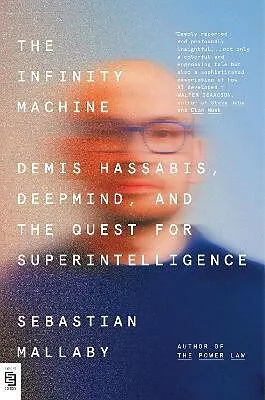
The Infinity Machine
Beschreibung
From one of our leading chroniclers of the intersection of innovation and capitalism, a landmark reckoning—based on unprecedented access—with one of the world’s most brilliant and driven tech visionaries, and his game-changing com...Format auswählen
- Kartonierter EinbandCHF 24.30
- Fester EinbandCHF 33.50

Wird oft zusammen gekauft
Andere Kunden kauften auch
Beschreibung
From one of our leading chroniclers of the intersection of innovation and capitalism, a landmark reckoning—based on unprecedented access—with one of the world’s most brilliant and driven tech visionaries, and his game-changing company
Even by the standard of a tech industry stacked with so-called geniuses, Demis Hassabis is a special case. Born poor in North London to immigrant parents—a chess prodigy by age five, and a wizard coder in his teens—he turned down a seven-figure job offer before turning eighteen to feed his insatiable scientific curiosity at the University of Cambridge. Later, he added a neuroscience PhD to his computer science skills to pursue the dream of artificial general intelligence, the ultimate goal being to unravel the mysteries of biology and theoretical physics and to usher in superabundance. Alongside a small group of fellow travelers, that is the Nobel Prize–winning path he is still on—imagining machines that will compound, or possibly supplant, the human understanding of the universe.
Hassabis has given Sebastian Mallaby a great deal of his time, sitting for over thirty hours of conversation. But Mallaby has also drawn from Hassabis’s detractors, such as his estranged DeepMind cofounder Mustafa Suleyman; from his rivals, such as OpenAI’s leading scientist Ilya Sutskever; and from academic pioneers who now fear for human survival, such as Geoffrey Hinton. The result is a revelatory account of a singular figure and his company, and a profound reckoning with this protean field as it leaps from the periphery to the center of our consciousness.
No one questions Hassabis’s brilliance. There are those who, like Elon Musk, regard him as an “evil genius.” He is in a game where the stakes are matched only by the exorbitant costs—for talent, and for compute. Celebrated scientists pursue the technology because they cannot resist the sweetness of discovery; others pursue it for money or power. The inventors believe they control their technology, but often their technology controls them.
This is not a Silicon Valley story. Hassabis deals with the Valley and takes its money, but remains outside—and furiously critical—of it, lambasting its leaders in conversation with Mallaby. The end of this race cannot be known, but as this great book shows us, Hassabis’s quest to will a new form of cognition into the world is a defining story for our era....
Autorentext
Sebastian Mallaby
Leseprobe
Chapter 1
Destiny
Partway through his doctoral research in neuroscience-when he had already been a chess master, a video game designer, an amateur theoretical physicist, an entrepreneur, a computer scientist, and five-time world champion at the international Mind Sports Olympiad-Demis Hassabis discovered a work of science fiction that made sense of who he really was. The book, called Ender's Game, by Orson Scott Card, tells the story of a diminutive boy genius who is taken from his family and sent off to a space station. There, at an intergalactic battle school, Ender is manipulated by adults, bullied by classmates, and put through extreme mental testing, all to discover whether he can shoulder responsibility for the survival of the human race. By dint of grit and talent, Ender rises to the challenge. At the climax of the novel, he outwits an army of alien invaders, destroying their armada and saving planet Earth, though the question of whether he committed genocide in the process hangs over the outcome.
Hassabis was around thirty years old when he discovered Ender, and he was so taken with the story that he asked his wife to read it. She told him she felt sorry for the central character-a boy deprived of childhood and harnessed to a mission chosen for him by adults. But Hassabis identified powerfully with Ender. He, too, had been a diminutive boy genius, socially isolated by his own prodigious talent. He, too, had undergone extreme mental testing, and was consumed by a desire to make his mark on the universe; one of his ambitions was to surpass his scientific heroes, Newton and Einstein, and "understand the fabric of reality itself." The fable of Ender-a gifted, bullied boy who saves all humanity-tapped into Hassabis's deepest preoccupations, even if (especially if!) the savior had been required to pay an immense personal price.
Some fifteen years later, now in his midforties, Hassabis sat across from me in a London restaurant, reflecting on the power of this tale. We had not stumbled on the subject by accident. Hassabis had suggested that I read the novel in advance of our first long conversation; this was a subject he wanted to tackle. If I was to get to know him, I would have to understand his science-fiction alter ego: to see the capacity for endurance, the ability to suffer and still soldier on. Like Ender, Hassabis had dedicated every fiber of his being to the accomplishment of a mission, which was why he worked night shifts from ten in the evening until around four in the morning in addition to his normal office hours. Like Ender, Hassabis felt a burden of responsibility. "If you are trying to solve humanity's problems and understand the nature of reality, you don't have any time to waste," he said.
I described this conversation to Shane Legg, one of the two cofounders who teamed up with Hassabis to form the company DeepMind. Back in 2010, when the pair of postdocs at University College London had begun fusing computer science and neuroscience, had Legg realized that he was hitching his career to someone so possessed?
At first, Legg answered warily. "I don't know if I was teaming up with a real-life Ender," he began.
But then he continued, weighing his words deliberately. "Demis has an extraordinary level of determination. Unlike pretty much anybody. Astonishing, incredible determination. That's his most defining characteristic. Just unbelievable determination."
"What do you mean?"
"He works, sleeps, eats, breathes the mission, twenty-four hours a day. To a degree that I just haven't seen with other people."
"No hobbies?"
"Football. Big fan of Liverpool. But other than that, it's the mission."
"And that was evident even back when you met him, more than a decade ago?"
"Always," Legg answered.
His face flickered, as though a memory had stirred somewhere just below the skin.
"Demis tells a story about his father saying that whether you win or lose, the really important thing is that you try your best. And Demis says he took that very literally. As in, absolutely try the absolute, absolute, absolute best you can possibly do, pretty much to the point of breaking yourself.
"That's how he is, twenty-four seven."
I nodded, kept eye contact, and hoped Legg would continue.
"I don't think his father meant his comment in quite that literal sense," Legg reflected. "Like, 'try your best' wasn't supposed to mean 'try literally to the point of destroying yourself, go absolutely, completely 100 percent.' But that's how Demis understood it.
"There is no 50 percent mode in Demis. There is not even a 99 percent mode in Demis. There is only 100 percent."
Demis Hassabis was born in modest circumstances in Finchley, North London, in July 1976. He was the eldest child of a Chinese Singaporean mother and a Greek Cypriot father, which made him an exemplary product of one of the world’s great melting pots. His mother had grown up in poverty, spending part of her childhood as an orphan on the streets of Singapore, eventually finding shelter with a benevolent relative and moving to London to study nursing. When Demis was small, she worked as a sales assistant at the John Lewis department store and took part-time jobs as a cleaner. Demis’s father had been the …