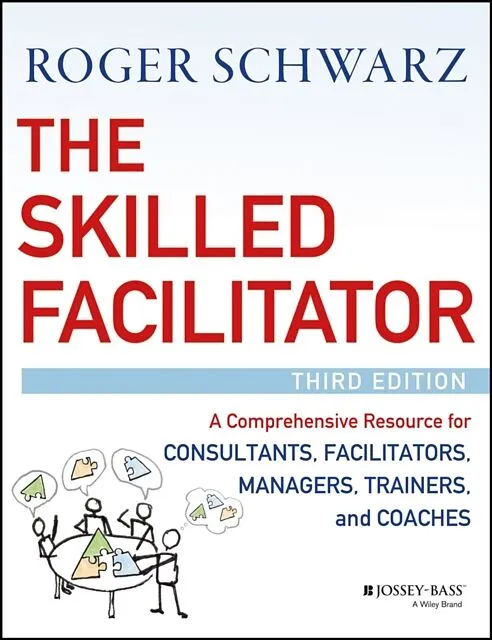
The Skilled Facilitator
Beschreibung
Autorentext ROGER SCHWARZ is an organizational psychologist and president and CEO of Roger Schwarz & Associates, Inc., a consulting firm that helps teams create fundamental change to get better results. He facilitates leadership teams and teaches, consults, co...Format auswählen
- Fester EinbandCHF 48.15

Wird oft zusammen gekauft
Andere Kunden kauften auch
Beschreibung
Autorentext
ROGER SCHWARZ is an organizational psychologist and president and CEO of Roger Schwarz & Associates, Inc., a consulting firm that helps teams create fundamental change to get better results. He facilitates leadership teams and teaches, consults, coaches, and speaks on facilitation, leadership, and developing effective teams. He is the author of Smart Leaders, Smarter Teams and The Skilled Facilitator Fieldbook, and blogs for Harvard Business Review. Contact him at www.schwarzassociates.com or find him on Twitter @LeadSmarter.
Klappentext
PRAISE FOR THE SKILLED FACILITATOR "This book replaces about a dozen that I have on my shelf. It has become the book on facilitation that aspiring and accomplished consultants should read."
**?Geoffrey Bellman,** author of The Consultant's Calling and Extraordinary Groups "There is no better guide for how to intervene effectively in organizational groups than Roger Schwarz. His incredibly useful third edition of The Skilled Facilitator adds a framework that makes clear distinctions among roles such as coach, consultant, and facilitator, and makes cogent recommendations for each role. At the heart and soul of Schwarz's wisdom is the notion of mindset?that we must first consider and alter our own thinking before we can work productively with the complexity of group dynamics."
**?Amy C. Edmondson,** Novartis Professor of Leadership and Management, Harvard Business School and author of Teaming: How Organizations Learn, Innovate and Compete in the Knowledge Economy "The Skilled Facilitator is essential reading for every group facilitator, consultant, and team coach to be grounded in the values, assumptions, principles and practice of group facilitation. In the third edition, Roger Schwarz continues to address these matters thoughtfully, coherently, and comprehensively so readers can help groups create the results they need."
**?Sandor P. Schuman,** editor of The IAF Handbook of Group Facilitation: Best Practices from the Leading Organization in Facilitation > ?Jeffrey Liker, Professor, University of Michigan and author of The Toyota Way > ?Stew Friedman, author of Total Leadership and founding director of the Wharton Leadership Program
Zusammenfassung
Help groups deliver results with an updated approach to facilitation and consulting The Skilled Facilitator: A Comprehensive Resource for Consultants, Facilitators, Trainers, and Coaches, Third Edition is a fundamental resource for consultants, facilitators, coaches, trainers, and anyone who helps groups realize their creative and problem-solving potential. This new edition includes updated content based on the latest research and revised models of group effectiveness and mutual learning. Roger M. Schwarz shows how to use the Skilled Facilitator approach to: boost improvement processes such as Six Sigma and Lean, create a psychologically safe learning environment for training, and help coaches work with teams and individuals in real-time. This edition features a new chapter that explains how to facilitate virtual teams using conferencing technology. Facilitation skills are essential in many kinds of work, and if you are looking to bring your skills up to date it is critical that you rely on trusted information like the knowledge offered in this go-to reference. * Develop the facilitative mentality and skills that enable you to help groups get better results, even in the most challenging situations * Help groups achieve greater performances, stronger working relationships, and higher levels of individual well-being * Quickly develop productive and trusting work relationships with the groups you help * Establish the functions of your facilitative role * Implement a research-based, systematic approach to diagnose and intervene in groups and improve their performance and results The Skilled Facilitator is a practical resource for corporate, government, non-profit, and educational practitioners, as well as graduate students in group-focused programs. This edition contains up-to-date material, based on recent studies, to help facilitators move beyond arbitrary tactics to utilize cutting edge, research-based strategies that improve group processes, relationships, mindsets, and outcomes.
Inhalt
Preface to the Third Edition xvii
What The Skilled Facilitator is About xvii
Who This Book is For xix
How the Book is Organized xix
Features of the Book xxii
What's Different in the Third Edition xxiii
Part One The Foundation 1
1 The Skilled Facilitator Approach 3
The Need for Group Facilitation 3
Most People Who Need to Facilitate Aren't Facilitators 3
Is This Book for You? 4
The Skilled Facilitator Approach 8
Experiencing the Skilled Facilitator Approach 10
Making the Skilled Facilitator Approach Your Own 11
Summary 12
2 The Facilitator and Other Facilitative Roles 13
Choosing a Facilitative Role 13
Basic and Developmental Types of Roles 23
Serving in Multiple Facilitative Roles 25
When It's Appropriate to Leave the Role of Facilitator 25
The Group is Your Client 28
What is Your Responsibility for the Group's Results? 29
Summary 33
3 How You Think is How You Facilitate: How Unilateral Control Undermines Your Ability to Help Groups 35
How You Think: Your Mindset as an Operating System 36
Two Mindsets: Unilateral Control and Mutual Learning 37
How You Think is Not How You Think You Think 37
The CIO Team Survey Feedback Case 38
The Unilateral Control Approach 41
Values of the Unilateral Control Mindset 41
Assumptions of the Unilateral Control Mindset 45
Unilateral Control Behaviors 46
Results of Unilateral Control 50
Give-Up-Control Approach 55
How Unilateral Control Reinforces Itself 55
How Did We Learn Unilateral Control? 56
Moving from Unilateral Control to Mutual Learning 57
Summary 58
4 Facilitating with the Mutual Learning Approach 59
The Mutual Learning Approach 59
Values of the Mutual Learning Mindset 61
Assumptions of the Mutual Learning Mindset 75
Mutual Learning Behaviors 77
Results of Mutual Learning 80
The Reinforcing Cycles of Mutual Learning 84
Are There Times When Unilateral Control is the Better Approach? 85
Summary 86
5 Eight Behaviors for Mutual Learning 87
Using the Eight Behaviors 87
Behavior 1: State Views and Ask Genuine Questions 89
Behavior 2: Share All Relevant Information 94
Behavior 3: Use Specific Examples and Agree on What Important Words Mean 97
Behavior 4: Explain Reasoning and Intent 99
Behavior 5: Focus on Interests, Not Positions 101
Behavior 6: Test Assumptions and Inferences 103
Behavior 7: Jointly Design Next Steps 114
Behavior 8: Discuss Undiscussable Issues 117
Learning to Use the Behaviors 119
Summary 120
6 Designing and Developing Effective Groups 121
How a Team Effectiveness Model Helps You and the Teams and Groups You Work With 122
The Difference between Teams and Groups-and Why It Matters 122
How Interdependence Affects Your Work with Teams and Groups 127
The Team Effectiveness Model 128
What's Your Mindset as You Design? 132
Team Structure, Process, and Context 133
Team Structure 134
Team Process 139
Team Context 143
Interorganizational Teams and Groups 150
Helping Design or Redesign a Team or Group 150
Summary 153
Part Two Diagnosing and Intervening with Groups 155
7 Diagnosing and Intervening with Groups 157
What You Need to Diagnose 158
What You Need to Intervene 160
The Mutual Learning Cycle 160
Summary 163
8 How to Diagnose Groups 165
Step 1: Observe Behavior 165
Step 2: Make Meaning 171
Step 3: Choose Whether, Why, and How to Intervene 178
Challenges in Diagnosing Behavior and How to Manage Them 186
Summary 192
9 How to Intervene with Groups 193
Key Elements of the Intervention Steps 193
Using the Mutual Learning Cycl…