Beschreibung
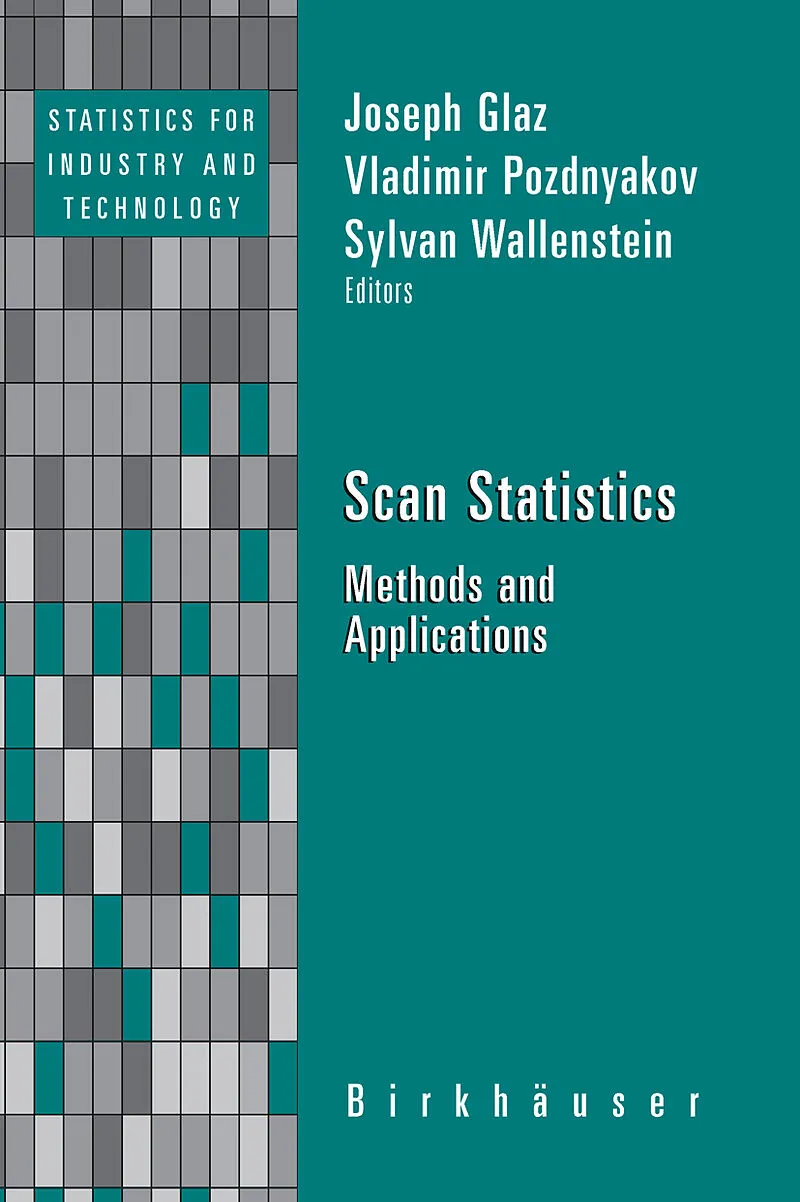
Scan statistics is currently one of the most active and important areas of research in applied probability and statistics, having applications to a wide variety of fields: archaeology, astronomy, bioinformatics, biosurveillance, molecular biology, genetics, c...Scan statistics is currently one of the most active and important areas of research in applied probability and statistics, having applications to a wide variety of fields: archaeology, astronomy, bioinformatics, biosurveillance, molecular biology, genetics, computer science, electrical engineering, geography, material sciences, physics, reconnaissance, reliability and quality control, telecommunication, and epidemiology.
Filling a gap in the literature, this self-contained volume brings together a collection of selected chapters illustrating the depth and diversity of theory, methods and applications in the area of scan statistics. The chapters are written by leading experts in the field of scan statistics. Key features include many current results and new directions for future research; challenging theoretical methodological research problems; presentation accessible to both statisticians and scientists from other disciplines where scan statistics are employed; emphasis on real-world applications to areas such as bioinformatics and biosurveillance; and extensive references to research articles, books, and relevant computer software.
Scan Statistics is an excellent reference for graduate students and researchers in applied probability and statistics, as well as for scientists in biology, computer science, pharmaceutical science, medicine, geography, quality control, communications, and epidemiology. The work may also be used as a textbook for a graduate-level seminar on scan statistics.
Presentation is accessible to statisticians as well as to scientists from other disciplines where scan statistics are employed Many current results and new directions for future research are featured Contains extensive references to research articles, books, and relevant computer software May be used as a textbook for a graduate-level seminar on scan statistics
Autorentext
Joseph Glaz has been appointed (effective July 1, 2011) as head of the Department of Statistics, University of Connecticut. He has co-authored several books. Glaz is the current editor-in-chief of the following Springer journal: Methodology and Computing in Applied Probability.
Honors and Awards include : election to the Connecticut Academy of Arts and Sciences (2011), elected fellow of the Institute of Mathematical Sciences (2009), AAUP Excellence in Research Award (2006), Abraham Wald Prize in Sequential Analysis (2006), elected fellow of the American Statistical Assoc. (2000), elected member of the International Statistical Institute (1999).
Most importantly, Joe Glaz has worked closely with Joseph Naus, the father of scan statistics, since this area of statistics was conceived around 1999.
Inhalt
Joseph Naus: Father of the Scan Statistic.- Precedence-Type Tests for the Comparison of Treatments with a Control.- Extreme Value Results for Scan Statistics.- Boundary Crossing Probability Computationsin the Analysis of Scan Statistics.- Approximations for Two-Dimensional Variable Window Scan Statistics.- Applications of Spatial Scan Statistics: A Review.- Extensions of the Scan Statistic for the Detection and Inference of SpatialClusters.- 1-Dependent Stationary Sequences and Applications to Scan Statistics.- Scan Statistics in Genome-Wide Scan for Complex Trait Loci.- On Probabilities for Complex Switching Rules in Sampling Inspection.- Bayesian Network Scan Statistics for Multivariate Pattern Detection.- ULS Scan Statistic for Hotspot Detection with Continuous Gamma Response.- False Discovery Control for Scan Clustering.- Martingale Methods for Patterns and Scan Statistics.- How Can Pattern Statistics Be Useful for DNA Motif Discovery?.- Occurrence of Patterns and Motifs in Random Strings.- Detection of Disease Clustering.