
IHR WARENKORB IST AKTUELL LEER.
Haben Sie noch nichts passendes gefunden? Stöbern Sie durch unser komplettes Sortiment.
Oder melden Sie sich an bzw. registrieren Sie sich.
- Kostenlose Lieferung
- Kauf auf Rechnung
- Ex Libris Tiefpreis
- Filiallieferung und 650+ Abholorte
- Rabatt-Bons als Club-Mitglied
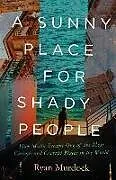
A Sunny Place for Shady People
Beschreibung
Autorentext Ryan Murdock is the author of Vagabond Dreams: Road Wisdom from Central America and editor-at-large (Europe) for Outpost, Canada’s national travel magazine. He shares his love of travel literature through the Personal Landscapes podcast and w...Format auswählen
- Fester EinbandCHF 29.50

Wird oft zusammen gekauft
Andere Kunden kauften auch
Beschreibung
Autorentext
Ryan Murdock is the author of Vagabond Dreams: Road Wisdom from Central America and editor-at-large (Europe) for Outpost, Canada’s national travel magazine. He shares his love of travel literature through the Personal Landscapes podcast and writes regularly for The Shift, an independent Maltese news portal. He lives in Berlin.
Klappentext
The car bomb assassination of Maltese investigative journalist Daphne Caruana Galizia in 2017 shocked the European Union and put the world’s spotlight on an island so small that few knew it was an independent country and even fewer could find it on the map. But Caruana Galizia’s death didn’t come as a surprise to those who lived there.
Ryan Murdock had visions of living a slow-paced island life on the Mediterranean while writing about his experiences, so in 2011 he moved from Canada to Malta. To the casual visitor, Malta is a sleepy place with sun-soaked shorelines and ancient fortified harbors. Murdock imagined it to be an archipelago island of warm weather, gorgeous views, busy cafes, and grilled fish dinners. On the surface, it was.
The six years Murdock spent in Malta revealed an insular culture whose fundamental baseline is amoral familism, a worldview in which any action taken to benefit one’s family or oneself is justifiable, regardless of whether it is legal or ethical. In such a place murder may or may not be wrong, depending on what one thinks of another’s politics. This pervasive perspective created a culture of corruption that rose all the way to the top of the island nation. The office of the prime minister was implicated in Caruana Galizia’s murder, and the investigation continues to reveal a government mired in money laundering, human trafficking, fuel smuggling, and the sale of EU passports to Russian and Middle Eastern oligarchs.
Interspersed with personal narrative, Murdock delves into Malta’s unique geopolitical, cultural, ethnic, and religious history—one that transformed it from a hub of prehistoric rule into a modern society where a powerful cabal of political and business leaders nearly got away with murder.
Zusammenfassung
A personal and critical examination of how a powerful cabal on the Mediterranean island nation of Malta planned an assassination
Leseprobe
I was visiting family in Canada when I got a late-evening text from my wife on October 16, 2017: “They killed Daphne with bomb.”
“Daphne” was Daphne Caruana Galizia, an independent Maltese journalist whose investigations into government corruption had made her a target of the country’s rich and powerful—especially the ruling Labour Party, which saw her as its only real opposition. The last story she had written was about a court appearance by the prime minister’s chief of staff, Keith Schembri, earlier that day. It ended with the words “There are crooks everywhere you look now. The situation is desperate.” She published her article, closed her laptop, and stood up to go to the bank, where she’d been cashing checks on her husband’s account because hers was still frozen by the economy minister.
Before leaving her peaceful hilltop home surrounded by gardens in rural Bidnija, she set a plate of tomatoes and mozzarella in front of her son Matthew, a data journalist who had shared a Pulitzer Prize as part of the International Consortium of Investigative Journalists that broke the Panama Papers, an expose of the secret world of offshore tax havens. The two were sifting through a database of 11.5 million leaked financial and legal records to figure out why two top government officials opened companies in Panama within days of the Labour Party’s election to power.
She ran out the door, then rushed back in to grab her checkbook. “Okay, I’m really going this time,” she said, smiling at Matthew. The explosion happened minutes after she drove away. She was fifty-three years old.
A neighbor who saw Daphne driving down the hill toward him told police he immediately sensed that something was wrong. “She appeared to be panicking,” he said. “I heard a small bang, like fireworks. Then I heard a piercing scream.”
The first explosion tore off her leg and scattered debris nearby, but she’d only just begun to scream when, seconds later, a larger explosion engulfed her car in a ball of fire.
“I saw parts of her ripped off,” the neighbor said. “Her hand flew off. It was terrible. Then I saw blood . . . I realized they were human parts. I could do nothing. It was so cruel.”
The blast shook the house where Matthew was hunched over his laptop. He ran out the door in a panic and saw a column of black smoke boiling into the sky from somewhere down the hill. His legs were shaking so badly he could barely run. The road was on fire when he reached the scene, where bloody pieces of his mother were scattered across a field.
The car’s horn continued to blare as he ran back and forth, frantic but unable to approach the inferno. He was looking for something to pry open the door when he saw a severed leg on the ground. Two young police officers arrived minutes later. One grabbed a fire extinguisher and ran toward the smoke but then stopped and dropped it on the ground. Matthew tried to take it from him, screaming, “What are you doing? What are you doing?” The officer placed a hand on his shoulder and said, “There’s nothing we can do.” As they stood there watching the car go up in flames, the other policeman began to cry.
Firefighters and Civil Protection Department officials described finding a person inside the burning car and pieces of flesh scattered around the bomb site, including “a leg ripped apart from the thigh.” Civil protection officer Frank Sammut said, “I saw a human hand on the passenger side and a burning figure inside. Nothing could be done.” Firefighters would return two days later to chop down a tree so investigators could search its branches for human remains.
Photos of Daphne’s burned body parts were circulated on WhatsApp and other digital messaging services within hours of her death. They were taken at the crime scene, evidently by police. At around the same time, police sergeant Raymond Mifsud posted a message to his Facebook page that read, “Everyone gets what they deserve, cow dung! Feeling happy :)”
He would eventually be suspended with pay but never dismissed. Loyalists in closed Labour Party Facebook groups, whose membership included senior government officials, celebrated her death with statements like “ma tistax rip ghax saret bicciet lanqas tista titqaleb ahseb u ara carma is a bich [sic]” (“She can’t rest in peace because she’s in pieces, she can’t even be buried, karma is a bitch”).
The killing made headlines around the world as readers with no understanding of Malta tried to make sense of the targeted murder of a journalist in a European Union member state. Prime minister Joseph Muscat appeared on CNN, where he told Christiane Amanpour he would “leave no stone unturned” in finding out who killed the woman he described as his “harshest critic.” He seemed to have difficulty suppressing a smirk as he spoke. His wife was more direct in an exclusive media interview nine months later. “If there is someone who wants Daphne Caruana Galizia to be alive today, that is me,” Michelle Muscat said. “When I heard the news about what happened to her, I think I was more sorry than her own family. Her family could go on to make her a saint; but at the time I said to myself, ‘Now I will have to live with her lies.’ I want her alive.”
The pr…