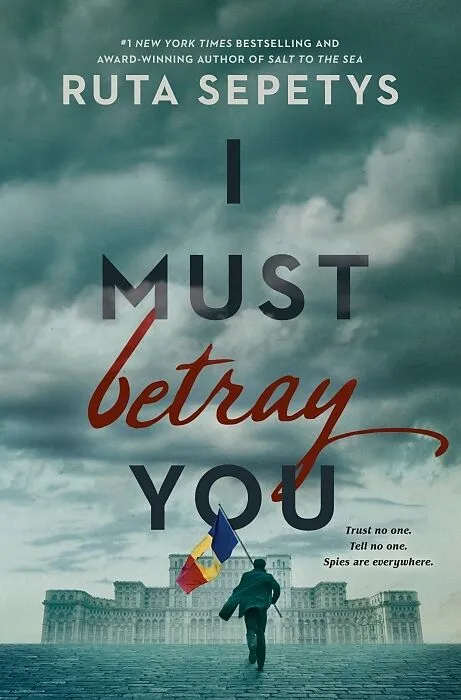
I Must Betray You
Beschreibung
“As educational as it is thrilling...[T]he power of I Must Betray You [is] it doesn’t just describe the destabilizing effects of being spied on; it will make you experience them too.” –New York Times Book Review ★ "Sepetys brillia...Format auswählen
- Fester EinbandCHF 24.30

Wird oft zusammen gekauft
Andere Kunden kauften auch
Beschreibung
“As educational as it is thrilling...[T]he power of I Must Betray You [is] it doesn’t just describe the destabilizing effects of being spied on; it will make you experience them too.” –New York Times Book Review
**★ "**Sepetys brilliantly blends a staggering amount of research with heart, craft, and insight in a way very few writers can. Compulsively readable and brilliant." **–Kirkus Reviews, starred review
★** "Sepetys once again masterfully portrays a dark, forgotten corner of history." **–Booklist, starred review
★ "**Sepetys’s latest book maintains the caliber readers have come to expect from an author whose focus on hidden histories has made her a YA powerhouse of historical fiction…Sepetys is a formidable writer, and her stories declare the need to write about global issues of social injustice. For that reason and her attention to detail, this is a must-read." –School Library Journal, starred review
**★ "**Cristian’s tense first-person narrative foregrounds stark historical realities, unflinchingly confronting deprivations and cruelty while balancing them with perseverance and hope as Romania hurtles toward political change." –Publishers Weekly, starred review
"A master class in pacing and atmosphere." –BookPage
Autorentext
Ruta Sepetys (www.rutasepetys.com) is an internationally acclaimed, #1 New York Times bestselling author of historical fiction published in over sixty countries and forty languages. Sepetys is considered a "crossover" novelist, as her books are read by both teens and adults worldwide. Her novels Between Shades of Gray, Out of the Easy, and Salt to the Sea have won or been shortlisted for more than forty book prizes, and are included on more than sixty state award lists. Between Shades of Gray was adapted into the film Ashes in the Snow, and her other novels are currently in development for TV and film. Winner of the Carnegie Medal, Ruta is passionate about the power of history and literature to foster global awareness and connectivity. She has presented to NATO, to the European Parliament, in the United States Capitol, and at embassies worldwide. Ruta was born and raised in Michigan and now lives with her family in Nashville, Tennessee. Follow her on Twitter and Instagram @RutaSepetys.
Klappentext
**#1 NEW YORK TIMES BESTSELLER • A gut-wrenching, startling historical thriller about a young man in communist Romania who dared to resist the spy network that devastated a nation, from the award-winning author of Salt to the Sea and Between Shades of Gray.
- "Sepetys brilliantly blends a staggering amount of research with heart, craft, and insight in a way very few writers can. Compulsively readable and brilliant."—Kirkus Reviews (starred review)
WINNER OF THE CARNEGIE MEDAL**
Romania, 1989. Communist regimes are crumbling across Europe. Seventeen-year-old Cristian Florescu dreams of becoming a writer, but Romanians aren’t free to dream; they are bound by rules and force.
Amidst the tyrannical dictatorship of Nicolae Ceaușescu in a country governed by isolation and fear, Cristian is blackmailed by the secret police to become an informer. He’s left with only two choices: either betray everyone and everything he loves, or use his position to creatively undermine the most notoriously evil dictator in Eastern Europe.
Cristian risks everything to unmask the truth behind the regime, give voice to fellow Romanians, and expose to the world what is happening in his country. He eagerly joins the revolution to fight for change when the time arrives. But what is the cost of freedom?
Master storyteller Ruta Sepetys is back with a historical thriller that examines the little-known history of a nation defined by silence, pain, and the unwavering conviction of the human spirit.
Leseprobe
1
Unu
Fear arrived at five o’clock.
It was October. A gray Friday.
If I had known? I would have run. Tried to hide.
But I didn’t know.
Through the dim half-light of the school corridor I spotted my best friend, Luca. He walked toward me, passing the tedious sign shouting from the concrete wall.
New Men of Romania:
Long live Communism—the bright future of mankind!
At the time, my mind churned on something far from communism. Something more immediate.
School dismissed at 7:00 p.m. If I left at the right moment, I’d fall into step with her—the quiet girl with the hair hiding her eyes. It would feel coincidental, not forced.
Luca’s tall, thin frame edged in beside me. “It’s official. My stomach’s eating itself.”
“Here.” I handed him my small pouch of sunflower seeds.
“Thanks. Did you hear? The librarian says you’re a bad influence.”
I laughed. Maybe it was true. Teachers referred to Luca as “sweet” but said I was sarcastic. If I was the type to throw a punch, Luca was the type to break up a fight. He had an eagerness about him, while I preferred to evaluate and watch from afar.
We paused so Luca could talk to a group of loud girls. I waited, impatient.
“Hei, Cristian,” smiled one of the girls. “Nice hair, do you cut it with a kitchen knife?”
“Yeah,” I said softly. “Blindfolded.” I gave Luca a nod and continued down the hall alone.
“Pupil Florescu!”
The voice belonged to the school director. He lingered in the hallway, speaking with a colleague. Comrade Director shifted his weight, trying to appear casual.
Nothing was ever casual.
In class, we sat erect. Comrade Instructor lectured, bellowing at our group of forty students. We listened, stock still and squinting beneath the sickly light. We were marked “present” in attendance but were often absent from ourselves.
Luca and me, we wore navy suits and ties to liceu. All boys did. Girls, navy pinafores and white hair bands. Embroidered badges sewn onto our uniforms identified which school we attended. But in the fall and winter, our school uniforms weren’t visible. They were covered by coats, knitted mufflers, and gloves to combat the bitter cold of the unheated cement building.
Cold and dark. Knuckles aching. It’s hard to take notes when you can’t feel your fingers. It’s difficult to concentrate when the electricity snaps off.
The director cleared his throat. “Pupil Florescu,” he repeated. “Proceed to the office. Your father has left a message for you.”
My father? My father never came to school. I rarely saw him. He worked twelve-hour shifts, six days a week at a furniture factory.
A slithering knot coiled inside my stomach. “Yes, Comrade Director.”
I proceeded to the office as I was told.
Could outsiders understand? In Romania, we did as we were told.
We were told a lot of things.
We were told that we were all brothers and sisters in communism. Addressing each other with the term “comrade” reinforced that we were all equal, with no social classes to divide us. Good brothers and sisters in communism followed rules.
I pretended to follow rules. I kept things to myself, like my interest in poetry and philosophy. I pretended other things too. I pretended to lose my comb, but really just preferred my hair spiky. I pretended not to notice when girls were looking at me. And this one—I pretended that studying English was a commitment to my country.
“Words are weapons. I’ll be able to fight our American and British enemies with words, not only guns.”
That’s what I said.
Our weapons course was called Preparing Youth for Defending the Country. We began training with guns at age fourteen …