Flexible Robot Dynamics and Controls
Beschreibung
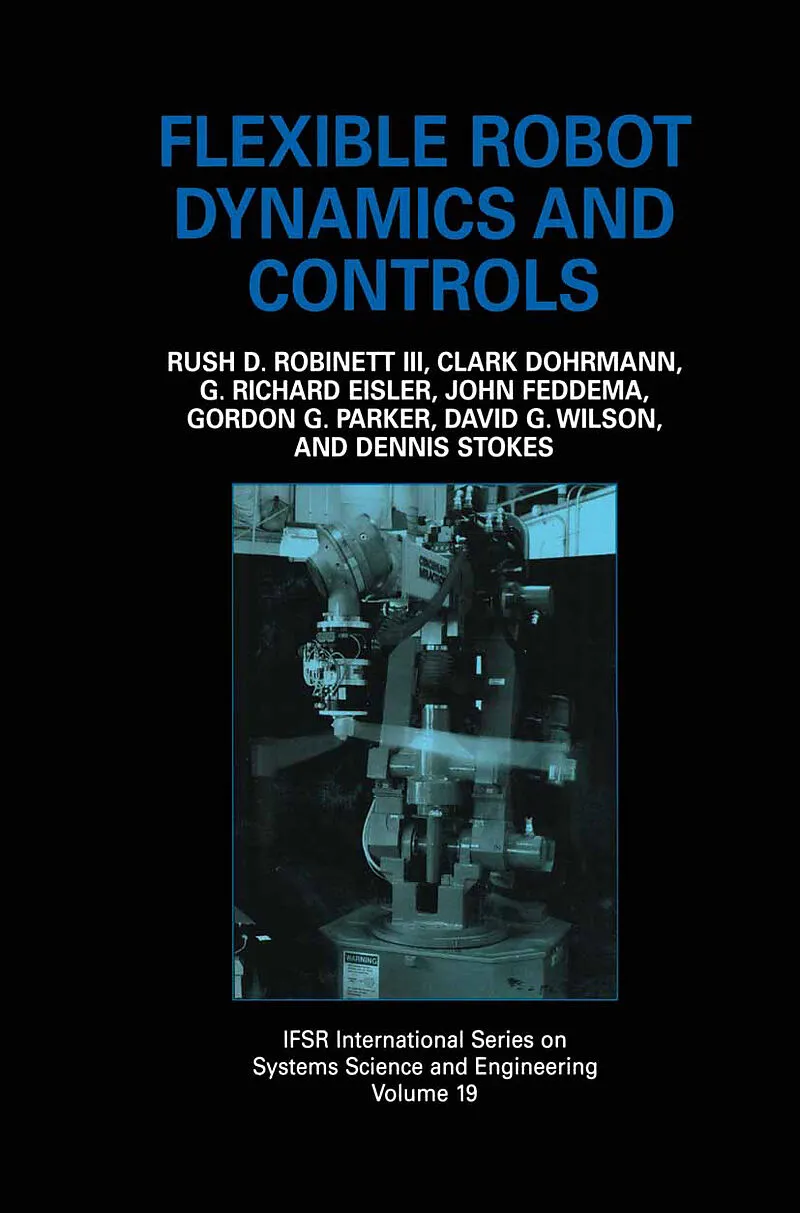
This book is the result of over ten (10) years of research and development in flexible robots and structures at Sandia National Laboratories. The authors de cided to collect this wealth of knowledge into a set of viewgraphs in order to teach a graduate class i...Format auswählen
- Kartonierter EinbandCHF 165.20
- Fester EinbandCHF 227.20

Wird oft zusammen gekauft
Andere Kunden kauften auch
Beschreibung
This book is the result of over ten (10) years of research and development in flexible robots and structures at Sandia National Laboratories. The authors de cided to collect this wealth of knowledge into a set of viewgraphs in order to teach a graduate class in Flexible Robot Dynamics and Controls within the Mechanical En gineering Department at the University of New Mexico (UNM). These viewgraphs, encouragement from several students, and many late nights have produced a book that should provide an upper-level undergraduate and graduate textbook and a reference for experienced professionals. The content of this book spans several disciplines including structural dynam ics, system identification, optimization, and linear, digital, and nonlinear control theory which are developed from several points of view including electrical, me chanical, and aerospace engineering as well as engineering mechanics. As a result, the authors believe that this book demonstrates the value of solid applied theory when developing hardware solutions to real world problems. The reader will find many real world applications in this book and will be shown the applicability of these techniques beyond flexible structures which, in turn, shows the value of mul tidisciplinary education and teaming.
From the reviews:
"'Flexible Robot Dynamics and Controls' is the result of more than 10 years of research and development in flexible robots and structures at Sandia National Laboratories. the aim of the author to provide an upper-level undergraduate and graduate textbook and a reference for experienced professionals in the fields of flexible robot dynamics and controls has been achieved. The manner of presentation seems to be comprehensive and a valuable addition to the literature for practitioners and researchers working in control of elastic structures." (Amit Ailon, Automatica, Vol. 41, 2005)
Autorentext
Rush D. Robinett III gained his PhD from Texas A&M University in 1987 and has since worked at Sandia National Laboratories. In 2002 he was recruited by the Director as Deputy Director of the Energy and Transportation Security Center to oversee the "reinvention" of the SNL's stagnated applied energy programs. He provides the "technical horsepower" behind new and reinvigorated programs in renewable energy supply and in energy security for the Department of Defense. He is the designer of the sustainability metric at the heart of the Center Vision and Strategic Plan. In early 2008 Doctor Robinett was nominated to participate in the Intergovernmental Panel on Climate Change scoping meeting on renewable energy sources and climate change and then, following acceptance of its proposals to the IPCC plenary which he helped to write, he is now helping to compose the IPCC report on renewable energy as lead author within the geothermal energy section. In December 2008, Doctor Robinett was invited (and has agreed) to serve on the United States Air Force Scientific Advisory Board (SAB) summer study on "Alternative Sources of Energy for USAF bases". During his previous appointment, from 1996-2002 as a Manager of Technical Staff, Doctor Robinett developed a strong research department in controls, optimisation, sensors and computer vision applied to advanced manufacturing, robotics and biomedical engineering (overseeing 28 staff members and 10 PhDs). This has since been split into two departments (Controls and Sensors) and has secured in excess of $20 million in research funding from various agencies in the past four year for a cross-disciplinary initiative "Engineering Collectives". He is at present working to expand this by conducting research and developing new business opportunities in decentralized, indigenous, sustainable energy infrastructures. The Engineering Collectives research and business organisation is coupled with a graduate program established by DoctorRobinett during time as an Adjunct Professor at New Mexico Institute of Mining and Technology between 2002 and 2006. David Wilson earned his PhD from the University of New Mexico in 2000 and having worked as an engineer wit the Rockwell International Space Division and Boeing Defense and Space Group. Since 2000 he has been a Chief Research and Design Analyst for WAYA Research Inc. and has held various posts at Sandia National Laboratories most recently between 2004 and 2007 as a Senior Member of the Technical Staff working in energy infrastructure analysis and exergy/entropy control design methodologies which work continued in his present position as Principal Member of the Technical Staff together with new work on active load alleviation control system development in the Wind Energy Department and the development of nonlinear control design methods for general nonlinear systems.
Klappentext
This volume will guide professional engineers whose disciplines include: robotics, controls, mechanical, electrical, computer science and electrical, etc., to a better, or first understanding of how to develop and control robotics or other systems with inherent or desirable structural flexibility. Furthermore, senior and graduate mechanical, electrical, and computer science engineering students, particular those new to a government or private sector research institution, will benefit from the academic study of this volume. In addition, it will guide the reader through a review and application of several necessary advanced mathematics, engineering and scientific principles.
Inhalt
1 Introduction.- 1.1. Sandia National Laboratories.- 1.2. Flexible Robotics Research Historical Background.- 1.3. Outline of the Book.- 1.4. Chapter 1 Summary.- 1.5. Chapter 1 References.- 1.6. Chapter 1 Problems.- 2 Mathematical Preliminaries.- 2.1. Introduction.- 2.2. Linear Algebra.- 2.3. Linear Control Systems.- 2.4. Digital Systems.- 2.5. Calculus of Variations.- 2.6. Hamilton's Principle & Lagrange's Equations.- 2.7. Analytical Optimization.- 2.8. Numerical Optimization.- 2.9. Chapter 2 Summary.- 2.10. Chapter 2 References.- 2.11. Chapter 2 Problems.- 3 Flexible Robot Dynamic Modeling.- 3.1. Introduction.- 3.2. Flexible Link Modeling Preliminaries.- 3.3. The Method of Quadratic Modes.- 3.4. Planar Flexible Robot Dynamics.- 3.5. Actuator Dynamics.- 3.6. Chapter 3 Summary.- 3.7. Chapter 3 References.- 3.8. Chapter 3 Problems.- 4 System Identification.- 4.1. Introduction.- 4.2. Linear Least Squares (LSS).- 4.3. Nonlinear Least Squares.- 4.4. Homotopy Methods.- 4.5. Robot and Actuator System ID.- 4.6. Chapter 4 Summary.- 4.7. Chapter 4 References.- 4.8. Chapter 4 Problems.- 5 Input Shaping for Path Planning.- 5.1. Introduction.- 5.2. Analytic Solutions for Input Shaping.- 5.3. Input Shaping Filters.- 5.4. Constrained Optimization with RQP.- 5.5. Dynamic Programming.- 5.6. Chapter 5 Summary.- 5.7. Chapter 5 References.- 5.8. Chapter 5 Problems.- 6 Linear Feedback Control.- 6.1. Introduction.- 6.2. PD Control of a Gantry Robot.- 6.3. Lag-Stabilized Feedback Control.- 6.4. Non-collocated Controls.- 6.5. Feedforward Control.- 6.6. Linear Quadratic Regulator.- 6.7. Linear Optimal Estimation.- 6.8. Linear Quadratic Gaussian (LQG) Control.- 6.9. Chapter 6 Summary.- 6.10. Chapter 6 References.- 6.11. Chapter 6 Problems.- 7 Nonlinear Systems and Sliding Mode Control.- 7.1.Introduction.- 7.2. State-Space Representation of a Dynamic System.- 7.3. Stability.- 7.4. Sliding Mode Control.- 7.5. Chapter 7 Summary.- 7.6. Chapter 7 References.- 7.7. Chapter 7 Problems.- 8 Adaptive Sliding Mode Control.- 8.1. Introduction.- 8.2. Adaptive Sliding Mode Control.- 8.3. Examples.- 8.4. Chapter 8 Summary.- 8.5. Chapter 8 References.- 8.6. Chapter 8 Problems.- Appendix A: VFO2AD Optimization.- Appendix C: Hardware &: Software Support.


