
IHR WARENKORB IST AKTUELL LEER.
Haben Sie noch nichts passendes gefunden? Stöbern Sie durch unser komplettes Sortiment.
Oder melden Sie sich an bzw. registrieren Sie sich.
- Kostenlose Lieferung
- Kauf auf Rechnung
- Ex Libris Tiefpreis
- Filiallieferung und 650+ Abholorte
- Rabatt-Bons als Club-Mitglied
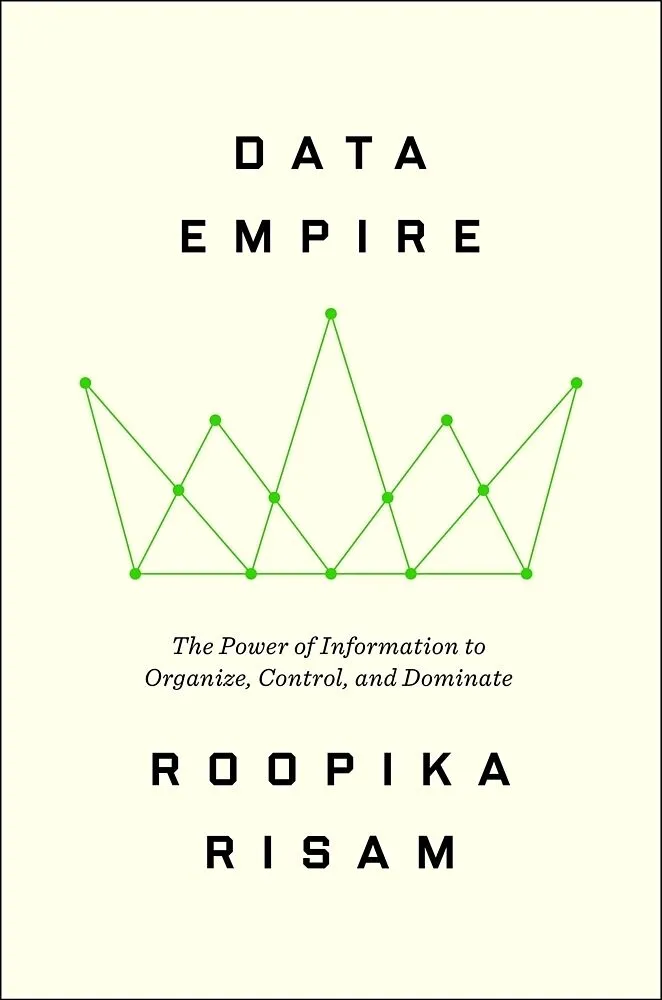
Data Empire
Beschreibung
A groundbreaking new lens on human history arguing that data has always been the seed of power--those who hold it have drawn and enforced borders, exploited nature, and governed lives--and that reckoning with this legacy must galvanize us to resist it. Histori...Format auswählen
- Fester EinbandCHF 38.80

Wird oft zusammen gekauft
Andere Kunden kauften auch
Beschreibung
A groundbreaking new lens on human history arguing that data has always been the seed of power--those who hold it have drawn and enforced borders, exploited nature, and governed lives--and that reckoning with this legacy must galvanize us to resist it. Historians have pointed to guns, germs, steel, religion, agriculture, and the female body as the engines of human history. But what do they all have in common? Every human approach to power and domination has involved collecting data--from tracking where and how long animals live to sharpen the hunt, to classifying our fellow humans by sex, race and religion to stratify, isolate, and subjugate them. Recording and mastering data has always been the foundation of rule--and we are living through it now, too. In Data Empire, Roopika Risam uncovers the hidden history of data as a force that has shaped civilizations, upheld empires, and controlled lives. From ancient cave markings and knotted strings to colonial censuses and modern digital surveillance, Risam shows how data has always been a technology of control. In this paradigm-shifting study, Risam confronts how data has deepened inequality, justified conquest, and fueled racial hierarchies over 11,000 years. Empire was never just about weapons or ships, she argues. It was built on information that now rules us. Both a sweeping history and a sharp critique, Data Empire is a call to recognize the power data holds--and to imagine what resistance looks like in an age defined by it. The story of humanity is the story of data--and knowing its past is the first step to breaking its grip on our lives and futures.
Autorentext
Roopika Risam is Professor of Digital Humanities and Social Engagement at Dartmouth. Her research explores how histories of race, empire, and technology shape the modern world. She is the author of New Digital Worlds: Postcolonial Digital Humanities in Theory, Praxis, and Pedagogy, taught in over 150 universities worldwide, and co- editor of four collections, including Anti-Racist Community Engagement and The Digital Black Atlantic. Her work has been supported by over $4.3 million in grants from the NEH, Mellon Foundation, and others. She is also known for her public scholarship and digital projects, including Torn Apart/Separados, which visualized the U.S. government's family separation policy at the border. Risam is past president of the Association for Computers and the Humanities, the U.S. scholarly organization for digital research in the humanities.
Klappentext
BARACK OBAMA’S 2026 SUMMER READING PICK
An NPR, New Scientist, Nautilus, and Next Big Idea Club Best Book of the Month
“Here is the new history of mankind demanded by our times.” —Jaron Lanier, author of Who Owns the Future?
“A must-read.”—NPR, “15 Books Our Critics Can’t Wait to Read This Summer”
“Essential reading for understanding the opportunities and dangers of the technological revolution now transforming our world.” —Jonathan Kennedy, author of Pathogenesis
From clay tablets to the algorithmic state, a groundbreaking new lens on human history arguing that information has always been the seed of power, for readers of Nexus and The Age of Surveillance Capitalism.
Long before writing existed, at the dawn of civilization in Mesopotamia, rulers pressed marks into clay to keep track of land, people and grain. To rule, they had to keep count. It is no accident, then, that the first written name in human history was neither a god nor a king, but an accountant.
As ships and navigation expanded our horizons, a new age of European empires took control of more than 80 percent of the world’s surface using censuses, maps and ledgers to decide who belonged, who owed, and who could be sacrificed. Today, we live in the third great era, when trading our information for access can feel harmless or inevitable – yet from targeted advertising to border policing and mass surveillance, data shapes the course of our lives.
With our earliest tools like ancient cave markings and knotted strings, to colonial record-keeping and the algorithmic state, Data Empire reveals how data has always been the seed of power: a technology of control that has shaped civilizations and upheld empires. Empire was never just about weapons or ships. It was built on collecting information on us, to rule us. Both a sweeping history and a sharp critique, Data Empire is a call to recognize the power data holds—and to imagine what resistance looks like in an age defined by it. In looking at the history of data, readers will understand:
- Data made civilization possible: Long before algorithms and AI, systems of counting, recording, and organizing information enabled everything from agriculture to taxation. The infrastructures of data are as old as cities themselves, and they are the precondition for large-scale human coordination.
- Every system of data is also a system of power: From clay tablets in Mesopotamia to colonial censuses to modern databases, data determines who is visible, who is legible, and who can be governed.
- The modern data state was built in moments of crisis: In the twentieth century, governments became vast information-processing systems. What we now think of as "data” was created in response to economic collapse and geopolitical conflict.
- The “data” we know now is built on much older inequalities: Today’s digital systems inherit the logics of earlier recordkeeping regimes, including those shaped by colonialism, racial classification, and forms of government that extract from land and from populations. The biases we see in algorithms are not new but continuations of a long history.
- We are living through a transformation in who controls data—and therefore power: For most of history, data infrastructures were largely state-driven. Today, they are increasingly owned and operated by private corporations, even as they structure public life. This shift raises urgent questions about accountability, sovereignty, and the future of public life.