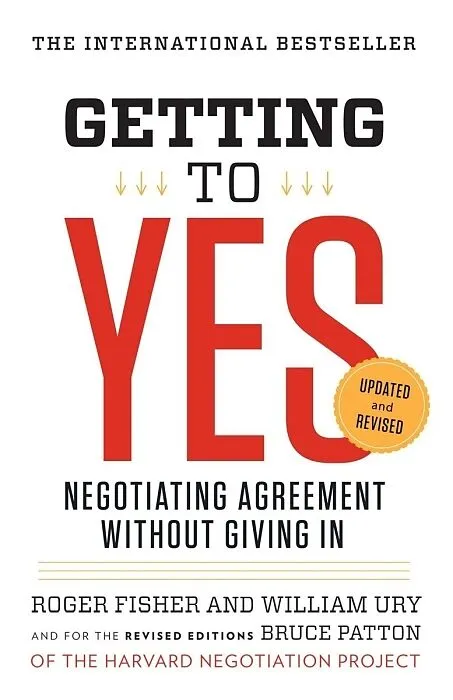
Getting to Yes
Beschreibung
INTERNATIONAL BESTSELLER • Learn the secret to successful negotiation with this proven, step-by-step strategy—now updated and revised. “The authors have packed a lot of commonsensical observation and advice into a concise, clearly ...Format auswählen
- Kartonierter EinbandCHF 22.70
Wird oft zusammen gekauft
Andere Kunden kauften auch
Beschreibung
INTERNATIONAL BESTSELLER • Learn the secret to successful negotiation with this proven, step-by-step strategy—now updated and revised.
**
“The authors have packed a lot of commonsensical observation and advice into a concise, clearly written little book.”—<Bloomberg Businessweek<**
One of the key business texts of the modern era, <Getting to Yes< has helped millions of people learn a better way to negotiate. Based on the work of the Harvard Negotiation Project, a group that deals with all levels of negotiation and conflict resolution, it offers readers a straightforward, universally applicable method for reaching mutually satisfying agreements—at home, in business, and with people in any situation. Read <Getting to Yes< to learn, step-by-step, how to
• disentangle the people from the problem
• focus on interests, not positions
• work together to find creative and fair options
• negotiate successfully with anybody at any level
ldquo;This is by far the best thing I’ve ever read about negotiation.”
—John Kenneth Galbraith
“The authors have packed a lot of commonsensical observation and advice into a concise, clearly written little book.”
—Businessweek
“A coherent brief for ‘win-win’ negotiations.”
—Newsweek
“Getting to Yes has an unrivaled place in the literature of dispute resolution. No other book in the field comes close to its impact on the way practitioners, teachers, researchers, and the public approach negotiation.”
—National Institute for Dispute Resolution Forum
“Getting to Yes is a highly readable and practical primer on the fundamentals of negotiation. All of us, as negotiators dealing with personal, community, and business problems need to improve our skills in conflict resolution and agreement making. This concise volume is the best place to begin.”
—John T. Dunlop
“This splendid book will help turn adversarial battling into hardheaded problem solving.”
—Averell Harriman
“Getting to Yes is a highly readable, uncomplicated guide to resolving conflicts of every imaginable dimension. It teaches you how to win without compromising friendships. I wish I had written it!”
—Ann Landers
“Getting to Yes is powerful, incisive, persuasive. Not a bag of tricks but an overall approach. Perhaps the most useful book you will ever read!”
—Elliot Richardson
“Simple but powerful ideas that have already made a contribution at the international level are here made available to all. Excellent advice on how to approach a negotiating problem.”
—Cyrus Vance
Autorentext
Roger Fisher is the Samuel Williston Professor of Law Emeritus and director emeritus of the Harvard Negotiation Project.
William Ury cofounded the Harvard Negotiation Project and is the award-winning author of several books on negotiation.
Bruce Patton is cofounder and Distinguished Fellow of the Harvard Negotiation Project and the author of Difficult Conversations, a New York Times bestseller.
Klappentext
The key text on problem-solving negotiation-updated and revised
Getting to Yes has helped millions of people learn a better way to negotiate. One of the primary business texts of the modern era, it is based on the work of the Harvard Negotiation Project, a group that deals with all levels of negotiation and conflict resolution.
Getting to Yes offers a proven, step-by-step strategy for coming to mutually acceptable agreements in every sort of conflict. Thoroughly updated and revised, it offers readers a straight- forward, universally applicable method for negotiating personal and professional disputes without getting angry-or getting taken.
Zusammenfassung
INTERNATIONAL BESTSELLER • Learn the secret to successful negotiation with this proven, step-by-step strategy—now updated and revised.
**
“The authors have packed a lot of commonsensical observation and advice into a concise, clearly written little book.”—Bloomberg Businessweek**
One of the key business texts of the modern era, Getting to Yes has helped millions of people learn a better way to negotiate. Based on the work of the Harvard Negotiation Project, a group that deals with all levels of negotiation and conflict resolution, it offers readers a straightforward, universally applicable method for reaching mutually satisfying agreements—at home, in business, and with people in any situation. Read Getting to Yes to learn, step-by-step, how to
• disentangle the people from the problem
• focus on interests, not positions
• work together to find creative and fair options
• negotiate successfully with anybody at any level
Leseprobe
 Chapter 4: Invent Options for Mutual Gain
The case of Israel and Egypt negotiating over who should keep how much of the Sinai Peninsula illustrates both a major problem in negotiation and a key opportunity.
the pie that leaves both parties satisfied. Often you are negotiating along a single dimension, such as the amount of territory, the price of a car, the length of a lease on an apartment, or the size of a commission on a sale. At other times you face what appears to be an either/or choice that is either markedly favorable to you or to the other side. In a divorce settlement, who gets the house? Who gets custody of the children? You may see the choice as one between winning and losing- and neither side will agree to lose. Even if you do win and get the car for $12,000, the lease for five years, or the house and kids, you have a sinking feeling that they will not let you forget it. Whatever the situation, your choices seem limited.
option like a demilitarized Sinai can often make the difference between deadlock and agreement. One lawyer we know attributes his success directly to his ability to invent solutions advantageous to both his client and the other side. He expands the pie before dividing it. Skill at inventing options is one of the most useful assets a negotiator can have.
Yet all too often negotiators end up like the proverbial children who quarreled over an orange. After they finally agreed to divide the orange in half, the first child took one half, ate the fruit, and threw away the peel, while the other threw away. the fruit and used the peel from the second half in baking a cake. All too often negotiators "leave money on the table" - they fail to reach agreement when they might have, or the agreement they do reach could have been better for each side. Too many negotiations end up with half an orange for each side instead of the whole fruit for one and the whole peel for the other. Why?
DIAGNOSIS
As valuable as it is to have many options, people involved in a negotiation rarely sense a need for them. In a dispute, people usually believe that they know the right answer - their view should prevail. In a contract negotiation they are equally likely to believe that their offer is reasonable and should be adopted, perhaps with some adjustment in the price. All available answers appear to lie along a straight line between their position and yours. Often the only creative thinking shown is to suggest splitting the difference.
inventing of an abundance of options: (1) premature judgment; (2) searching for the single answer; (3) the assumption of a fixed pie; and (4) thinking that "solving their problem is their problem." In order to overcome these constraints, you need to understand them.
Premature judgment
Inventing options does not come naturally. Not inventing i…