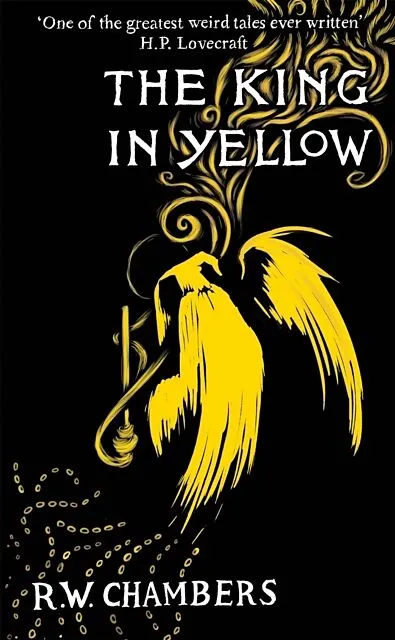

The King in Yellow
Beschreibung
I cannot forget Carcosa where black stars hang in the heavens; where the shadows of men's thoughts lengthen in the afternoon... I pray God will curse the writer, as the writer has cursed the world with this beautiful, stupendous creation, terrible in its simpl...Format auswählen
- Fester EinbandCHF 18.70

Wird oft zusammen gekauft
Andere Kunden kauften auch
Beschreibung
I cannot forget Carcosa where black stars hang in the heavens; where the shadows of men's thoughts lengthen in the afternoon... I pray God will curse the writer, as the writer has cursed the world with this beautiful, stupendous creation, terrible in its simplicity, irresistible in its truth - a world which now trembles before the King in Yellow.The weird tales in this slim volume are all linked by a play, the second act of which reveals truths so terrible and beautiful that it drives all who read it to despair: The King in Yellow.These four macabre, uncanny and unsettling stories are some of the most thrilling ever written in the field of weird fiction, and since their first publication in 1895 have become a cult classic, influencing many writers from the renowned master of cosmic horror H.P Lovecraft to the creators of HBO's True Detective.Contains: 'The Repairer of Reputations', 'The Mask', 'In the Court of the Dragon', 'The Yellow Sign'
"Altogether one of the greatest weird tales ever written." — H.P. Lovecraft
Vorwort
A beautiful new gift edition of this cult classic of supernatural fiction, out in time for Halloween and Christmas
Autorentext
Robert W. Chambers (1865-1933) was an American author and artist. He was a prolific writer and enjoyed great success during his lifetime, with an output comprising works of romance, adventure and science fiction, as well as some books for children. However, it is principally for his weird and supernatural stories, and in particular this collection, which is regarded as one of the most important works of American supernatural fiction, that he is remembered today.
Klappentext
Time is a flat circle in this beautiful gift edition of the cult classic work of weird fiction and supernatural horror that inspired H.P. Lovecraft and HBO's True Detective "...For we do not know what beasts the night dreams when its hours grow too long for even God to be awake." - Attributed to Hildred Castaigne, narrator of "The Repairer of Reputations." The weird tales in this slim volume are all linked by a play, the second act of which reveals truths so terrible and beautiful that it drives all who read it to despair: The King in Yellow. I cannot forget Carcosa where black stars hang in the heavens; where the shadows of men's thoughts lengthen in the afternoon . . . I pray God will curse the writer, as the writer has cursed the world with this beautiful, stupendous creation, terrible in its simplicity, irresistible in its truth-a world which now trembles before the King in Yellow. These four macabre, uncanny, and unsettling stories are some of the most thrilling ever written in the field of weird fiction, exploring themes of the supernatural, spirituality, and the potentially corrosive influence of belief in the afterlife. Since their first publication in 1895, they have become a cult classic, influencing everyone from the renowned master of cosmic horror, H.P Lovecraft, to the creators of HBO's True Detective.
Zusammenfassung
A beautiful gift edition of this cult classic of supernatural fiction, out in time for Christmas.
Leseprobe
THE REPAIRER OF
REPUTATIONS
*“Ne raillons pas les fous; leur folie dure
plus longtemps que la nôtre… Voilà
toute la différence.”*
I
Toward the end of the year 1920 the Government of
the United States had practically completed the programme,
adopted during the last months of
President Winthrop’s administration. The country
was apparently tranquil. Everybody knows how the
Tariff and Labor questions were settled. The war
with Germany, incident on that country’s seizure of
the Samoan Islands, had left no visible scars upon
the republic, and the temporary occupation of
Norfolk by the invading army had been forgotten in
the joy over repeated naval victories, and the subsequent
ridiculous plight of General Von Gartenlaube’s
forces in the State of New Jersey. The Cuban and
Hawaiian investments had paid one hundred per
cent and the territory of Samoa was well worth its
cost as a coaling station. The country was in a superb
state of defence. Every coast city had been well
supplied with land fortifications; the army under the
parental eye of the General Staff, organized according
to the Prussian system, had been increased to
300,000 men, with a territorial reserve of a million;
and six magnificent squadrons of cruisers and
battle- ships patrolled the six stations of the navigable
seas, leaving a steam reserve amply fitted to
control home waters. The gentlemen from the West
had at last been constrained to acknowledge that a
college for the training of diplomats was as necessary
as law schools are for the training of barristers;
consequently we were no longer represented abroad
by incompetent patriots. The nation was prosperous;
Chicago, for a moment paralyzed after a second
great fire, had risen from its ruins, white and imperial,
and more beautiful than the white city which
had been built for its plaything in 1893. Everywhere
good architecture was replacing bad, and even in
New York, a sudden craving for decency had swept
away a great portion of the existing horrors. Streets
had been widened, properly paved and lighted, trees
had been planted, squares laid out, elevated structures
demolished and underground roads built to
replace them. The new government buildings and
barracks were fine bits of architecture, and the long
system of stone quays which completely surrounded
the island had been turned into parks which proved
a god- send to the population. The subsidizing of the
state theatre and state opera brought its own
reward. The United States National Academy of
Design was much like European institutions of the
same kind. Nobody envied the Secretary of Fine
Arts, either his cabinet position or his portfolio. The
Secretary of Forestry and Game Preservation had a
much easier time, thanks to the new system of
National Mounted Police. We had profited well by
the latest treaties with France and England; the
exclusion of foreign- born Jews as a measure of selfpreservation,
the settlement of the new independent
negro state of Suanee, the checking of immigration,
the new laws concerning naturalization, and the
gradual centralization of power in the executive all
contributed to national calm and prosperity. When
the Government solved the Indian problem and
squadrons of Indian cavalry scouts in native costume
were substituted for the pitiable organizations
tacked on to the tail of skeletonized regiments by a
former Secretary of War, the nation drew a long sigh
of relief. When, after the colossal Congress of
Religions, bigotry and intolerance were laid in their
graves and kindness and charity began to draw
warring sects together, many thought the millennium
had arrived, at least in the new world which
after all is a world by itself.
But self- preservation is the first law, and the
United States had to look on in helpless sorrow as
Germany, Italy, Spain, and Belgium writhed in the
throes of Anarchy, while Russia, watching from the
Caucasus, stooped and bound them one by one.
In the city of New York the summer of 1899 was
signalized by the dismantling of the Elevated
Railroads. The summer of 1900 will live in the memories
of New York people for many a cycle; the Dodge
Statue was removed in that year. In the following
winter began that agitation for the repeal of the
laws prohibiting suicide which bore its final fruit in
the month of April, 1920, when the first Government
Lethal Chamber was opened on Washington Square.
I had walked down that day from Dr. Archer’s
house on Madison Avenue, where I had…