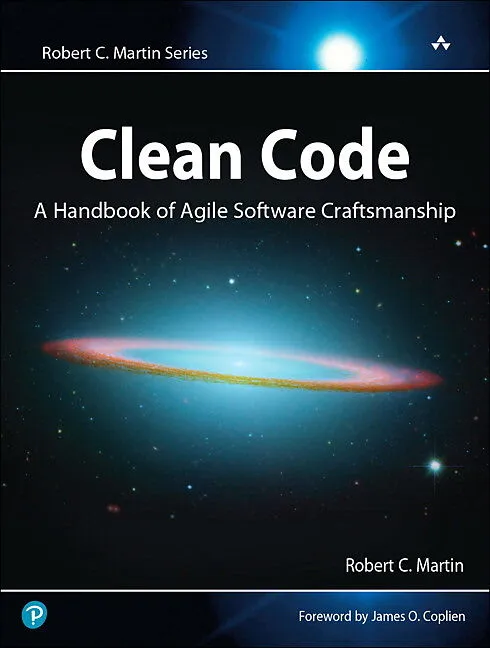
Clean Code: A Handbook of Agile Software Craftsmanship
Beschreibung
Even bad code can function. But if code isn't clean, it can bring a development organization to its knees. Every year, countless hours and significant resources are lost because of poorly written code. But it doesn't have to be that way. Noted software expert...Format auswählen
- Kartonierter EinbandCHF 51.50
- E-Book (pdf)CHF 33.50
- E-Book (epub)CHF 23.10

Wird oft zusammen gekauft
Andere Kunden kauften auch
Beschreibung
Even bad code can function. But if code isn't clean, it can bring a development organization to its knees. Every year, countless hours and significant resources are lost because of poorly written code. But it doesn't have to be that way.
Noted software expert Robert C. Martin, presents a revolutionary paradigm with Clean Code: A Handbook of Agile Software Craftsmanship . Martin, who has helped bring agile principles from a practitioner's point of view to tens of thousands of programmers, has teamed up with his colleagues from Object Mentor to distill their best agile practice of cleaning code on the fly into a book that will instill within you the values of software craftsman, and make you a better programmerbut only if you work at it.
What kind of work will you be doing? You'll be reading codelots of code. And you will be challenged to think about what's right about that code, and what's wrong with it. More importantly you will be challenged to reassess your professional values and your commitment to your craft.
Clean Code is divided into three parts. The first describes the principles, patterns, and practices of writing clean code. The second part consists of several case studies of increasing complexity. Each case study is an exercise in cleaning up codeof transforming a code base that has some problems into one that is sound and efficient. The third part is the payoff: a single chapter containing a list of heuristics and smells gathered while creating the case studies. The result is a knowledge base that describes the way we think when we write, read, and clean code.
Readers will come away from this book understanding
- How to tell the difference between good and bad code
- How to write good code and how to transform bad code into good code
- How to create good names, good functions, good objects, and good classes
- How to format code for maximum readability
- How to implement complete error handling without obscuring code logic
- How to unit test and practice test-driven development
- What smells and heuristics can help you identify bad code This book is a must for any developer, software engineer, project manager, team lead, or systems analyst with an interest in producing better code.
Autorentext
Robert C. “Uncle Bob” Martin has been a software professional since 1970 and an international software consultant since 1990. He is founder and president of Object Mentor, Inc., a team of experienced consultants who mentor their clients worldwide in the fields of C++, Java, C#, Ruby, OO, Design Patterns, UML, Agile Methodologies, and eXtreme programming.
Klappentext
Anyone with a modicum of industry experience knows that there is an awful lot
of bad code out there. It's not that it's just unsightly. Code that is not clean can
quite easily move beyond being a functional problem to becoming an expensive
organizational issue that has to be dealt with immediately.
There are no shortage of suggestions and methods for cleaning up your code
after it has been written, but in this new book, Robert C. Martin espouses
nipping these potential problems in the bud by cleaning on the fly, rather than
doing it in segments or waiting until the end of a project. The book is a tutorial
and reference that will teach the reader to conceive and write cleaner code
through a multitude of proven examples.
This book shows the PROCESS of cleaning code. Rather than just illustrating
the end result, or just the starting and ending state, Martin shows how several
dozen seemingly small code changes can positively impact the performance and
maintainability of an application's code base. It will also explain why each of
those changes was made. In the end the book will boil all these changes down
into a suite of heuristics and principles that will guide the reader in his own
code cleanups.
Zusammenfassung
Even bad code can function. But if code isn’t clean, it can bring a development organization to its knees. Every year, countless hours and significant resources are lost because of poorly written code. But it doesn’t have to be that way.
Noted software expert Robert C. Martin presents a revolutionary paradigm with Clean Code: A Handbook of Agile Software Craftsmanship. Martin has teamed up with his colleagues from Object Mentor to distill their best agile practice of cleaning code “on the fly” into a book that will instill within you the values of a software craftsman and make you a better programmer—but only if you work at it.
What kind of work will you be doing? You’ll be reading code—lots of code. And you will be challenged to think about what’s right about that code, and what’s wrong with it. More importantly, you will be challenged to reassess your professional values and your commitment to your craft.
Clean Code is divided into three parts. The first describes the principles, patterns, and practices of writing clean code. The second part consists of several case studies of increasing complexity. Each case study is an exercise in cleaning up code—of transforming a code base that has some problems into one that is sound and efficient. The third part is the payoff: a single chapter containing a list of heuristics and “smells” gathered while creating the case studies. The result is a knowledge base that describes the way we think when we write, read, and clean code.
Readers will come away from this book understanding
- How to tell the difference between good and bad code
- How to write good code and how to transform bad code into good code
- How to create good names, good functions, good objects, and good classes
- How to format code for maximum readability
- How to implement complete error handling without obscuring code logic
- How to unit test and practice test-driven developmentThis book is a must for any developer, software engineer, project manager, team lead, or systems analyst with an interest in producing better code.
Inhalt
Foreword xix
Introduction xxv
On the Cover xxix
Chapter 1: Clean Code 1
There Will Be Code 2
Bad Code 3
The Total Cost of Owning a Mess 4
Schools of Thought 12
We Are Authors 13
The Boy Scout Rule 14
Prequel and Principles 15
Conclusion 15
Bibliography 15
Chapter 2: Meaningful Names 17
Introduction 17
Use Intention-Revealing Names 18
Avoid Disinformation 19
Make Meaningful Distinctions 20
Use Pronounceable Names 21
Use Searchable Names 22
Avoid Encodings 23
Avoid Mental Mapping 25
Class Names 25
Method Names 25
Don't Be Cute 26
Pick One Word per Concept 26
Don't Pun 26
Use Solution Domain Names 27
Use Problem Domain Names 27
Add Meaningful Context 27
Don't Add Gratuitous Context 29
Final Words 30
Chapter 3: Functions 31
Small! 34
Do One Thing 35
One Level of Abstraction per Function 36
Switch Statements 37
Use Descriptive Names 39
Function Arguments 40
Have No Side Effects 44
Command Query Separation 45
Prefer Exceptions to Returning Error Codes 46
Don't Repeat Yourself 48
Structured Programming 48
How Do You Write Functions Like This? 49
Conclusion 49
SetupTeardownIncluder 50
Bibliography 52
Chapter 4: Comments 53
Comments Do Not Make Up for Bad Code 55
Explain Yourself in Code 55
Good Comments 55
Bad Comments 59
Bibliography 74
Chapter 5: Formatting 75
The Purpose of Formatting 76
Vertical Formatting 76
Horizontal Formatting 85
Team Rules 90
Uncle Bob's Formatting Rules 90
Chapter 6: Objects and Data Structures 93
Data Abstraction 93
Data/Object Anti-Sy…