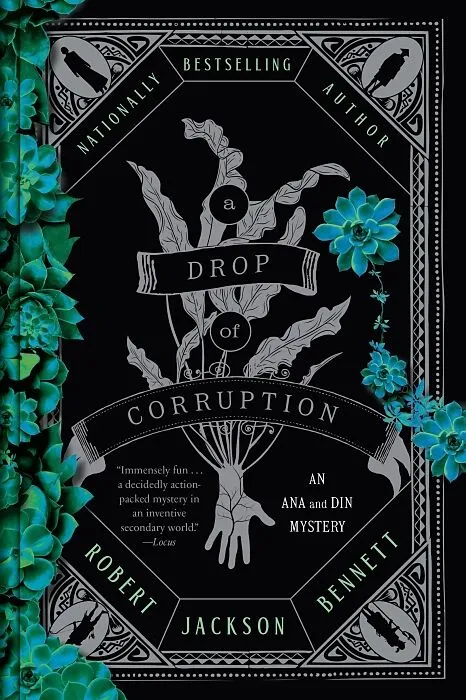
A Drop of Corruption
Beschreibung
NATIONAL BESTSELLER • The eccentric detective Ana Dolabra matches wits with a seemingly omniscient adversary in this brilliant fantasy-mystery from the author of Robert Jackson Bennett's novels include the Founders Trilogy and the Divine Cities Trilog...Format auswählen
- BroschiertCHF 20.00

Wird oft zusammen gekauft
Andere Kunden kauften auch
Beschreibung
**NATIONAL BESTSELLER • The eccentric detective Ana Dolabra matches wits with a seemingly omniscient adversary in this brilliant fantasy-mystery from the author of Robert Jackson Bennett's novels include the Founders Trilogy and the Divine Cities Trilogy, which was a Hugo Award finalist in the Best Series category. His books have received the Edgar Award, the Shirley Jackson Prize, and the Philip K. Dick Citation of Excellence, and been finalists for the World Fantasy, Locus, and British Fantasy Awards.
Klappentext
**NATIONAL BESTSELLER • ONE OF BOOKPAGE’S TEN BEST BOOKS OF THE YEAR • AN ELLE BEST BOOK OF THE YEAR
The eccentric detective Ana Dolabra matches wits with a seemingly omniscient adversary in this brilliant fantasy-mystery from the author of The Tainted Cup.**
“Wonderfully clever and compulsively readable . . . another winning blend of fantasy and classic detection.”—Publishers Weekly
In the canton of Yarrowdale, at the very edge of the Empire’s reach, a Treasury officer has disappeared into thin air—vanishing from a room within a heavily guarded tower, its door and windows locked from the inside.
To solve the case, the Empire calls on its most brilliant and mercurial detective, the great Ana Dolabra. At her side, as always, is her bemused assistant Dinios Kol.
Ana soon discovers that they are investigating not a disappearance but a murder—and one of surpassing cunning, carried out by an opponent who can pass through warded doors like a ghost.
Worse still, the killer may be targeting the high-security compound known as the Shroud, where the Empire harvests fallen titans for the volatile magic found in their blood. Should it fall, the Empire itself will grind to a halt, robbed of the magic that allows its wheels of power to turn.
Din has seen his superior solve impossible cases before. But as the death toll grows and their quarry predicts each of Ana’s moves with uncanny foresight, he fears that she has at last met an enemy she can’t defeat.
Leseprobe
Chapter 1
I’d thought the jungles of the eastern Empire to be oppressively hot, but as I sat in the prow of the little canal boat and felt the sweat slip down my brow, I decided the north was, without question, far worse. The final leg of our journey had been almost entirely shaded by the dense tree canopies, yet even in the coolest shadows, the jungle underbrush perpetually steamed, as if all the world was just shy of boiling. My blue Iudex coat had been soaked in sweat from collar to cuff for nigh on three days now, so much so that I left a wet print where I sat. Not a fine first impression to make for the officer waiting for me.
We made one last bend around the canal and finally approached the Yarrowdale waterfront. Even at this early hour, the piers were swarming with vessels: tiny fishing junkers and lumbering barges and merry little oyster cogs—as well as some unusual craft I’d never seen before.
I eyed these as we approached the piers. They were unwieldy, low-bellied boats with thick stonewood walls fastened to their sides, yet the walls sparkled with glints of hammered iron. I realized they were stubbled with arrowheads lodged deep in the wood, the shafts splintered or cut away. It was as if each craft had withstood a half-dozen volleys mere moments ago. An odd sight in so quiet a place.
I disembarked, my bag thrown over my shoulder, and stood on the busy waterfront, peering about for the imperial officer assigned to meet me here.
Yet no one appeared. There were the fisherfolk, lined at the piers and looping nets about their arms, half-naked with their pale flesh burned dark from the sun. There were a number of indigents, filthy and with matted hair, who sat at the edge of the waterfront bowed like religious supplicants. There were many Engineers, returning from the canals so mummified in mud you could hardly spy the purple of their uniforms. And last were the many Apothetikal soldiers, who stood on guard with their crimson Apoth capes about their shoulders and their spears clutched tight in their hands, watching the crowds with hard, brittle eyes.
I noted their pose, their tension. Strange to see Apoths assigned to guard duties: they were usually more concerned with tinctures and reagents. I glanced again at the scarred, armored boats rigged up along the piers, and wondered exactly what had been going on here in the port town of Yarrowdale.
I waited for twenty minutes at the piers, the air roiling and steaming, the jungle beyond sighing as the wind tousled the trees, but I did not see my officer. I silently cursed the Empire’s much-delayed and always-confused communications. Perhaps they’d told them the wrong day.
I trudged off, my bag on my back, headed for the Yarrowdale ossuary, for that was where the corpse was stored. Yet as I started down the road, I paused.
Just past the start of the road there was a small hillock, dotted with barri trees with thick turf gathered about their roots, and there, lying in the middle of the turf, was a young woman, wearing a hooded cloak with her fingers clasped over her belly like she was deep in restful slumber. Her trousers and boots were so congealed with mud they were now little more than clods of soil, but the color of her cloak was Apoth crimson.
And there, at her breast: a few winking heralds. The bars of an imperial signum, just like myself.
I had been told an Apoth signum would be waiting for me here. I approached her, hoping I was wrong.
I’d planned to clear my throat to wake her once I was near, but when I was within ten span of her she spoke aloud, her Yarrow accent as thick as pudding: “Can I help you?”
“I was told I was to meet an Apoth signum here,” I said. “Might that be you?”
She opened her eyes and looked at me. She was quite young and short, a pale, pink-skinned, broad girl, with short, greasy hair stuck to her scalp. Her eyes were very round, and the whites of them had a greenish tint to them—a common feature of Yarrow folk of the region—but the flesh about them was purpled, as was the flesh of her ears and nose: a sign of significant augmentations. It was likely the girl could hear every beat of my heart and smell every drop of sweat upon my body.
“Oh!” she said. She looked me over, still lying flat on the grass. “I thought you’d smell more expensive.”
“I . . . What?”
She propped herself up on her elbows. “I have been smelling the breeze, waiting for you. Inner ring officers always have a very expensive aroma. Lots of oils in their hair, and their skin so perfumed. Yet you do not smell as this.” She squinted at me. “So. You are the Iudex officer who is here to help us with our mysterious dead man?”
“I am,” I said. I gave her a short bow. “I am Signum Dinios Kol, Iudex Special Division.”
She looked me over but said nothing.
“And you are?” I asked.
“Did you eat dried fish on your journey here?” she asked.
“I beg your pardon?”
“Dried fish. Did you eat a slice or two of this today? Perhaps one spiced with coriander?”
“I . . . Well, yes? Why?”
“Mm,” she said, nodding sagely. Then she stood, bowed, and said, “Signum Tira Malo, Warden of the Apothetikals. I apologize for not giving you a finer greeting, Kol. The true Empire lies a long way from here. Sometimes we forget its touch.”
“Is it common for Yarrow officers to just lie about on riverbanks in the morning?”
“Lie about?” she said. “I was attempting to dry.” She extended an arm into the sun, and ghostly…