

Matilda, English edition
Beschreibung
Now a musical! Matilda is a sweet, exceptional young girl, but her parents think she's just a nuisance. She expects school to be different but there she has to face Miss Trunchbull, a menacing, kid-hating headmistress. When Matilda is attacked by the Trunchbul...Format auswählen
- Fester EinbandCHF 28.40

Wird oft zusammen gekauft
Andere Kunden kauften auch
Beschreibung
Now a musical! Matilda is a sweet, exceptional young girl, but her parents think she's just a nuisance. She expects school to be different but there she has to face Miss Trunchbull, a menacing, kid-hating headmistress. When Matilda is attacked by the Trunchbull she suddenly discovers she has a remarkable power with which to fight back. It'll take a superhuman genius to give Miss Trunchbull what she deserves and Matilda may be just the one to do it! Here is Roald Dahl's original novel of a little girl with extraordinary powers. This much-loved story has recently been made into a wonderful new musical, adapted by Dennis Kelly with music and lyrics by Tim Minchin.
Autorentext
Roald Dahl (1916-1990) was born in Wales of Norwegian parents. He spent his childhood in England and, at age eighteen, went to work for the Shell Oil Company in Africa. When World War II broke out, he joined the Royal Air Force and became a fighter pilot. At the age of twenty-six he moved to Washington, D.C., and it was there he began to write. His first short story, which recounted his adventures in the war, was bought by The Saturday Evening Post, and so began a long and illustrious career.
After establishing himself as a writer for adults, Roald Dahl began writing children’s stories in 1960 while living in England with his family. His first stories were written as entertainment for his own children, to whom many of his books are dedicated.
Roald Dahl is now considered one of the most beloved storytellers of our time. Although he passed away in 1990, his popularity continues to increase as his fantastic novels, including James and the Giant Peach, Matilda, The BFG, and Charlie and the Chocolate Factory, delight an ever-growing legion of fans.
Learn more about Roald Dahl on the official Roald Dahl Web site: www.roalddahl.com
Klappentext
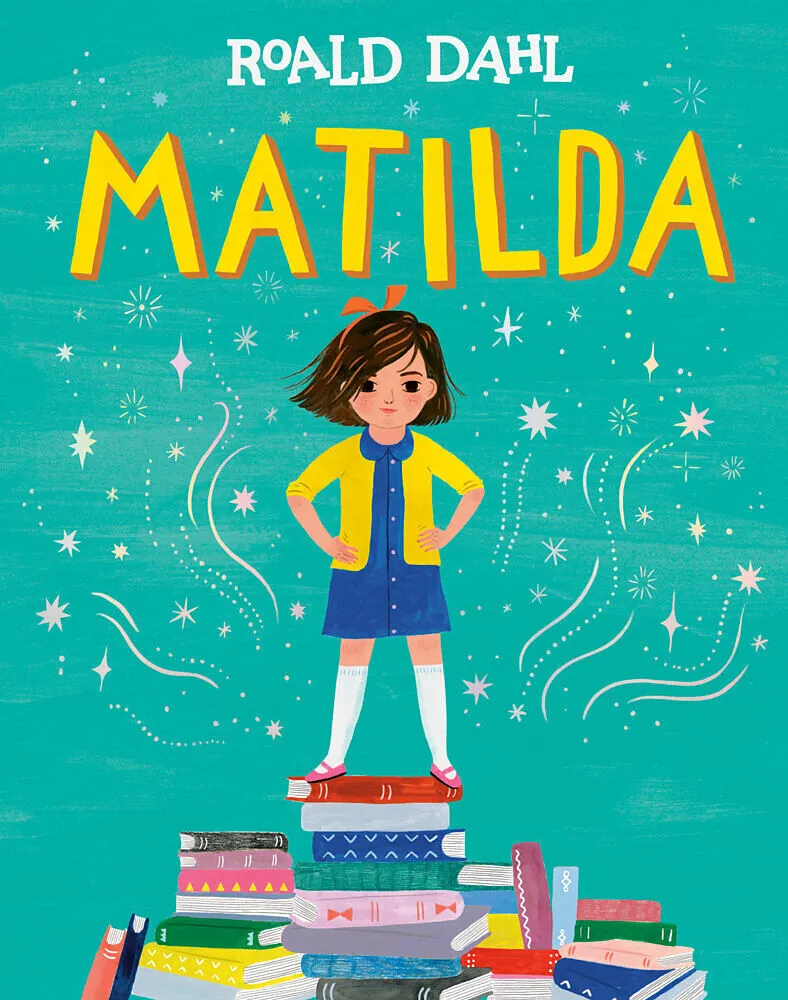
*A brand-new, completely illustrated, full-color edition of Roald Dahl's beloved classic Matilda* with all-new artwork by illustrator Sarah Walsh.
Matilda has been adapted into a Tony Award-winning Broadway musical and a Netflix film!**
This is Roald Dahl's beloved Matilda like you have never seen her before! Celebrated for fighting for what is right and for standing up to bullies and injustice, Matilda is a five-year-old genius with horrible, mean parents. Fortunately, she has a great time giving them what they deserve. But at school she meets Miss Trunchbull: two hundred pounds of kid-hating headmistress. Giving Miss Trunchbull what she deserves will take a superhuman genius! Readers will delight in seeing Matilda become the hero of her own story.
Leseprobe
The Reader of Books
It’s a funny thing about mothers and fathers. Even when their own child is the most disgusting little blister you could ever imagine, they still think that he or she is wonderful.
Some parents go further. They become so blinded by adoration they manage to convince themselves their child has qualities of genius.
Well, there is nothing very wrong with all this. It’s the way of the world. It is only when the parents begin telling us about the brilliance of their own revolting offspring, that we start shouting, “Bring us a basin! We’re going to be sick!”
School teachers suffer a good deal from having to listen to this sort of twaddle from proud parents, but they usually get their own back when the time comes to write the end-of-term reports. If I were a teacher I would cook up some real scorchers for the children of doting parents. “Your son Maximilian”, I would write, “is a total wash-out. I hope you have a family business you can push him into when he leaves school because he sure as heck won’t get a job anywhere else.” Or if I were feeling lyrical that day, I might write, “It is a curious truth that grasshoppers have their hearing-organs in the sides of the abdomen. Your daughter Vanessa, judging by what she’s learnt this term, has no hearing-organs at all.”
I might even delve deeper into natural history and say, “The periodical cicada spends six years as a grub underground, and no more than six days as a free creature of sunlight and air. Your son Wilfred has spent six years as a grub in this school and we are still waiting for him to emerge from the chrysalis.” A particularly poisonous little girl might sting me into saying, “Fiona has the same glacial beauty as an iceberg, but unlike the iceberg she has absolutely nothing below the surface.” I think I might enjoy writing end-of-term reports for the stinkers in my class. But enough of that. We have to get on.
Occasionally one comes across parents who take the opposite line, who show no interest at all in their children, and these of course are far worse than the doting ones. Mr and Mrs Wormwood were two such parents. They had a son called Michael and a daughter called Matilda, and the parents looked upon Matilda in particular as nothing more than a scab. A scab is something you have to put up with until the time comes when you can pick it off and flick it away. Mr and Mrs Wormwood looked forward enormously to the time when they could pick their little daughter off and flick her away, preferably into the next county or even further than that.
It is bad enough when parents treat ordinary children as though they were scabs and bunions, but it becomes somehow a lot worse when the child in question is extraordinary, and by that I mean sensitive and brilliant. Matilda was both of these things, but above all she was brilliant. Her mind was so nimble and she was so quick to learn that her ability should have been obvious even to the most half-witted of parents. But Mr and Mrs Wormwood were both so gormless and so wrapped up in their own silly little lives that they failed to notice anything unusual about their daughter. To tell the truth, I doubt they would have noticed had she crawled into the house with a broken leg.
Matilda’s brother Michael was a perfectly normal boy, but the sister, as I said, was something to make your eyes pop. By the age of one and a half her speech was perfect and she knew as many words as most grown-ups. The parents, instead of applauding her, called her a noisy chatterbox and told her sharply that small girls should be seen and not heard.
By the time she was three, Matilda had taught herself to read by studying newspapers and magazines that lay around the house. At the age of four, she could read fast and well and she naturally began hankering after books. The only book in the whole of this enlightened household was something called Easy Cooking belonging to her mother, and when she had read this from cover to cover and had learnt all the recipes by heart, she decided she wanted something more interesting.
“Daddy,” she said, “do you think you could buy me a book?”
“A book?” he said. “What d’you want a flaming book for?”
“To read, Daddy.”
“What’s wrong with the telly, for heaven’s sake? We’ve got a lovely telly with a twelve-inch screen and now you come asking for a book! You’re getting spoiled, my girl!”
Nearly every weekday afternoon Matilda was left alone in the house. Her brother (five years older than her) went to school. Her father went to work and her mother went out playing bingo in a town eight miles away. Mrs Wormwood was hooked on bingo and played it five afternoons a week. On the afternoon of the day when her father had refused to buy her a book, Matilda set out all by herself to walk to the public library in the village. When she arrived, she introduced herself to the librarian, Mrs Phelps. She asked if she might sit awhile and read a book. Mrs Phelps, slightly taken aback at the arrival of such a tiny girl unaccompanied by a parent, …