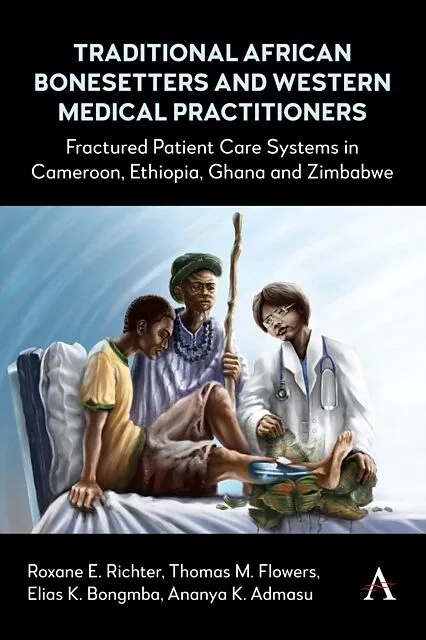
Traditional African Bonesetters and Western Medical Practitioners
Beschreibung
Autorentext Roxane Richter is an Assistant Professor of Epidemiology & Population Health at the School of Public Health, University of Louisville. She has been distinguished as a Fulbright Specialist in Medical Mass Casualty Planning & Response (Ghana), U.S. E...Format auswählen
- Fester EinbandCHF 122.00

Wird oft zusammen gekauft
Andere Kunden kauften auch
Beschreibung
Autorentext
Roxane Richter is an Assistant Professor of Epidemiology & Population Health at the School of Public Health, University of Louisville. She has been distinguished as a Fulbright Specialist in Medical Mass Casualty Planning & Response (Ghana), U.S. Embassy Ambassador Distinguished Scholar (University of Gondar, Ethiopia), and a Fulbright-Fogarty NIH Postdoctoral Global Health Fellow (Sub-Saharan Africa).
Dr. Thomas Max Flowers is a certified emergency physician with the American Board of Emergency Medicine since 1992. He currently practices Emergency Medicine at Commonwealth Health Care Corporation public hospital in Saipan, Commonwealth of the Northern Marianas Islands.
Elias Kifon Bongmba, PhD, grew up in Cameroon. He holds The Harry & Hazel Chavanne Chair in Christian Theology and Professor of Religion at Rice University. Bongmba is past President of the African Association for the Study of Religion. He is author of Facing a Pandemic: The African Church and Crises of AIDS, and other works on religion. Bongmba was awarded DTheo hc from Lund University in Sweden and the Doctor of Divinity hc from The University of Zululand. He is the recipient of the 2020 Ray L. Hart Service Award from the American Academy of Religion and the The Dr. A.O Larson Distinguished Alumni Service Award from the University of Sioux Falls in SD.
Dr. Ananya Kassahun Admasu is an Assistant professor in Orthopedics, FCS(Ortho) ECSA. Adjunct Professor at University of Gondar, Ethiopia. SURGhub Ambassador and Global Surgery leader.
Klappentext
Explores the enduring role of traditional bone setting in African healthcare, highlighting its cultural depth, ethnobotanical roots, and growing biomedical collisions s with Western orthopedic medical sciences that split and fracture current patient-care systems.
Traditional bone setting (TBS) has long held a prominent sway in African healthcare, particularly in the more remote and pastoral expanses of Africa. This unique interdisciplinary religious, human rights, and sociological study of medicine manuscript is an examination of not only generationally inherited ethnobotanical, pharmacognosy TBS traditions but also direct observations on how current surgical orthopedic medicine and modern-day social mechanisms clash with traditional healthcare approaches in contemporaneous and inexorable ways. Whether intentionally or not, this entrenched two-tier infrastructure supports, promotes, and maintains a fiscally and socially alienated infrastructure: one that serves the poor general public; and the other that is oriented toward serving the prosperous and powerful urban class. Some argue that these disparate structures are destined to remain grassroots-based adversaries, due to systemic mistrust, irreconcilable intellectual and spiritual beliefs, and possible biochemical appropriations.
These ensuing biomedical collisions between "Western" orthopedic trauma care and traditional bonesetters in Cameroon (Central Africa), Ethiopia (East Africa), Ghana (West Africa), and Zimbabwe (South Africa) were documented over eight years via one-on-one interviews with TBS patients, practicing bonesetters, and in-country practicing orthopedic surgeons; evidence-based ethnobotanical research, and patient service preferences.
In Western biomedical quarters, it will continue to be argued that traditional bonesetters' lack of anatomical, physiological, and radiological knowledge effects tragic and unnecessary limb- and/or life-threatening complications. However, in stark contrast to Western medicine-which focuses on the empirical and scientific dissection, analysis, diagnosis, and profitable treatment of singular biological organ systems or body parts via medical specialties-holistic traditional medicine distinguishes itself to take into consideration the complete person in the treatment of injuries and illnesses-physically, psychologically, socially, and spiritually.
In traditional medicine, poor health, disease, misfortune, or even unexpected successes are not viewed as chance occurrences but are imbalances believed to arise from the actions of individuals or ancestral spirits. At its core, traditional medicine can be defined as "health practices, approaches, knowledge and beliefs incorporating plant, animal, and/or mineral-based medicines, spiritual therapies, manual techniques and exercises, applied singularly (or in combination) to treat, diagnose, and prevent illnesses or maintain well-being" (Fokunang et al., 2011). So, we can argue that almost every global region has had, at one time or another in its history, a form of traditional medicine. However, despite being consigned to a secondary placement in the health planning of developing countries, traditional medicine practices are gradually undergoing systemic revitalizations and rehabilitations, particularly in the last two decades.