
IHR WARENKORB IST AKTUELL LEER.
Haben Sie noch nichts passendes gefunden? Stöbern Sie durch unser komplettes Sortiment.
Oder melden Sie sich an bzw. registrieren Sie sich.
- Kostenlose Lieferung
- Kauf auf Rechnung
- Ex Libris Tiefpreis
- Filiallieferung und 650+ Abholorte
- Rabatt-Bons als Club-Mitglied
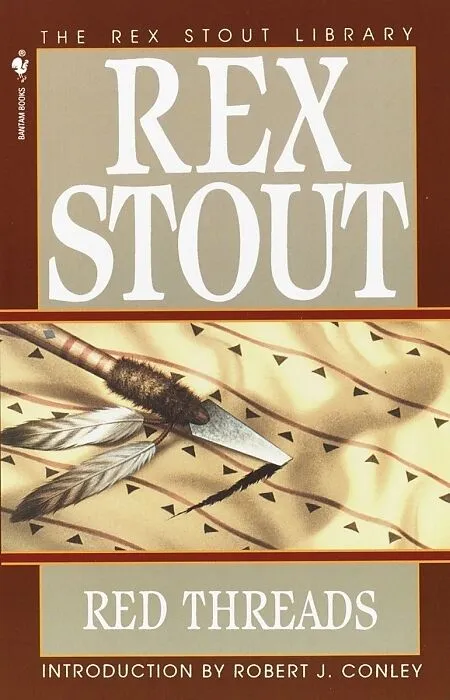
Red Threads
Beschreibung
Informationen zum Autor Rex Stout Klappentext Val Carew had come a long way-from Oklahoma to Wall Street-only to be clubbed to death at his wife's tomb. The wealthy financier had built the magnificent crypt in memory of his beautiful Cherokee bride! whose prem...Format auswählen
- Kartonierter EinbandCHF 21.90
Wird oft zusammen gekauft
Andere Kunden kauften auch
Beschreibung
Informationen zum Autor Rex Stout Klappentext Val Carew had come a long way-from Oklahoma to Wall Street-only to be clubbed to death at his wife's tomb. The wealthy financier had built the magnificent crypt in memory of his beautiful Cherokee bride! whose premature death left behind a lot of unanswered questions. Now Carew himself is dead! struck down by a reminder from his past: an Indian war club. The case lands in the capable hands of Inspector Cramer of the New York Homicide squad. The cigar-chomping detective has to follow the only clue left behind-a piece of red thread found in the dead man's hand that no doubt leads to his killer. Introduction Red Threads is early Rex Stout, and it's not Nero Wolfe. Still, it has many of the characteristics readers expect of Rex Stout. The events of the tale take place among upper-crust, high-society New York City characters, many of whom are shallow, self-centered, small-minded, and petty. There's a bizarre and seemingly inexplicable murder, and the victim is an eccentric millionaire. The wrong suspect is arrested and would undoubtedly be tried and found guilty were it not for the dogged determination of one individual who believes in his innocence. All of the action takes place in the hectic, fast-paced world of the high fashion industry. But there are a couple of surprising deviations from Rex Stout's norm. Early in the story we expect Inspector Cramer to fill the role of Nero Wolfe. Cramer is a rumpled, cigar-smoking veteran cop, a man Wolfe would barely be able to tolerate, but he is like a bloodhound when he gets on a trail. At least up to a point. That point in Red Threads is when he finally makes an arrestbut he may have the wrong man. Then comes the biggest surprise of the novel: Jean Farris, clothing designer, who may or may not be in love with Guy Carew, the major suspect, begins investigating on her own, and it is her stubbornness, not Cramer's, that finally cracks the case. The other unusual aspect of Red Threads is Stout's inclusion of three Cherokee characters and what they reveal about his perception of Cherokee culture. Woodrow Wilson is a full-blood Cherokee. Guy Carew is half Cherokee. His father, Val, the murder victim, was a white man whose wife, Guy's mother, had been the lovely Cherokee Tsianina. She's dead before the novel begins, but her presence is always with us. The characters of Tsianina and Guy and their involvement in the world of American Indian art must have been suggested to Stout by the enormous popularity in the nineteen-twenties of a real-life Tsianina. Florence Evans, half Cherokee and half Creek, took the country by storm performing the songs of Charles Wakefield Cadman in her white buckskin dress. Evans also made the news when she helped Dr. Edgar L. Hewett dedicate his new Fine Arts Museum in Santa Fe, New Mexico. Stout must have found the spectacle of Indians moving in high society a fascinating one. But be warned. Don't read Red Threads for any insight into Cherokee culture or the Cherokee character. Stout may have read something about the Cherokee people before writing this book, but it could not have provided him with much more than a brief overview. As a Cherokee, and one who has been much involved in studying and writing about Cherokee issues for a number of years, I find Stout's misinformation painfully obvious. There is an element of truth in the claim, frequently made and vital to the plot, that the Cherokees are sun worshipers. That element, however, is played out in a misleading way, indicating that Stout had no real understanding of Cherokee religion. The one Cherokee tradition he is absolutely right about is expressed in Woodrow Wilson's statement Always the house is the woman's house. But beyond that observation, Stout's knowledge falls short again. Wilson mistrusts women, and Guy Carew does not underst...
Autorentext
Rex Stout
Klappentext
Val Carew had come a long way-from Oklahoma to Wall Street-only to be clubbed to death at his wife's tomb. The wealthy financier had built the magnificent crypt in memory of his beautiful Cherokee bride, whose premature death left behind a lot of unanswered questions. Now Carew himself is dead, struck down by a reminder from his past: an Indian war club.
The case lands in the capable hands of Inspector Cramer of the New York Homicide squad. The cigar-chomping detective has to follow the only clue left behind-a piece of red thread found in the dead man's hand that no doubt leads to his killer.
Zusammenfassung
Val Carew had come a long way—from Oklahoma to Wall Street—only to be clubbed to death at his wife’s tomb. The wealthy financier had built the magnificent crypt in memory of his beautiful Cherokee bride, whose premature death left behind a lot of unanswered questions. Now Carew himself is dead, struck down by a reminder from his past: an Indian war club.
The case lands in the capable hands of Inspector Cramer of the New York Homicide squad. The cigar-chomping detective has to follow the only clue left behind—a piece of red thread found in the dead man’s hand that no doubt leads to his killer.
Leseprobe
Introduction
Red Threads is early Rex Stout, and it’s not Nero Wolfe. Still, it has many of the characteristics readers expect of Rex Stout. The events of the tale take place among upper-crust, high-society New York City characters, many of whom are shallow, self-centered, small-minded, and petty. There’s a bizarre and seemingly inexplicable murder, and the victim is an eccentric millionaire.
The wrong suspect is arrested and would undoubtedly be tried and found guilty were it not for the dogged determination of one individual who believes in his innocence. All of the action takes place in the hectic, fast-paced world of the high fashion industry. But there are a couple of surprising deviations from Rex Stout’s norm.
Early in the story we expect Inspector Cramer to fill the role of Nero Wolfe. Cramer is a rumpled, cigar-smoking veteran cop, a man Wolfe would barely be able to tolerate, but he is like a bloodhound when he gets on a trail. At least up to a point.
That point in Red Threads is when he finally makes an arrest—but he may have the wrong man. Then comes the biggest surprise of the novel: Jean Farris, clothing designer, who may or may not be in love with Guy Carew, the major suspect, begins investigating on her own, and it is her stubbornness, not Cramer’s, that finally cracks the case.
The other unusual aspect of Red Threads is Stout’s inclusion of three Cherokee characters and what they reveal about his perception of Cherokee culture. Woodrow Wilson is a full-blood Cherokee. Guy Carew is half Cherokee. His father, Val, the murder victim, was a white man whose wife, Guy’s mother, had been the lovely Cherokee Tsianina. She’s dead before the novel begins, but her presence is always with us.
The characters of Tsianina and Guy and their involvement in the world of American Indian art must have been suggested to Stout by the enormous popularity in the nineteen-twenties of a real-life Tsianina. Florence Evans, half Cherokee and half Creek, took the country by storm performing the songs of Charles Wakefield Cadman in her white buckskin dress. Evans also made the news when she helped Dr. Edgar L. Hewett dedicate his new Fine Arts Museum in Santa Fe, New Mexico.
Stout must have found the spectacle of Indians moving in high society a fascinating one. But be warned. Don’t read Red Threads for any insight into Cherokee culture or the Cherokee character. Stout may have read something about the Cherokee people before writing this book, but it could not have provided him with much more than a brief overview. As a Cherokee, and one who has been much involved in studying and writing about Cher…