Haben Sie noch nichts passendes gefunden? Stöbern Sie durch unser komplettes Sortiment.
Oder melden Sie sich an bzw. registrieren Sie sich.


Beschreibung
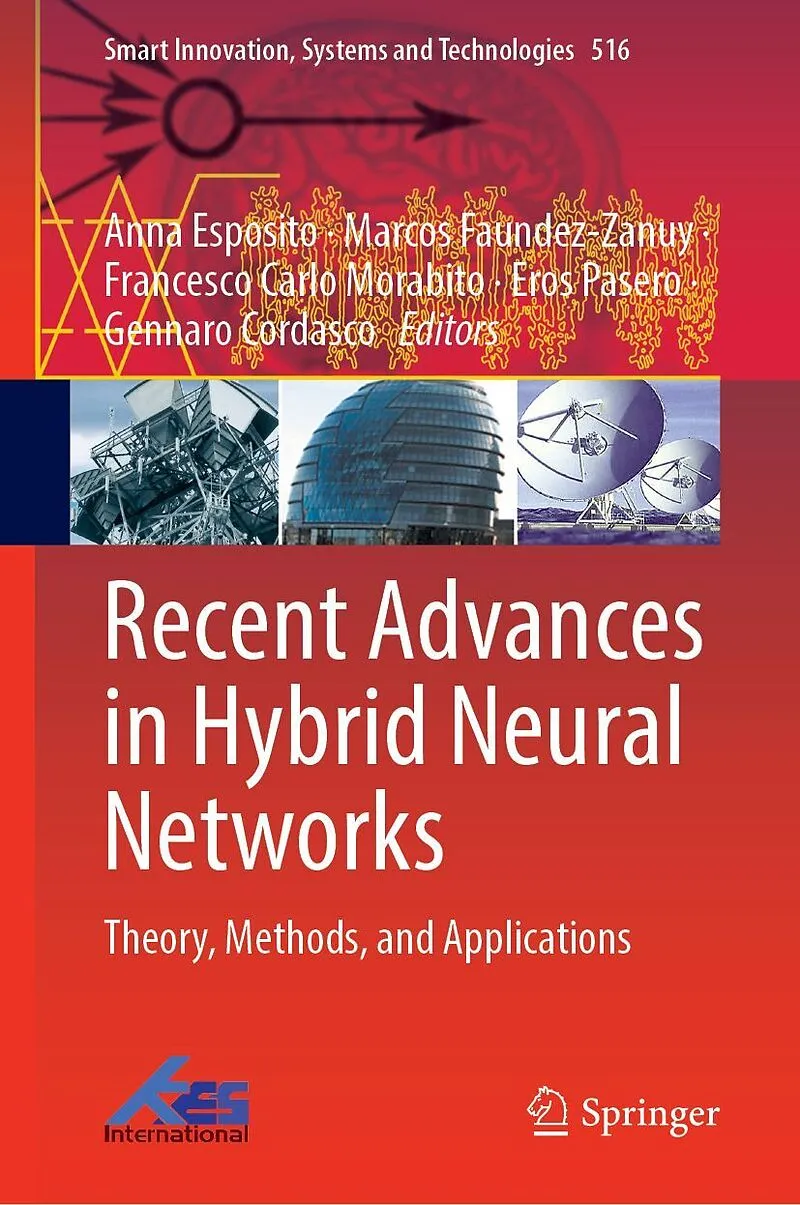
This book offers a comprehensive survey of recent progress in hybrid neural networks, combining theoretical foundations, methodological advances, and applicationdriven research across diverse scientific and engineering domains. Neural networks are increasingl...
This book offers a comprehensive survey of recent progress in hybrid neural networks, combining theoretical foundations, methodological advances, and applicationdriven research across diverse scientific and engineering domains. Neural networks are increasingly advancing beyond purely datadriven paradigms toward hybrid approaches that integrate machine learning with physical laws, domain constraints, causal reasoning, and human expertise. The chapters included in the bookoriginate from peerreviewed contributions presented at an international conference and two specialized workshops focused on artificial intelligence for civil engineering, industrial systems, and business applications. Collectively, the authorsexamine how hybrid neural models improve interpretability, robustness, fairness, and generalizationcapabilities essential for deploying AI in safetycritical and highimpact environments. Methodologically, the bookcovers a wide range of hybrid learning paradigms, including physicsinformed neural networks, hybrid multiscale architectures, graph neural networks, transformerbased and vision models, and entropyguided analyses of deep learning systems. Additional chapters explore learning strategies grounded in causal principles, physically inspired regularization, and humanintheloop optimization. A substantialportion of the book is devoted to realworld applications. In engineering and the physical sciences, the bookincludes studies on seismic monitoring, structural and architectural optimization, synthetic data generation, smart energy management, load disaggregation, and atmospheric retrieval for exoplanet investigation. Further chapters examine economic, social, and industrial use cases, including financial forecasting, insurance and sales analytics, fairnessaware decisionsupport systems, social wellbeing estimation, and AIenhanced manufacturing aligned with Industry 5.0. By unifying theoretical principles, computational models, and practical applications within a hybrid neural framework, this book highlights the growing role of neural networks as interpretable, trustworthy, and domainaware systems. It serves as a timely reference for researchers, advanced students, and practitioners seeking to design and implement nextgeneration neural solutions that bridge the gap between data, structured knowledge, and realworld decisionmaking.
Presents hybrid neural methods that help readers build more interpretable and trustworthy AI models Offers practical techniques that strengthen AI performance in complex scientific and engineering tasks Provides applied solutions that enable efficient, realworld deployment of nextgeneration hybrid AI systems
Autorentext
Anna Esposito received her Laurea degree summa cum laude from the University of Salerno and a Ph.D. from the University of Naples Federico II, completing her doctoral work at the Massachusetts Institute of Technology. She has previously held positions as Assistant Professor at the University of Salerno and Research Professor at Wright State University. She is currently Full Professor in cybernetics, artificial intelligence, and multimodal communication at Università della Campania L. Vanvitelli, where she leads the Behaving Cognitive Systems Laboratory. She also serves as President of SIREN and Chair of the IAPR Conferences & Meetings Committee. Her scientific output includes more than 320 peerreviewed publications and over 32 edited international volumes.
Marcos FaundezZanuy earned his B.Sc. in telecommunications and Ph.D. from the Polytechnic University of Catalunya. He is Full Professor at Tecnocampus, Universitat Pompeu Fabra, where he leads the Signal Processing Group. His research areas include biometrics, speech processing, and intelligent systems. He has chaired and contributed to several European COST Actions related to nonlinear speech and multimodal communication. He has authored more than 100 ISIindexed journal papers, over 100 conference articles, and several books.
Francesco Carlo Morabito received his Laurea degree summa cum laude from the University of Naples and subsequently served as Researcher in the Radar Department of Selenia SpA. He joined the University of Reggio Calabria, where he progressed from Research Associate to Associate Professor and is now Full Professor of electrical engineering. He has held numerous academic leadership roles, including Dean of the Faculty of Engineering and ViceRector for Internationalization. His teaching experience spans EPFL Lausanne and several Italian universities. He has authored more than 280 scientific publications, edited multiple academic volumes, and received several distinctions, including membership in the Royal Academy of Doctors and the Henry Coanda Gold Medal.
Eros G. Pasero has been Professor of electronics at the Politecnico di Torino since 1991, following an earlier appointment at the University of Rome. He has held visiting positions at international institutions including ICSIUC Berkeley, Tongji University in Shanghai, and TTPU in Tashkent, where he also served as ViceRector. His research focuses on artificial neural networks and electronic sensors, and he founded the Neuronica Laboratory to advance neuromorphic systems and sensorbased intelligent applications. He has published over 100 international works, supervised numerous graduate students, holds several patents, and has chaired major international conferences.
Gennaro Cordasco received his Laurea degree (cum laude) and Ph.D. in computer science from the University of Salerno. He conducted research as Scholar at the University of Massachusetts Amherst in the Theoretical Aspects of Parallel and Distributed Systems Laboratory. He subsequently served as PostDoctoral Fellow and later as Assistant Professor at Università della Campania Luigi Vanvitelli. He is currently Associate Professor in the Department of Computer Science at the University of Salerno. His research areas include distributed systems, algorithms, and computational models. He also serves as Associate Editor for cognitive computation and the Journal of Ambient Intelligence and Humanized Computing.
Inhalt
Tief- preis